


On August 19, Mitsui O.S.K. Lines announced that it had signed a memorandum of understanding (this memorandum) with Itochu Corporation regarding joint development of ammonia bunkering demonstration and other related matters.
Going forward, the two companies will use their actual vessels to conduct concrete joint development, including demonstrations of bunkering, which involves supplying marine ammonia fuel from ship to ship, off the coast of Singapore and other locations. Furthermore, through demonstrations planned for the second half of 2027, the two companies aim for the early social implementation of ammonia bunkering vessels and ammonia-fueled vessels.
Mitsui O.S.K. Lines (MOL) will jointly own three ammonia-fueled Capesize bulk carriers, the world's first of their kind, at the China Shipbuilding Corporation Qingdao Beihai Shipyard (scheduled for completion in 2026-2027), with CMB.TECH NV (Belgium), and MOL will charter them on a time charter basis.
Itochu Corporation ordered the world's first newly built 5000m³ ammonia bunkering vessel in June 2025, which will be constructed by Sasaki Shipbuilding (scheduled for completion in 2027). Through ammonia bunkering demonstrations using this vessel, Itochu aims to establish safe marine ammonia fuel supply operations at sea. Furthermore, it aims to commercialize ammonia bunkering at Singapore and other major maritime traffic hubs.
<Pathway towards achieving net-zero emissions by 2050>
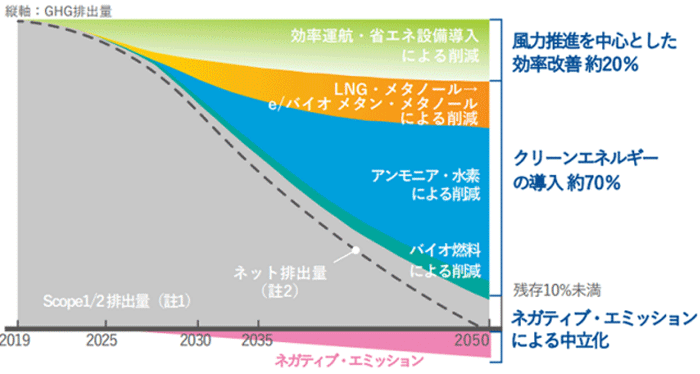
Furthermore, the International Maritime Organization (IMO) approved a draft amendment to the Convention in April of this year as a medium-term measure to achieve the international goal of "net-zero greenhouse gas (GHG) emissions from international shipping by around 2050." This amendment includes a system for gradually switching marine fuels to alternative fuels with lower GHG emissions, and a system to provide economic incentives for the introduction of zero-emission fuel ships. Once it comes into effect, efforts to supply alternative fuels with lower GHG emissions and the introduction of zero-emission fuel ships will be accelerated.
Among alternative fuels, ammonia is expected to be a zero-emission fuel, and many maritime stakeholders are currently considering and developing ammonia-fueled vessels. In this context, the ammonia bunkering business, which supplies ammonia fuel to ships, is the interface between the maritime industry and the fuel industry, and bunkering vessels in particular are attracting attention worldwide as important facilities that handle the last mile of fuel supply.


