


Teikoku Databank (TDB) announced on May 19 that the percentage of companies experiencing a shortage of full-time employees is projected to reach 50.8% by April 2025.
<Monthly trends in the proportion of labor shortages among regular and non-regular employees>
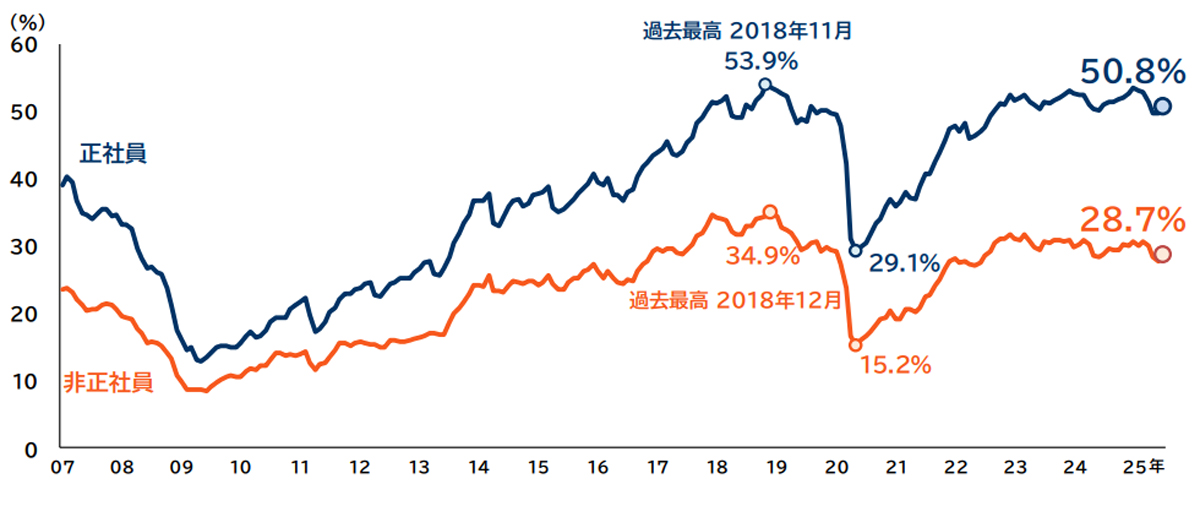
The labor shortage remains a serious and persistent problem. As of July 2025, 50.8% of companies reported experiencing a shortage of full-time employees.
For the third consecutive year, the figure for July has exceeded 50%, and although it fell by 0.2 percentage points from 51.0% in the same month last year, the fluctuation was small, and it remains at a high level. The percentage of companies experiencing labor shortages among non-regular employees was 28.7%, a slight decrease from the same month last year, and it has remained below 30% for the second consecutive year.
<Percentage of labor shortages by industry. "Transportation and warehousing" shows a slight increase compared to the previous year.>
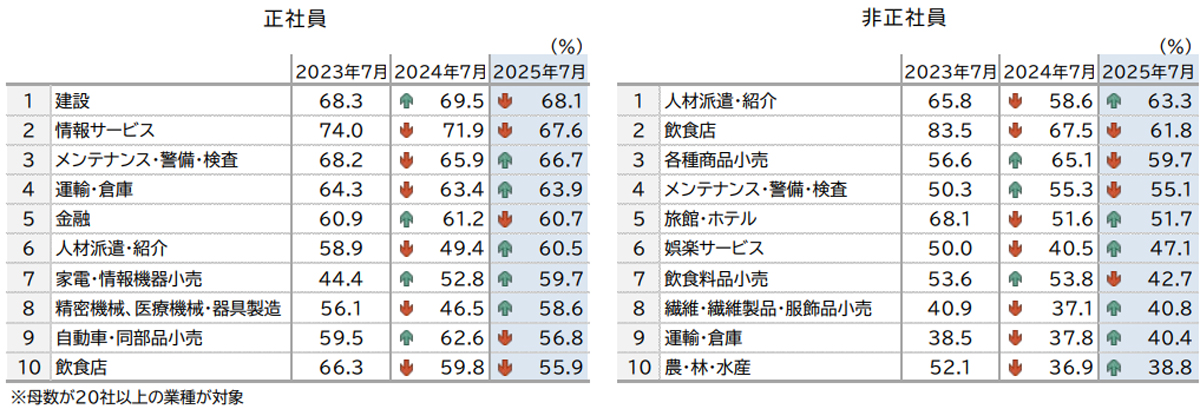
By industry, the construction industry had the highest percentage of companies feeling a shortage of full-time employees, at 68.1%. In particular, in July, some companies commented that "not only have employees' working hours decreased due to overtime restrictions, but work efficiency has also worsened due to the intense heat" (painting work, Yamanashi Prefecture), indicating that restrictions on work due to the intense heat and revisions to work procedures due to mandatory heatstroke prevention measures are having an impact on the feeling of labor shortage.
The "transportation and warehousing" sector, which is suffering from a severe driver shortage, remains at a high labor shortage rate of 63.9%, a 0.5 percentage point increase from the previous year. Of the 10 industries surveyed, six exceeded 60%.
Looking ahead, as of July 2025, 50.8% of companies reported a shortage of regular employees, while 28.7% reported a shortage of non-regular employees. Both figures were slightly lower than the same period last year, but remained at roughly the same level.
In particular, half of companies have reported experiencing labor shortages for the third consecutive year, especially among full-time employees, indicating that the situation remains at a high level. The "construction" sector, in particular, which sees strong demand for public works such as infrastructure and urban redevelopment, is experiencing increased labor shortages due to factors such as worsening working conditions caused by the intense heat and the need to revise work procedures due to mandatory heatstroke prevention measures.


