


On August 20, Teikoku Databank (TDB) released its estimates of the impact of Trump's tariffs on the Japanese economy (August 2025).
Although the US-Japan negotiations on Trump's tariffs reached an agreement on July 23, the 25% tariff rate remains in effect due to differences in the wording of the executive order.
According to an analysis using the TDB Macroeconomic Forecasting Model, if the agreement is revised in accordance with the terms, Japan's real GDP growth rate in fiscal year 2025 is projected to be 0.4 percentage points lower than if the Trump tariffs had not been imposed.
<Simulation results of the impact of Trump's tariffs on the Japanese economy in fiscal year 2025>
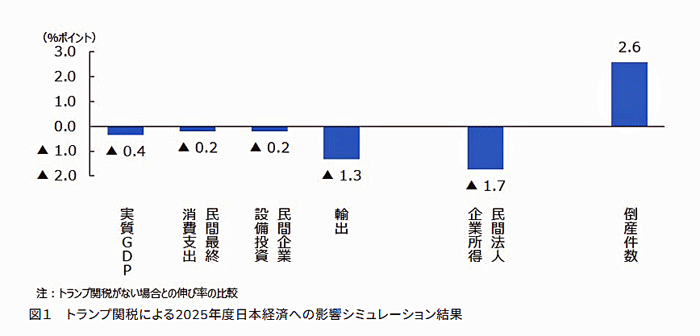
Of particular concern is the export growth rate, which is projected to decline by 1.3 percentage points. Automobiles and their parts account for 7.2575 trillion yen, or 34.1%, of Japan's total exports to the United States in 2024, which amounted to 21.2948 trillion yen.
While the tariff rate is expected to be lowered to 15% from mid-September onwards, it is believed that "the significant increase from the previous tariff rate of 2.5% will result in high tariffs on automotive-related products, which have a broad base, becoming the biggest factor dragging down overall exports."
Furthermore, the decline in export growth is expected to spill over into corporate capital investment, with private sector capital investment projected to fall by 0.2 percentage points.
The impact on exports and capital investment will also affect private corporate income (equivalent to operating profit in accounting terms), with the growth rate of operating profit projected to decline by 1.7 percentage points. There is also a possibility that the Trump tariffs could lead to a decline for the first time in five years.
This situation will negatively impact workers' incomes and act as a drag on personal consumption, so the growth rate of private final consumption expenditure is expected to fall by 0.2 percentage points.
Regarding the impact on corporate bankruptcies nationwide, with the number of bankruptcies exceeding 10,000 for the first time in 11 years at 10,070 in fiscal year 2024, it is projected that the number of bankruptcies in fiscal year 2025 will rise by 2.6 percentage points (264 cases).
The US-Japan negotiations on Trump's tariffs concluded on July 23rd with an agreement to set reciprocal tariff rates and sector-specific tariff rates of 15% on automobiles and auto parts, as well as to invest $550 billion in the US to rebuild and expand core US industries and to further open their markets to US exports.
The reciprocal tariff rates agreed upon in the U.S.-Japan negotiations were scheduled to take effect on August 7, but the implementation date for automobiles and auto parts remained undetermined. A mistake was discovered in the presidential order signed on August 1, which did not reflect the details of the U.S.-Japan agreement and instead added a uniform 15% tariff.
It has been confirmed that the United States will take measures to amend the executive order in a timely manner, and that it will also issue an executive order to lower tariffs on automobiles and other goods at the same time. However, the timing of the amendment is undecided, and as of August 20, the tariff rate remains at 15% on top of the baseline tariff of 10%.
By sector, tariffs of 25% are imposed on steel and aluminum, and 50% on copper. As of August 6, some estimates suggest that the effective US tariff rate will rise from 2.5% in 2024 to 18.6% as a result of these tariffs, reaching its highest level in 92 years since 1933.
The situation remains difficult for companies to decide on, and it is said that decisions regarding sectoral tariffs, particularly on semiconductors and pharmaceuticals, are yet to be made and should continue to be closely monitored.
Furthermore, even small and medium-sized enterprises (SMEs) that do not directly engage in overseas trade will be affected through various channels, and the government needs to effectively implement countermeasures to mitigate these effects. The report concludes that it is important for companies to "gather information to the best of their ability and respond flexibly."


