


Teikoku Databank (TDB) announced the results of its "Survey on Companies' Attitudes Towards Promoting Women (2025)" on August 22.
<Average percentage of female managers - by company size and industry>
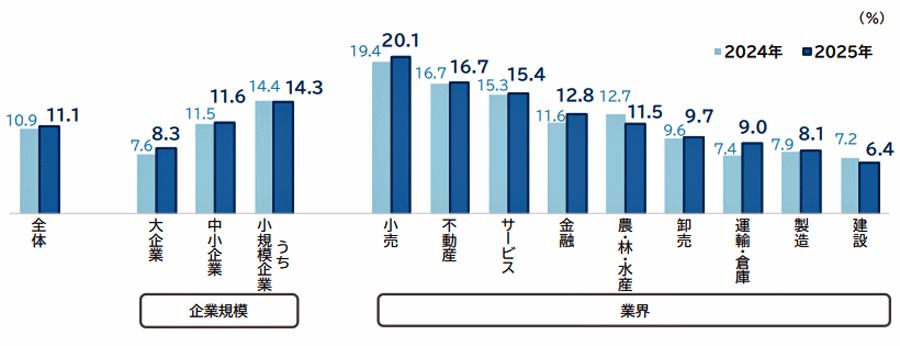
The average percentage of female managers across all industries rose by 0.2 percentage points year-on-year to 11.1%, reaching a record high, but the increase was modest. However, while still below the average, the transportation and warehousing industry showed the highest growth rate among all industries, rising by 1.6 percentage points from 7.4% to 9% in 2024.
By industry, "Retail," which has a relatively large number of female employees, topped the list with 20.1%, 9.0 percentage points higher than the overall average (11.1%). This was followed by "Real Estate" (16.7%), "Services" (15.4%), "Finance" (12.8%), and "Agriculture, Forestry, and Fisheries" (11.5%). On the other hand, industries with relatively few female employees, such as "Manufacturing," where working hours tend to be irregular due to three-shift systems in factories, as well as "Transportation and Warehousing" and "Construction," which are often associated with long working hours and physically demanding work, remained at low levels.
In terms of company size, "large companies" had the lowest average percentage at 8.3%. On the other hand, "small and medium-sized enterprises" had 11.6%, with "micro-enterprises" at 14.3%, indicating that the average percentage of female managers continues to be higher in smaller companies.
Companies commented, "We feel that women's contributions are very significant in every company. We believe it's necessary to place women in positions that utilize what only women can do and their unique sensibilities" (machinery manufacturing) and "The meticulousness of women improves the quality of work" (maintenance, security, inspection). Several companies also expressed opinions such as, "We want to promote people regardless of gender if they are suitable" (electrical machinery manufacturing).
On the other hand, companies with a low percentage of female managers or no female managers offered comments such as, "We are promoting the advancement of women, but most of them show no desire to be promoted and decline the offer" (information services) and "We are promoting the advancement of women, including through internal systems, but it seems that there are still many hurdles for women to continue working, such as marriage, childbirth, and their partner's relocation" (chemical manufacturing).
<What we are doing to promote women's participation in the workforce>
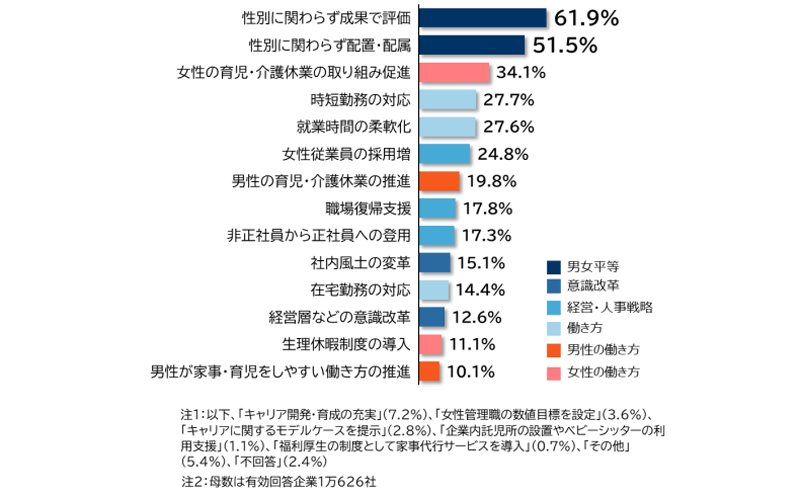
Regarding actions taken to promote women's advancement, "evaluating based on results regardless of gender" topped the list at 61.9% (multiple responses allowed). This was followed by "assigning and assigning employees regardless of gender" (51.5%), with items related to gender equality dominating the top rankings. Other measures related to creating an environment where women can easily balance family and work included "promoting initiatives for women to take childcare and eldercare leave" (34.1%).
Furthermore, approximately one in four companies were implementing flexible work arrangements that support work-life balance for both male and female employees, such as "adjusting working hours" (27.7%) and "making working hours more flexible" (27.6%). On the other hand, "promoting paternity leave for childcare and family care," which the government is particularly strengthening, was at 19.8% (up 2.3 percentage points from the previous year), the largest increase among all items.
On the other hand, items that directly support women's careers, such as "enhancing career development and training" (7.2%) and "providing model cases related to careers" (2.8%), were at a low level.


