


Teikoku Databank (TDB) announced on August 28th the results of a survey on "price pass-through" conducted among 26,196 companies nationwide. This is the sixth time that TDB has conducted a survey on the actual state of price pass-through, the first being in February 2025.
<Status of price pass-through>
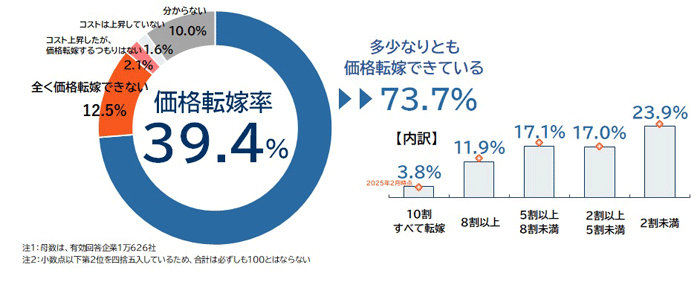
When asked to what extent they were able to pass on increased costs to their main products and services in the form of sales prices or service fees, 73.7% of companies responded that they were "able to pass on some of the increased costs to prices," a decrease of 3.3 percentage points from the previous survey (February 2025).
Looking at the breakdown, 23.9% reported passing on less than 2%, 17.0% between 2% and 5%, and 17.1% between 5% and 8%, indicating that the majority of companies are only partially passing on their costs. On the other hand, 11.9% of companies were able to pass on 8% or more, and 3.8% were able to pass on 10%. The pace of price pass-through is slowing, and the percentage of companies that responded that they "cannot pass on prices at all" increased by 1.3 percentage points from the previous survey to 12.5%.
<Price pass-through rate is at its lowest level since the survey began>
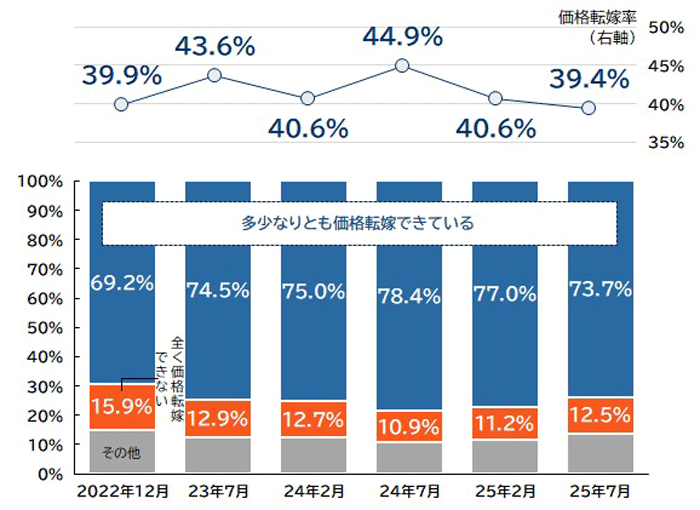
Furthermore, the "price pass-through rate," which indicates the degree to which increased costs are passed on to sales prices, was 39.4%. This means that if costs increase by 100 yen, only 39.4 yen can be reflected in the sales price, with companies bearing the remaining 60% or more. This is a decrease of 1.2 percentage points compared to the previous survey (price pass-through rate of 40.6%), and the lowest since the survey began in December 2022.
<Price pass-through situation by cost>
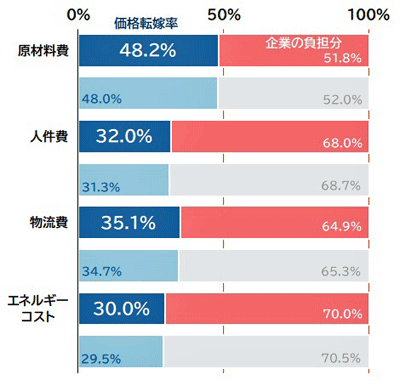
Furthermore, when asked about the extent to which they were able to pass on the costs of raw materials, labor, logistics, and energy—typical costs for their main products and services—they reported price pass-through rates of 48.2% for raw materials, 32.0% for labor, 35.1% for logistics, and 30.0% for energy.
Although logistics costs have increased slightly compared to the previous survey (34.7%), companies have commented that "we can easily explain material costs as there is a basis for them, but we often cannot provide a basis for other costs, so we are often not able to get responses" (machinery manufacturing, Gunma Prefecture), and "we can easily provide clear data for raw material costs, but labor costs, logistics costs, and energy costs have a wide range of impacts, and it is difficult to provide a convincing explanation considering confidential company information" (food and beverage/feed manufacturing, Tokyo).
<Price pass-through situation by supply chain>
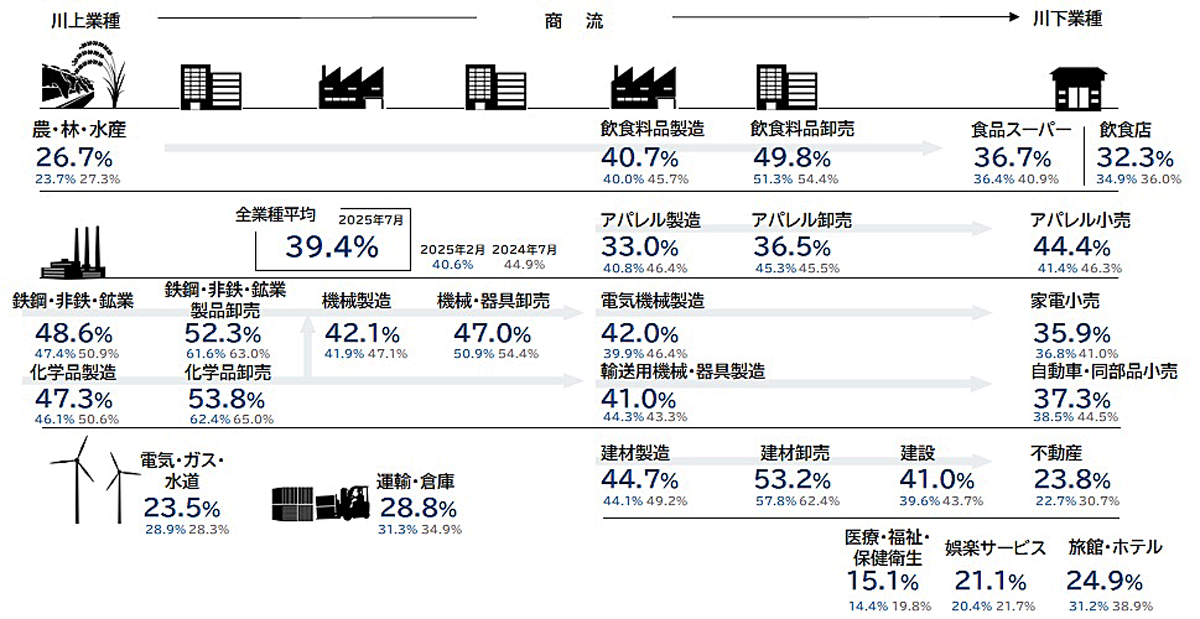
An examination of price pass-through by supply chain reveals that the further downstream the industry is from consumers, the more difficult it becomes to pass on prices.
While the overall price pass-through rate remained below 5%, it reached 28.8% in the transportation and warehousing sector, which is facing the "2024 problem." As exemplified by the opinion that "through the 2024 problem, we have made our customers understand that price increases are necessary in order to continue providing logistics as before" (transportation and warehousing, Hyogo Prefecture), there are signs that the industry is gradually moving towards passing on prices in the wake of the 2024 problem. However, it is also analyzed that "high fuel costs and a multi-layered transaction structure are still making price increase negotiations difficult."
Based on this survey, TDB recommends that "companies need to clearly demonstrate the rationale for cost increases and continue their efforts to seek understanding for price increases through dialogue with customers. At the same time, governments and industry associations are required to create an environment in which companies can pass on prices appropriately by promoting fair trade practices and providing institutional support."


