


On September 5th, Phoxter announced that it had installed an AMR (Automated Mobile Robot) system at Suntory's Osaka Plant.
<How AMR and robotic cell work together>
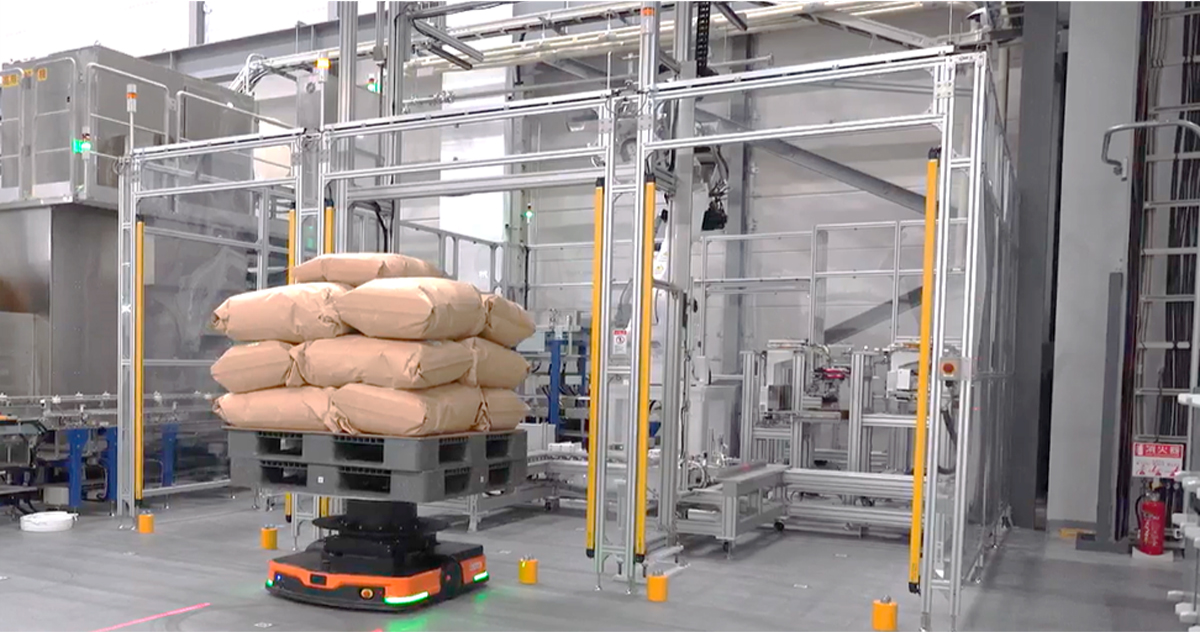
Normally, forklifts, conveyors, and RGVs (rail-mounted automated guided vehicles) are used to transport heavy raw materials, but AMRs autonomously transport raw materials from the warehouse to the manufacturing area, streamlining processes that were previously performed by humans.
Suntory's Osaka Plant is investing 55 billion yen in equipment between 2024 and 2025 to increase production capacity and improve quality. As part of this investment, they have adopted Phoxter's system, which will free on-site engineers from demanding tasks and allow them to dedicate more time to quality pursuit.
The implemented system does not fix the transport to a specific AMR, but rather replans the allocation to the optimal AMR at a high frequency and periodically, thus optimizing the number of AMRs required compared to forklifts or RGVs.
Furthermore, since there is no need to lay magnetic tape or rails on the ground to guide the vehicles, and the AMR transports the vehicles to their destination via the optimal and shortest route, highly efficient operation is possible.
Furthermore, since there is no intersection of forklifts and worker movements, and the transfer of raw materials between the AMR and the articulated robot is performed automatically, a high level of safety is achieved without the need for human intervention.
With the revision of the Logistics Efficiency Law and the ongoing development of roadmaps for labor-saving and rationalization in manufacturing logistics, expectations for AMRs with system flexibility and scalability are rising. In light of this, Phoxter plans to explore a system that can optimize the dwell time and quantity of raw materials and work-in-progress flowing through the factory.


