


The Japan Logistics Systems Association (JILS) announced the results of its "2024 Logistics System Equipment Production and Shipment Statistics" survey on September 4th. Total sales of logistics system equipment in fiscal year 2024 exceeded 657 billion yen, a 3.8% increase compared to fiscal year 2023, reaching a record high.
<Trends in total sales amount>
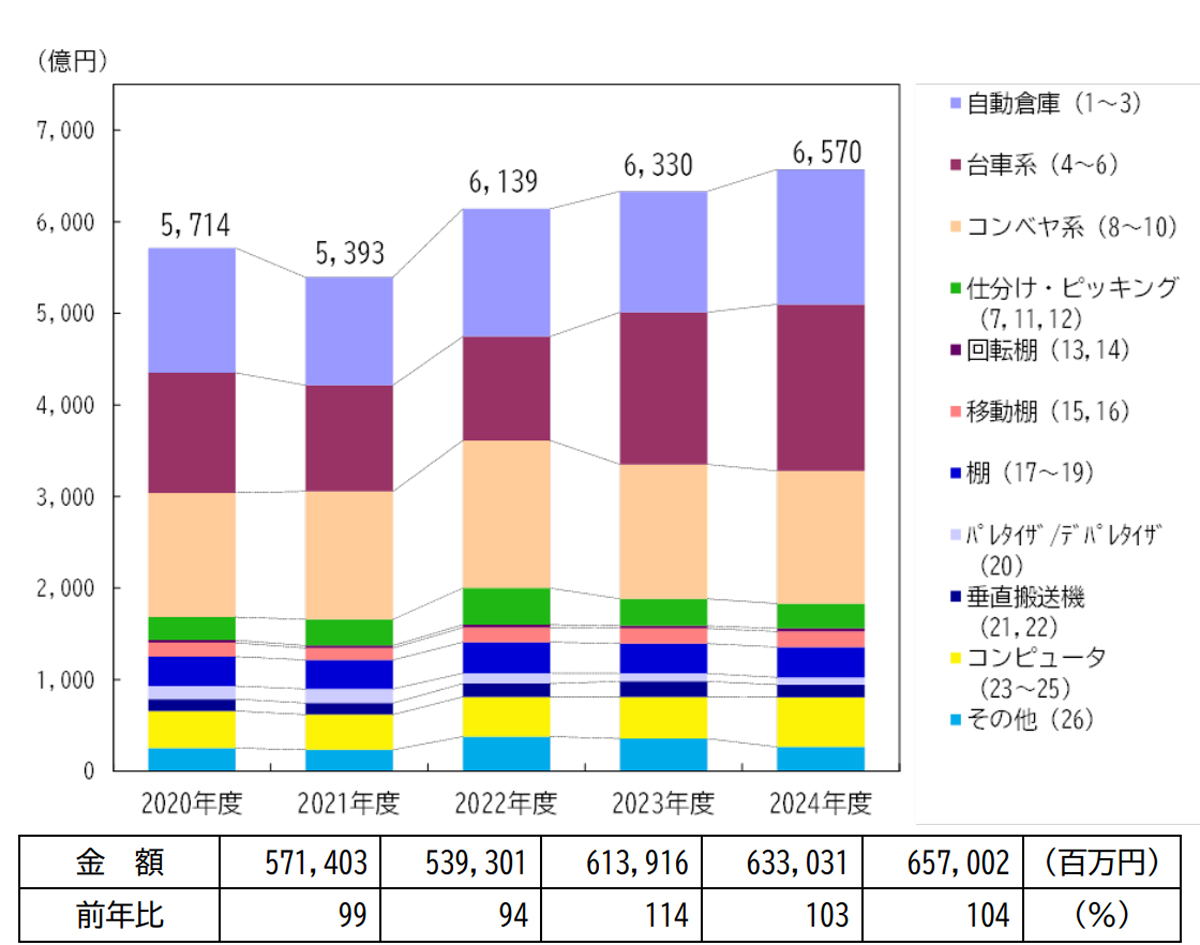
The survey was conducted with the aim of quantitatively and continuously understanding the production and shipment status of logistics system equipment, and compiled data from April 2024 to March 2025 for major domestic logistics system equipment manufacturers.
The results of the compilation show that total sales of logistics system equipment in fiscal year 2024 increased by 3.8%, from 633.031 billion yen in fiscal year 2023 to 657.02 billion yen, and the number of sales also increased from 118,357 to 133,532.
Regarding the record-high total sales figures, the research report states, "This is likely the result of manufacturers producing and supplying equipment in response to the continued high demand for many types of equipment. Furthermore, the increase in sales figures, along with the continued increase in the number of sales transactions compared to the previous year, suggests that demand for many types of equipment is on an upward trend."
Looking at trends by product type, automated warehouses increased from 132 billion yen to 147.098 billion yen (an 11.4% increase compared to the same period last year). By product type, automated warehouses for buckets (unit type) decreased from 86.382 billion yen to 79.104 billion yen (an 8.4% decrease), while those for cleanrooms increased from 38.206 billion yen to 38.493 billion yen (a 0.8% increase).
The sales of bogie systems increased from 165.937 billion yen to 182.039 billion yen (a 9.7% increase), and the number of units also increased from 11,499 to 12,818 (an 11.5% increase). By type, overhead-running bogies increased from 146.869 billion yen to 154.463 billion yen (a 5.4% increase), tracked bogie systems increased from 5.705 billion yen to 9.515 billion yen (a 66.8% increase), and trackless bogie systems increased from 13.363 billion yen to 18.061 billion yen (a 35.2% increase).
Conveyor systems decreased from 146.763 billion yen to 144.746 billion yen (1.4% decrease). By type, case conveyors decreased from 87.34 billion yen to 73.205 billion yen (16.2% decrease), hanger-type conveyors decreased from 13.111 billion yen to 9.408 billion yen (28.3% decrease), and pallet conveyors increased from 46.313 billion yen to 62.134 billion yen (34.2% increase).
Sales of sorting and picking equipment decreased from 29.713 billion yen to 27.161 billion yen (down 8.6%). While sorting machines accounted for the majority of the total, sales of sorting machines decreased from 19.82 billion yen to 15.761 billion yen (down 20.4%), while the number of units increased from 2764 to 2782 (up 0.6%). Sales of digital picking indicators increased from 8.982 billion yen to 10.612 billion yen (up 18.1%).
Sales of rotating and mobile shelving increased from 19.217 billion yen to 20.202 billion yen (a 5.1% increase). By model, mobile shelving accounted for the majority of sales (83.3%). Sales of mobile shelving decreased from 13.293 billion yen to 12.842 billion yen (a 3.4% decrease) for electric models and from 3.182 billion yen to 3.982 billion yen (a 25.1% increase) for manual models. Furthermore, sales of vertical rotating shelving increased from 937 million yen to 940 million yen (a 0.3% increase), and sales of horizontal rotating shelving increased from 1.805 billion yen to 2.441 billion yen (a 35.2% increase).
The shelving consists of three types: heavy-duty shelving, light-duty shelving, and flowable shelving. Sales increased from 32.677 billion yen to 33.307 billion yen (1.9% increase). Breaking it down, heavy-duty shelving increased from 10.919 billion yen to 11.773 billion yen (7.8% increase), light-duty shelving increased from 21.559 billion yen to 21.023 billion yen (2.4% decrease), and flowable shelving increased sharply from 199 million yen to 511 million yen (256.8% increase).
Sales of palletizers/depalletizers decreased from 8.534 billion yen to 8.147 billion yen (a 4.5% decrease), and the number of units decreased from 980 to 788 (a 19.6% decrease).
Sales of vertical conveyors decreased from 17.118 billion yen to 13.725 billion yen (a 19.8% decrease). By model, sales of vertical conveyors for pallet transport decreased from 14.57 billion yen to 10.535 billion yen (a 27.7% decrease), while sales of vertical conveyors for case and piece transport increased from 2.548 billion yen to 3.19 billion yen (a 25.2% increase).
Total computer sales increased from 45.581 billion yen to 54.083 billion yen (an 18.7% increase). Computers consist of computer software and hardware, including control systems for information processing and inventory management of logistics system equipment, and WMS (Warehouse Management Systems). Regarding WMS, the statistics primarily survey logistics system equipment manufacturers (including engineering companies), resulting in insufficient coverage. In particular, it is likely that many major information system vendors develop their own logistics information systems that include WMS functionality, but this is not covered by the survey.
By product type, computer (hardware) sales increased from 10.013 billion yen to 16.646 billion yen (a 66.2% increase), while computer (software) sales increased from 32.821 billion yen to 32.919 billion yen (a 0.2% increase). It should be noted that many computers are used for controlling logistics system equipment, and their sales are influenced by the shipment trends of other product types.
Overseas sales increased from 183.209 billion yen to 228.582 billion yen (a 26.0% increase). Overseas sales have traditionally had a high proportion of cleanroom-related products and tend to be strongly influenced by this trend.
Overseas sales for cleanrooms increased from 159.775 billion yen to 190.175 billion yen (a 19.0% increase), while sales for non-cleanroom products increased from 23.434 billion yen to 40.663 billion yen (a 73.5% increase).
In terms of overseas sales, trolley-type systems account for 62.6% of the total, automated warehouses for 18.2%, and conveyor systems for 7.1%, with these three product categories accounting for over 80% (87.9%) of sales.
Of these three models, sales of trolley-type equipment increased from 116.806 billion yen to 142.995 billion yen (a 22.4% increase), automated warehouses increased from 30.664 billion yen to 41.58 billion yen (a 35.6% increase), and conveyor systems increased from 13.749 billion yen to 16.234 billion yen (an 18.0% increase).
<Trends in overseas sales>
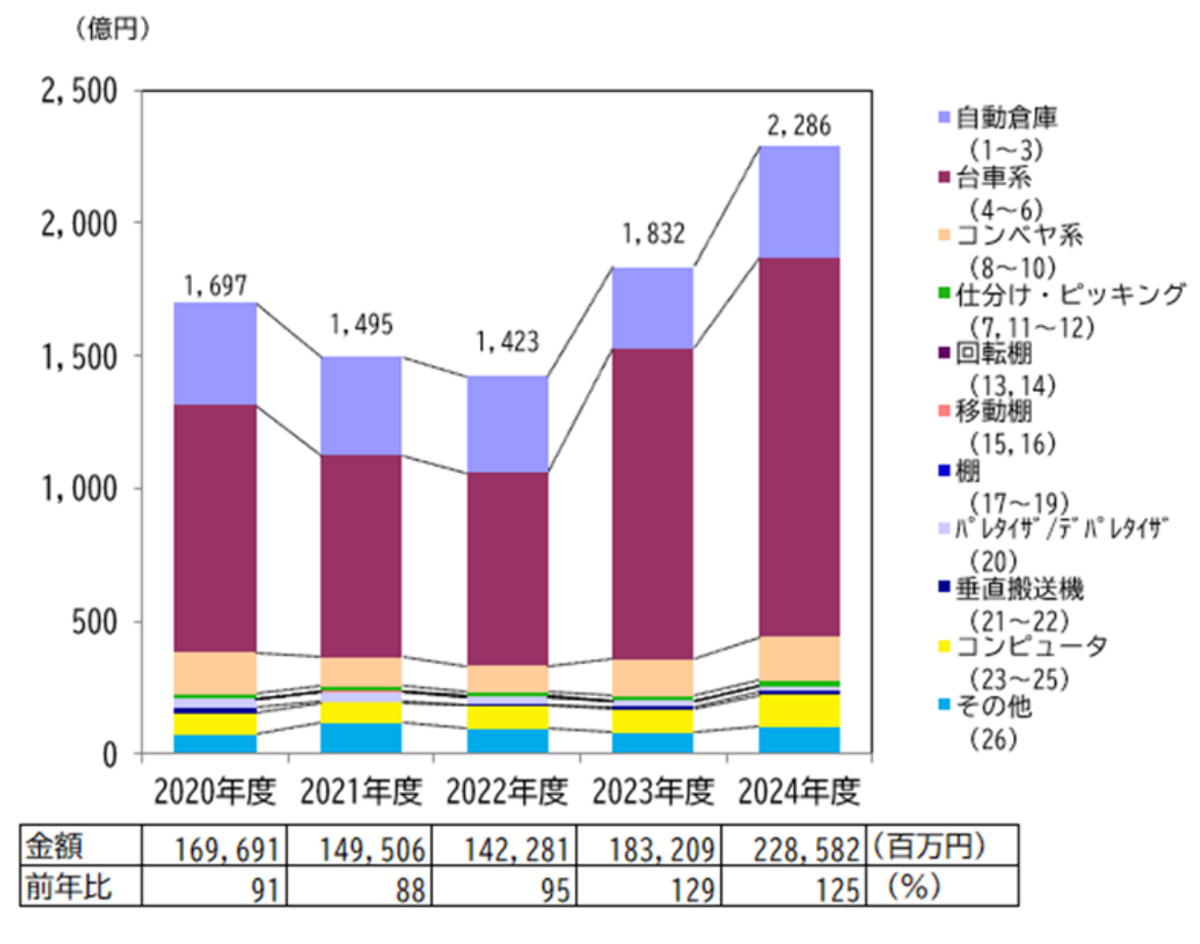
The report concludes that the total sales for fiscal year 2024 exceeded 600 billion yen for the second consecutive year, following the trend in fiscal year 2023, stating, "Changes in the external environment, such as the global surge in raw material and product prices, continue to have a significant impact on the logistics and distribution sector. This year's survey confirmed that total sales have increased for the third consecutive year, which suggests that demand for automation and labor-saving measures in logistics remains robust as a response to the labor shortage symbolized by the so-called '2024 logistics problem'."


