


Five considerations for "improving logistics efficiency"
Over the past eight installments, we have considered efficiency from various perspectives. The importance of "logistics efficiency" should remain unchanged, both in the past, present, and future. However, as the importance of logistics efficiency is recognized, we are now in an era where specific details of efficiency are being rigorously questioned, such as "for whom is efficiency being considered? What indicators should be used to define efficiency? Are there any legal or institutional constraints?"
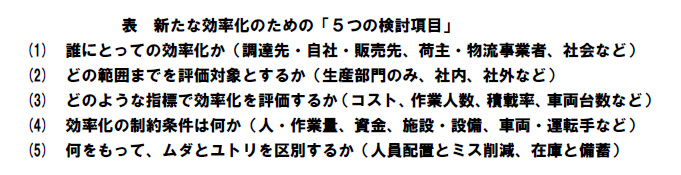
Therefore, as a summary of the "Considering Logistics Efficiency" series, this time we will consider five items for evaluating logistics efficiency (beneficiaries of efficiency, scope of evaluation, evaluation indicators, constraints, and the distinction between waste and leeway) (see table).
(1) For whom is this efficiency improvement?
The first point is, "For whom is this efficiency improvement beneficial?" Specifically, among "suppliers, our own company, customers, shippers, logistics operators, etc.," whose benefit is the efficiency improvement, and who will be negatively affected? This is because in logistics, the interests of the stakeholders often conflict.
For example, the "efficiency for shippers" of specifying delivery times for small packages often leads to "inefficiencies for logistics providers," such as an increase in the number of deliveries and waiting times.
(2) What scope should be included in the evaluation?
The second point is "to what extent should the evaluation be conducted?" Specifically, the scope of the evaluation should be defined from options such as "production department only," "internal (procurement, production, and sales departments)," "supply chain connecting internal and external parties (suppliers, internal parties, and customers)," and "internal and external parties, including affiliated companies (logistics companies, partner companies, etc.)." The term "overall optimization" is often used, but unless the scope of "overall" is clearly defined, an appropriate evaluation cannot be conducted.
For example, the efficiency metrics and evaluation methods will likely differ depending on whether the focus is on "the entire company (procurement, production, and sales departments)" or "the entire supply chain," including external parties such as suppliers and customers.
(3) What indicators will be used to evaluate efficiency?
The third point is "what indicators should be used to evaluate efficiency?" Specifically, this involves deciding which indicators to select from "cost, number of workers, error rate, load factor, number of vehicles, CO2 emissions, etc."
For example, if goods are loaded manually without using pallets, the working time will be longer, but the loading rate will be higher. Conversely, if pallets are used, the working time will be shorter, but the loading rate will be lower. As such, trade-offs are inherent in logistics (you can't have your cake and eat it too), which is why it's necessary to consider "which indicators to prioritize and to what extent you can tolerate each other's shortcomings."
(4) What are the constraints on efficiency?
The fourth point is, "What are the constraints on efficiency?" Specifically, these include "people, workload, work speed, funds, facilities, equipment, vehicles, drivers, etc." If there are constraints on efficiency measures, they need to be clearly defined.
For example, working hours are restricted by labor laws, as is evident from the 2024 logistics problem. Furthermore, the number of vehicles and drivers a company can provide is also limited.
(5) What criteria should be used to distinguish between waste and leeway?
The fifth point is, "What criteria do we use to distinguish between waste and leeway?" Of course, waste should be eliminated in order to improve efficiency, but doing so may result in a loss of leeway and the creation of new waste.
For example, reducing the number of workers due to perceived waste can eliminate leeway and increase the likelihood of errors. Also, inventory that was considered excessive may be useful as emergency supplies during disasters.
Therefore, when considering efficiency improvements, it's not enough to simply eliminate waste; it's necessary to distinguish between waste and leeway while also considering the impact on other areas.
Efficiency improvements are not as straightforward as they seem.
Efficiency improvements often seem like a panacea, and we tend to accept them unconditionally. However, upon closer examination, "efficiency improvements" have diverse aspects, and while there are positives, there are also negatives.
Therefore, the more we strive to achieve the optimal state through efficiency improvements, the more essential the above considerations become. Instead of simply ending with the word "efficiency improvements," I hope that you will pursue "more in-depth efficiency improvements" by considering the following: (1) who it is for, (2) what scope it covers, (3) what indicators will be used for measurement, (4) what constraints exist, and (5) can we distinguish between waste and leeway?


