


Jones Lang LaSalle (JLL) released its "Japan Market Dynamics – Q2 2025 Logistics" report on September 19.
<Trends in supply and demand in the Tokyo metropolitan area>
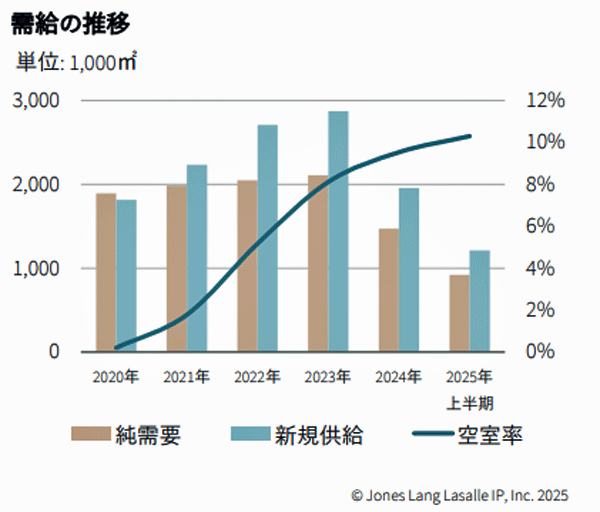
According to the report, in the Tokyo metropolitan area, demand remains strong, with net demand reaching 332,000 m2 in the second quarter of 2025. However, this represents a 43% decrease compared to the previous quarter due to a decline in new supply. Rising transportation costs are strengthening demand for properties located close to the city center, while demand is weakening for properties in surrounding areas with longer transportation distances, and some properties are struggling to find tenants.
In the second quarter of 2025, four new properties totaling 358,000 m2 were supplied, increasing the total stock area by 1.5% compared to the previous quarter. All four properties were supplied in inland areas, two of which were located in the Ken-O Expressway area. The vacancy rate for the entire Tokyo metropolitan area was 10.3%, unchanged from the previous quarter and up 64 basis points year-on-year. The vacancy rate in the bay area fell by 18 basis points to 8.4%, while the vacancy rate in inland areas remained unchanged from the previous quarter at 11.0%.
The average monthly rent per tsubo (approximately 3.3 square meters) in the Tokyo metropolitan area was 4704 yen, a 0.6% increase from the previous quarter and a 1.4% increase from the same period last year. Rising construction costs are driving up rents for new properties, which in turn are pushing up rents for surrounding properties.
<Trends in supply and demand in the Osaka area>
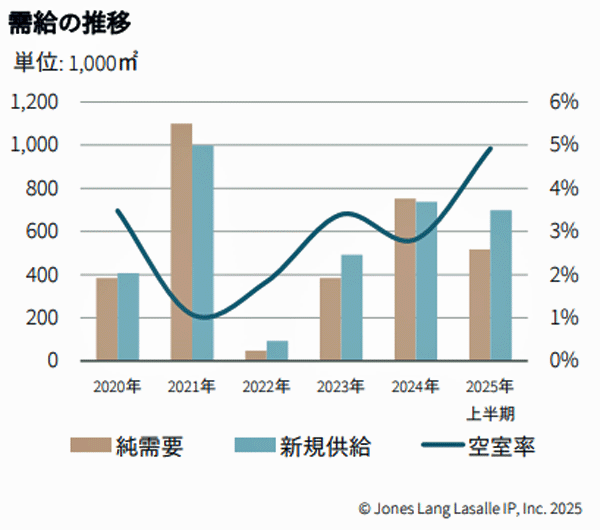
In the Osaka metropolitan area, robust demand and a large volume of new supply led to a net demand of 236,000 m2 in the second quarter of 2025. Demand is diverse, including from e-commerce companies, 3PL companies, and retailers, suggesting that location-based demand differences are not as pronounced in the Osaka area as they are in the Tokyo metropolitan area.
In the second quarter of 2025, four new buildings totaling 366,000 m2 were supplied, bringing the total stock area to 7,724,000 m2, a 5.0% increase compared to the previous quarter. While vacancies in existing properties were absorbed, the increase in vacant area due to the new supply resulted in a vacancy rate of 4.9% for the Osaka metropolitan area, a rise of 152 bps compared to the previous quarter and 259 bps compared to the same period last year.
In the Osaka area, the average monthly rent per tsubo (approximately 3.3 square meters) was 4206 yen, a 0.5% increase from the previous quarter and a 2.1% increase from the previous year. While the expansion of the property supply area resulted in some new properties being offered at lower-than-average rents, the overall average rose due to increases in rents for existing properties.
<Trends in supply and demand in the Fukuoka area>
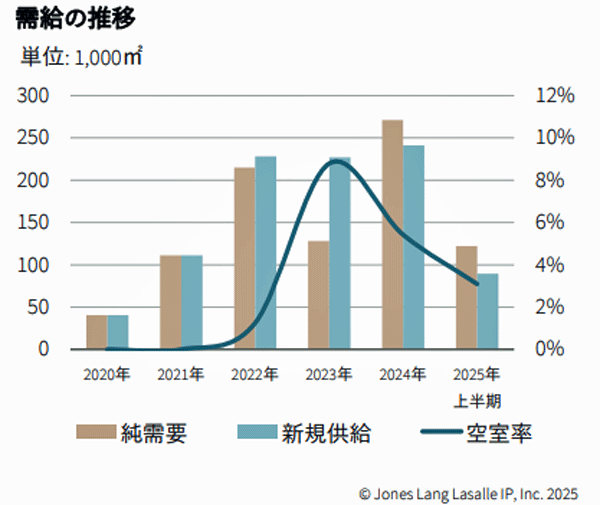
In the Fukuoka area, demand remains strong, with net demand for the second quarter of 2025 reaching 26,000 m2.
In the second quarter of 2025, there was no new supply, and the total stock area was 1,608,000 m2, a 12.0% increase compared to the same period last year. The vacancy rate for the Fukuoka area as a whole was 3.1%, a decrease of 160 basis points from the previous quarter and a decrease of 31 basis points from the same period last year. In particular, the absorption of vacancies in inland areas with favorable locations pushed down the overall vacancy rate.
In the Fukuoka area, the average monthly rent per tsubo (approximately 3.3 square meters) was 3551 yen, a 0.2% increase from the previous quarter and a 3.2% increase from the previous year. Due to the relatively high rents for new properties, rents for existing properties are being reviewed upon contract renewal or renegotiation, with some cases seeing increases of around 10%.


