


Teikoku Databank (TDB) announced its bankruptcy statistics for the first half of fiscal year 2025 (April-September) on October 8.
<Trends in the number of bankruptcies>
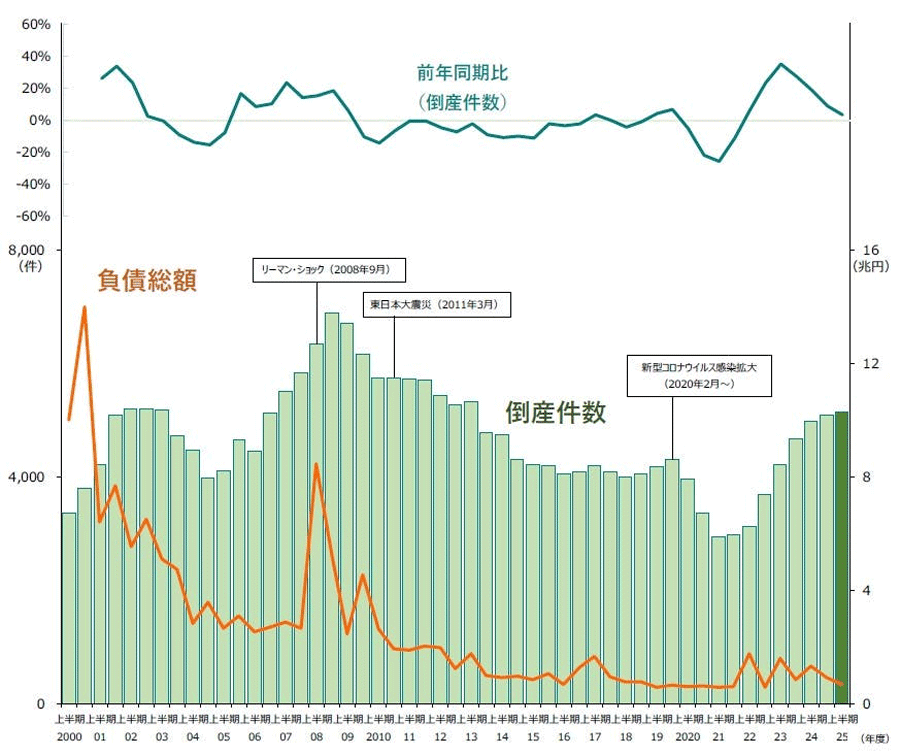
According to the report, the number of bankruptcies was 5146 (4990 in the same period last year, a 3.1% increase), exceeding 5000 for the first half of the year for the first time in 12 years, since fiscal year 2013 (5320 cases). On a half-year basis, this marks the eighth consecutive half-year increase since the second half of fiscal year 2021 (2978 cases). This eight-half-year increase is the longest streak since fiscal year 2000.
<Bankruptcies by Industry>
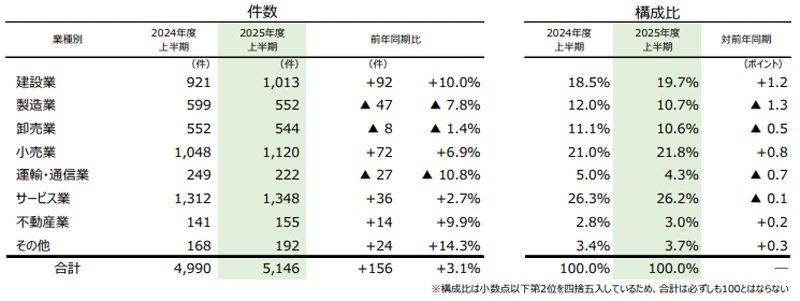
Looking at the data by industry, four out of seven industries saw an increase compared to the previous year. The "service industry" (1312 cases in the same period last year → 1348 cases, a 2.7% increase) saw an increase for the eighth consecutive quarter, reaching its highest level since fiscal year 2000. The "retail industry" (1048 cases → 1120 cases, a 6.9% increase) had the third highest number of cases on record.
In the "Transportation and Communications" sector, the "Transportation" sector (242 cases → 217 cases) dragged down the overall figures, resulting in a decrease compared to the previous year for the first half of the year for the first time in five years.
Regarding bankruptcy trends, 214 cases were identified as being due to labor shortages, a new record high. 264 bankruptcies were identified due to difficulties in finding successors, the second highest number for the first half of the year on record. 488 bankruptcies were identified due to inflation, also a new record high.
Looking ahead, the second half of fiscal year 2025 will see increased attention focused on trends in the automotive industry and the construction industry, which has seen a significant increase in bankruptcies compared to the first half of fiscal year 2024. The number of bankruptcies is expected to remain above 5000, and exceed 10,000 for the full fiscal year, mainly due to "giving up bankruptcies" among small and medium-sized businesses, primarily in the service and retail sectors, which have overcome the COVID-19 pandemic with zero-zero loans but have given up on continuing operations due to the limitations of responding to rising prices, price increases, labor shortages, and wage increases.


