


On October 9, the Ministry of Land, Infrastructure, Transport and Tourism held an "Information Sharing Meeting on Diversification and Strengthening of International Logistics," where participating companies in demonstration shipments between Japan and Europe via the Central Corridor-Caspian Sea route reported on their results. While each company acknowledged the effectiveness of the route as an alternative when shipping by sea becomes difficult, many challenges were highlighted, including costs, transport quality, and lead times.
The demonstration transport project, which began in 2017, aims to identify challenges and consider countermeasures for alternative routes to Japan's international transport routes, which have traditionally relied on maritime transport, by anticipating geopolitical risks and large-scale disasters. In the supplementary budget for fiscal year 2023, five cases were selected as part of a study on the Central Corridor.
<Demonstration study regarding the central corridor>
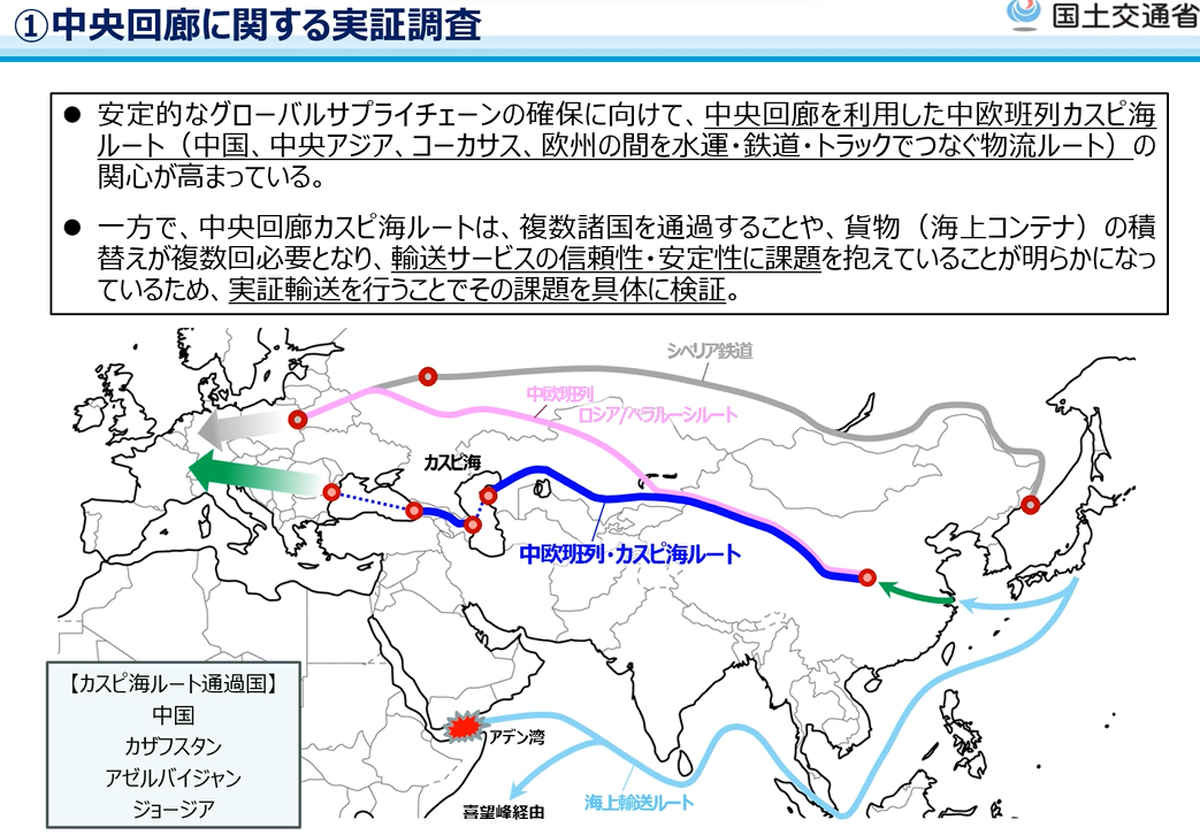
The shipment from Kobe to Italy, which was expected to take 100 days, ended up taking over six months due to a 41-day delay in Taicang, China.
For the shipment of automotive parts from Nagoya to Turkey, the usual shipping route via the Cape of Good Hope took about 60 days, but due to strong winds in the Caspian Sea, it took 98 days, and the freight cost was about four times higher.
Furthermore, it was reported that the paperwork involved in rail transport within China is cumbersome, leading to increased operational costs.
In addition, the information-sharing meeting included reports on four case studies of "demonstration studies aimed at diversifying and strengthening international logistics," which were conducted under the 2024 budget.
In the shipment of honey from Kyrgyzstan to Japan, instead of the usual route via the Black Sea, the honey was transported by truck to the port of Karachi in Pakistan, and then by ship to the port of Tokyo. Upon arrival, the cargo shifted inside the container, and some of the products were found to have been removed.
It was explained that the cost of transporting automotive parts from Nagoya to Thailand was 12 to 13 times higher than normal transport, and that the impact on the cargo during gantry crane handling at the port, which is usually around 30G and even 40G is considered rare, reached 76G.
Following the report, Takehito Makino, Director of the International Logistics Office at the Ministry of Land, Infrastructure, Transport and Tourism's Logistics and Automobile Bureau, announced that applications for participation in the demonstration transportation project funded by the 2024 supplementary budget are being accepted until October 24th.
<Outline of demonstration transport related to diversification and strengthening of international logistics, funded by the FY2024 supplementary budget>
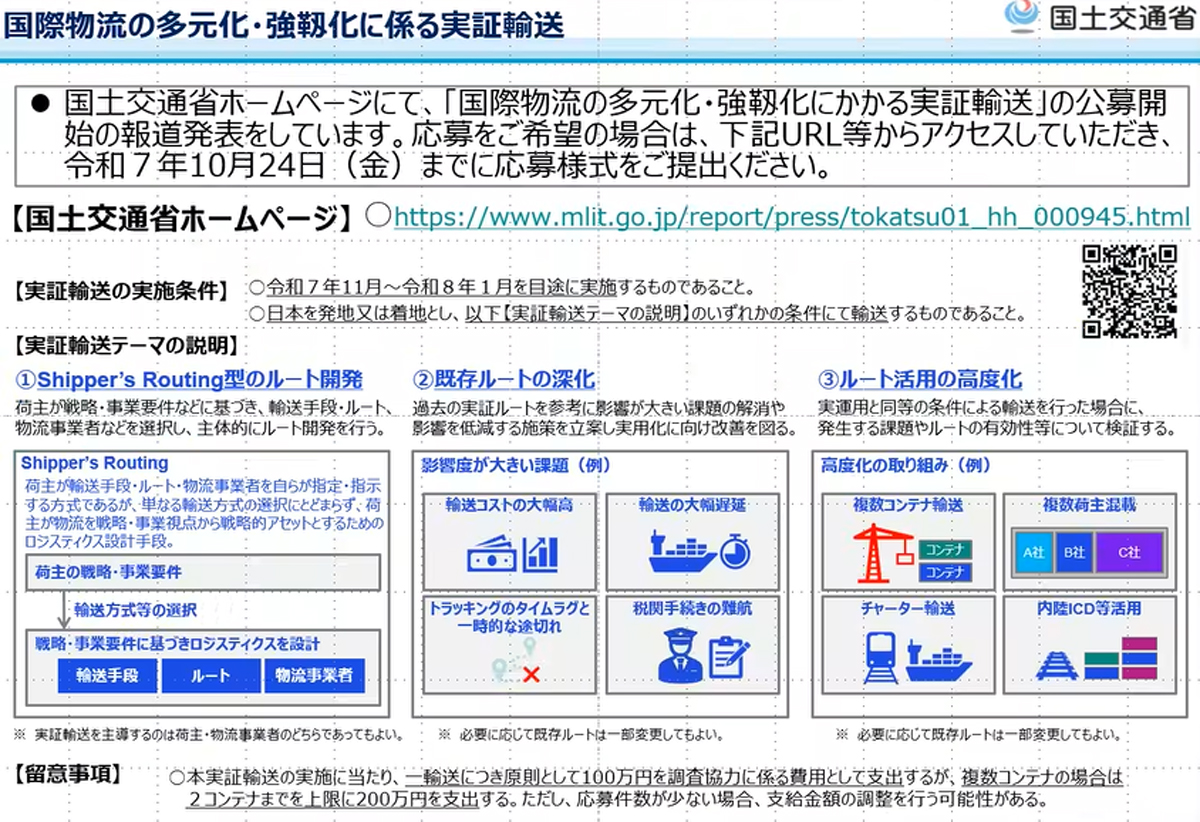
Makino, head of the logistics department, also explained that a business tour related to the central corridor would be conducted in the 2025 budget and called on relevant parties to participate.


