


How to utilize and nurture Generation Z (22)
From the 16th to the 21st session , we have explained, with examples, strategies for using KPIs to involve everyone, motivate them, and gain their active cooperation to achieve success as a departmental organization (acquiring new business through improved performance and increased client satisfaction, and developing human resources).
Since many of our readers are likely department managers, this time, as a KPI summary, we will explain strategies for incorporating KPI indicators into organizational management activities (policy deployment) and utilizing them effectively.
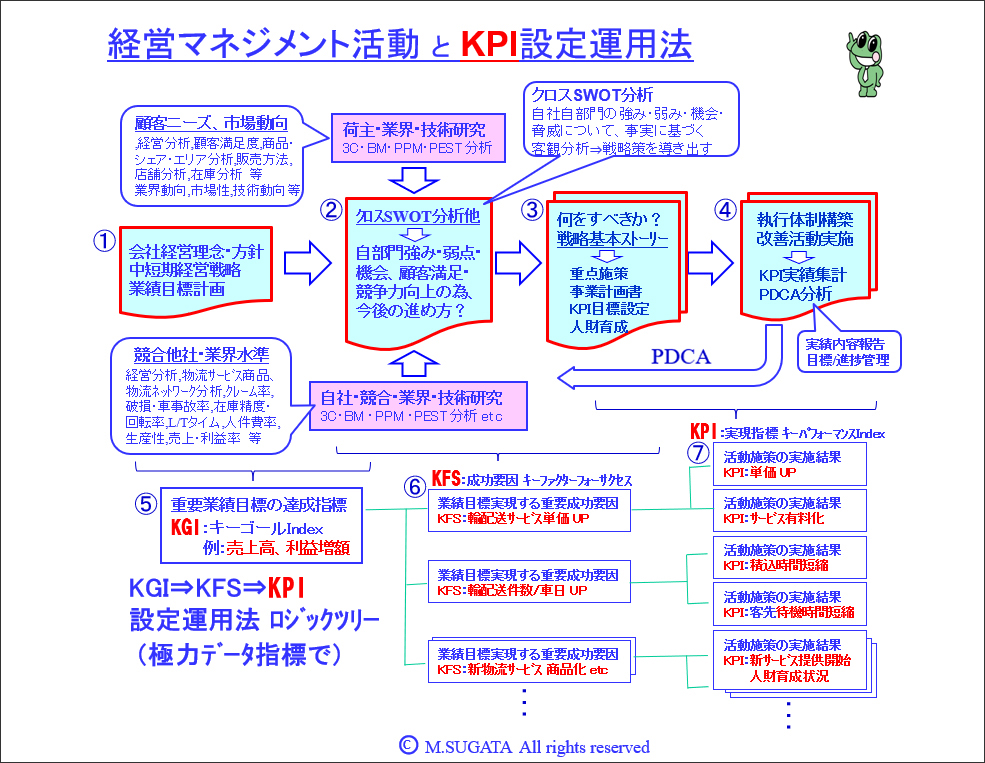
<Figure 1>
■ Management Activities
Please look at Figure 1. Your business management activities should be carried out in the flow from (1) to (4), as shown in the upper half of the conceptual diagram.
(1) Presentation of the "Management Philosophy and Policy, Medium- and Short-Term Management Strategies, and Performance Targets (Draft)" for the New Fiscal Year
(2) "Consideration of future steps based on cross-SWOT analysis, etc." in each business division.
This activity involves identifying what should be prioritized. A cross-SWOT analysis of one's own department, based on an understanding of the company's management policies, analysis of customer needs, and an understanding of competitors and industry trends, is crucial. If this analysis is off-target, no improvement will be achieved. It is essential to maintain a customer-first mindset ( see diagram in Part 6 ) and continuously conduct research, keeping a close eye on shippers, market, and industry trends.
(3) Consideration and creation of the basic strategic story and business plan
A business plan is needed that clearly outlines the strategic background and flow of considerations in relation to the current situation of each department, and how to promote it with concrete, feasible measures (5W1H). It should be easy for everyone to understand, be convincing, and clearly define roles and responsibilities. This plan is key to effective communication and problem-solving.
(4) "Improvement implementation activities and results compilation" through the establishment of an implementation system.
An organizational structure based on management strategy is established, roles and responsibilities are assigned (clarified and instructed) to each individual, and then put into action. Improvement (suggestion) activities become more active, necessary professional skills development activities are implemented, and appropriate daily management (PDCA) control activities are also important.
■ KGI → KFS → KPI Logic Tree
Following the flow and steps of the management activities described above, the lower half of the conceptual diagram in Figure 1 shows the method for setting and operating the "KGI → KFS → KPI logic tree (see Figure 3 in Chapter 16 )".
As you can see, (5) to (7) should also be included in the KPI metrics.
(5) The overall performance targets for each business unit will be set as the KGI (Key Goal Index). For example, this could be achieving an increase in sales and profits (e.g., 1 million yen or more).
(6) What are the success factors for achieving the overall performance target KGI? This is called KFS (Key Factor for Success). For example, what must be done to achieve a performance target of 100 million yen or more? In the recent efforts of 3PL logistics companies, various costs such as labor costs and operating costs (fuel costs and tire costs) have risen, so possible measures include requesting shippers to negotiate higher rates for transportation services, charging for ancillary services that were previously provided free of charge (e.g., delivery and storage at designated locations), or increasing the number of transportation transactions by improving productivity.
(7) The KPI indicators will be what indicators measure whether the above success factors KFS are being successfully achieved. For example, if a 6% price increase is approved against an 8% request, what is the monetary effect of this? By when will negotiations for the remaining 2% increase continue? What is the monetary effect of the price increase that has been achieved?
■ We focus on KPI indicators and collect data persistently.
Depending on the content of each item, KGI → KFS → KPI indicators can be reviewed daily (daily revenue/expense indicators), weekly (weekly reporting indicators), or monthly (monthly reporting indicators).
I would like departmental managers to diligently collect these KPI indicators and use them to drive improvement activities (PDCA control). Furthermore, I hope that these KPI indicators will not be kept as personal records, but will be closely shared with everyone who cooperates in the improvement activities.
By expressing gratitude and recognition for good results, encouraging improvement for bad results, and continuously motivating everyone as providers of customer satisfaction and colleagues with the same aspirations, you can create a team of professionals who act proactively, leading to significant improvements.
Especially with younger employees, including Generation Z, make an effort to communicate with them regularly, offer encouragement, and foster mutual trust. This will change the workplace atmosphere, so please persevere in this effort.
In my corporate consulting work, I made an effort to create opportunities for employees to recognize and celebrate good practices during morning and afternoon meetings, by actively introducing individuals and teams by name and encouraging everyone to applaud. Do you often create opportunities for applause in your workplace? I suspect it's very rare.
When applause occurs frequently, the individuals or teams who are called by name and introduced receive applause of praise from everyone, which makes them even more proactive, transforming it into a great example of spiral improvement. Instead of just using morning and midday meetings as a place for giving work instructions, actively incorporate them as participatory spaces for interactive communication, where people can talk, get excited, and give each other praise.
Like former Urawa Reds player Tomoaki Makino, let's strive to inspire our team members. I myself have been encouraged by his way of leading his team (and fan supporters) and have tried to put it into practice. This will foster a bright, positive, and challenging organizational culture in the workplace.
■ Not just tallying data, but also close communication
As I mentioned last time , setting logistics KPI items and starting to collect data is easy, but simply collecting data won't lead to any improvement activities or increased performance. It's crucial to use KPI indicators to communicate effectively.
In particular, improving logistics quality (such as reducing delivery complaints, forklift accidents, and inventory discrepancies; creating a positive work environment; providing prompt and efficient customer service; developing and improving multi-skilled personnel; and implementing 5S improvement activities in the workplace and vehicles) is difficult to achieve without the involvement and cooperation of everyone, and the degree of involvement greatly influences the quality of the results.
While large 3PL companies offer highly IT-equipped logistics services, many medium-sized and small logistics companies, despite their more analog logistics services, provide comparable or even superior customer satisfaction and are competitive in areas such as productivity improvements.
There are many strategies that can be used to compete without spending a lot of money.
While I was still working, I actively collected data on the number and content of instances where I received praise from shippers or thanks from consignees, meticulously compiled it into KPIs, and frequently presented it as a good example at morning and midday meetings and other conferences.
As a result, the morale of the employees was fostered, they became more and more energetic, and a positive cycle was created in which they became even more proactive in improvement activities because they wanted to hear more good news.
As I've mentioned many times in this series, this is not about running an organization with a "Don't! Do! (Don't do this, do it this way)" type of organizational management, but rather a "Well done! We'll ask you again" type of management.
Another strategy I implemented as a department head, using KPIs, was to effectively utilize metrics such as increasing the retention rate of part-time employees (target 90%) and the number of employees hired through referrals (e.g., 10 or more people in a half-year period, so-called referral hires). I would express my gratitude to these employees. I also urged managers, supervisors, and leaders to be mindful of these efforts.
I hope that even if you are small in scale, you will be able to become a competitive logistics company that "wins through on-the-ground capabilities" by being creative, gaining the satisfaction and trust of your shippers (senders and recipients), expanding your business, and growing. Based on my 25 years of experience as a logistics consultant, managers who are good at involving everyone generally achieve good results.
■Series: Human Resource Development that Transforms the Workplace


