On October 16, CBRE released its market analysis of Chiba Prefecture within the Tokyo metropolitan area's LMT (Large Multi-Tenant Logistics Facility) market, titled "Tokyo Metropolitan Area LMT Market Analysis - Unraveling Chiba Prefecture's Strengths."
<Comparison of vacancy rates between Chiba Prefecture and LMT in the Tokyo metropolitan area>
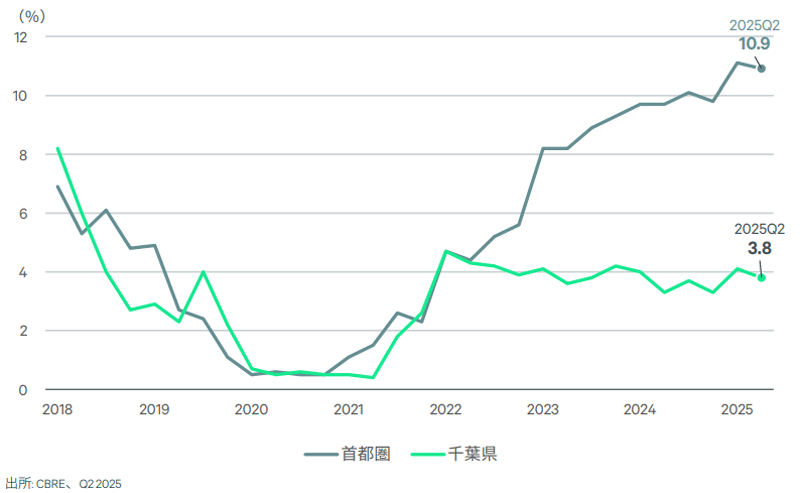
According to the report, Chiba Prefecture has a remarkably low vacancy rate compared to other areas in the Tokyo metropolitan area. The vacancy rate for the entire Tokyo metropolitan area has been on an upward trend since hitting a low of 0.5% in Q4 2020, and remains high at 10.9% in Q2 2025.
Three factors contributing to the low vacancy rate
In contrast, Chiba Prefecture's vacancy rate peaked at 4.7% in Q1 2022 and remained low at 3.8% in Q2 2025. Factors cited for this include the relatively small supply of new LMT (Landmarked Mobility) properties in Chiba Prefecture in recent years, the favorable locations of the newly supplied properties, and relatively low rent levels.
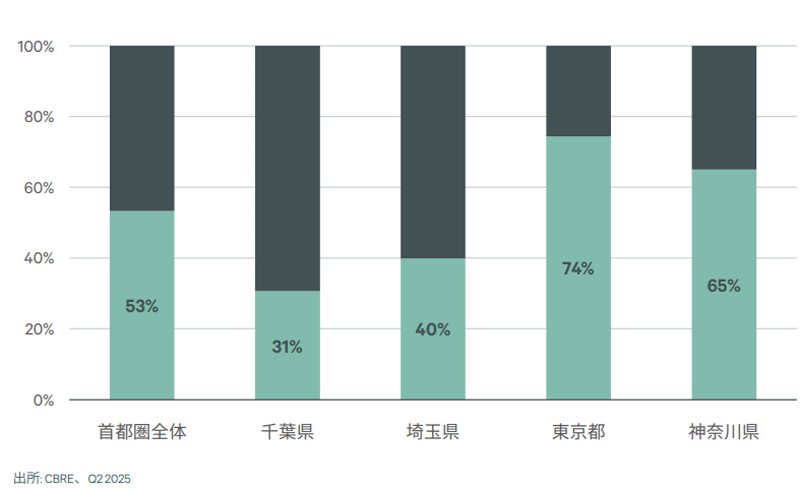
In the Tokyo metropolitan area, new supply of LMT (Landmarked Housing) reached a record high for three consecutive years from 2021 to 2023, resulting in a significant rise in the vacancy rate. The vacancy rate for the entire metropolitan area reached 53%. In contrast, Chiba Prefecture's rate was 31%, lower than Saitama Prefecture's 40% and Kanagawa Prefecture's 65%. The low volume of new supply is said to have supported Chiba's competitiveness.
<LMT New Supply Rate from Q1 2022 to Q2 2025 (compared to total leased floor area in Q4 2021)>
<Percentage of new housing supply from Q1 2022 to Q2 2025 located within a 30km radius of the city center>
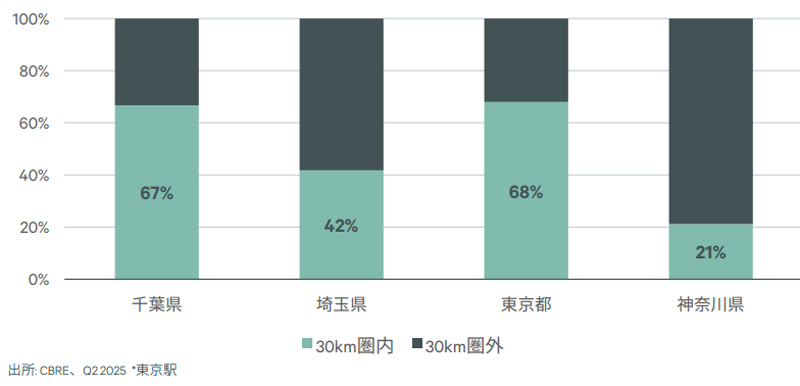
Another contributing factor in the Chiba Prefecture area is the large volume of new supply in suburban areas close to central Tokyo. Specifically, when looking at the percentage of properties completed within a 30km radius of Tokyo Station (approximately 1 hour to central Tokyo), Chiba Prefecture accounted for 67%, significantly higher than Saitama Prefecture's 42% and Kanagawa Prefecture's 21%. In recent years, new supply in Chiba Prefecture has largely consisted of locations close to central Tokyo, which offer good delivery efficiency, and this is thought to have been advantageous in attracting tenants.
<Comparison of projected contracted rents (Chiba Prefecture, Q1 2022 = 100)>
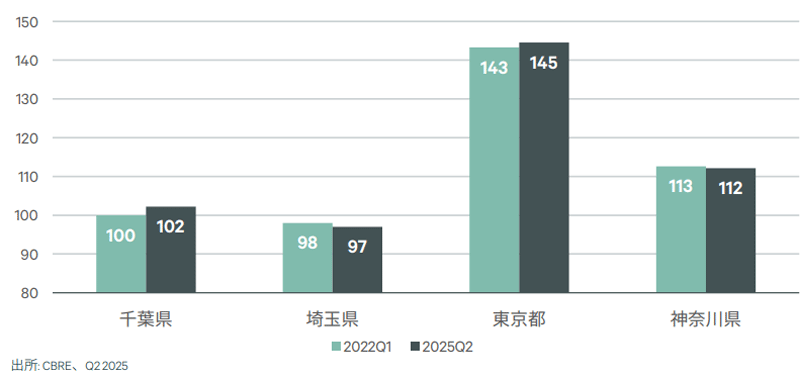
Furthermore, relatively low rent levels are also a major factor. Comparing rents as of Q1 2022, rents in Chiba Prefecture were 43% lower than in Tokyo and 13% lower than in Kanagawa Prefecture. Against the backdrop of a low vacancy rate, rents in Chiba Prefecture rose by approximately 2% over the three years leading up to Q2 2025, but the gap between Chiba and Tokyo and Kanagawa Prefectures remains roughly the same as it was in Q1 2022.
Regional characteristics and the development of infrastructure are also important.
In addition to newly supplied properties being selected by tenants based on factors such as location and rent levels, the concentration of apparel companies with a strong desire for expansion is also thought to have contributed to maintaining a stable supply-demand balance in Chiba Prefecture.
<Classification of cargo handling industries (LMTs completed by 2024) based on area>
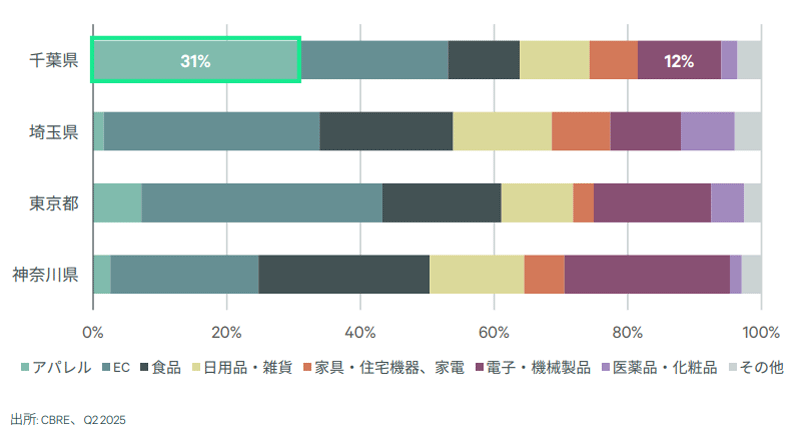
In Chiba Prefecture, apparel accounts for 31% of the cargo stored at LMT (Landing Mechanism), an overwhelmingly high percentage compared to other prefectures. This is because apparel goods require a large workforce for logistics tasks such as attaching price tags and inspection. In addition to access to commercial areas in Tokyo, apparel companies' logistics centers were concentrated in the Chiba Prefecture coastal area in the early 2000s due to the need to secure labor.
Subsequently, apparel clusters expanded to inland areas, but in recent years, sports apparel companies, including outdoor wear, have accelerated their opening of new stores in urban areas, which is believed to have driven the demand for logistics facilities in Chiba Prefecture.
The region also has its strengths in terms of regional characteristics and infrastructure. Chiba Prefecture's LMT market anticipates cargo demand from Japan's largest airport, and infrastructure development is progressing around Narita Airport. In addition, the Ken-O Expressway is scheduled to open by March 2027, including the section including the Ken-O Narita Interchange. On general arterial roads, the full opening of National Route 464 (Kita-Chiba Road) (Narita City to Matsudo City) is expected to shorten delivery times from Narita to central Tokyo.
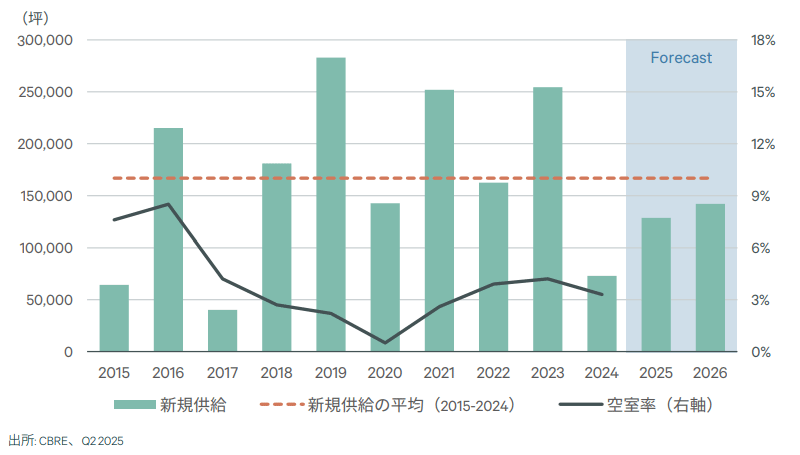
CBRE predicts that the LMT rental market in Chiba Prefecture will continue to maintain a stable supply-demand balance. Based on previous analyses, the proximity to the city center, well-developed infrastructure, ease of securing labor, and diverse tenant sectors are expected to contribute to its continued robustness. The LMT market in Chiba Prefecture is expected to generate new demand through development that takes advantage of its locational characteristics.
<Chiba Prefecture's New Supply Forecast and Vacancy Rate>