


Hakobel announced on October 21 that it has added a "work start/completion time stamping function" to the driver app for its truck reservation/acceptance system, "Truck Log."
<New features included>
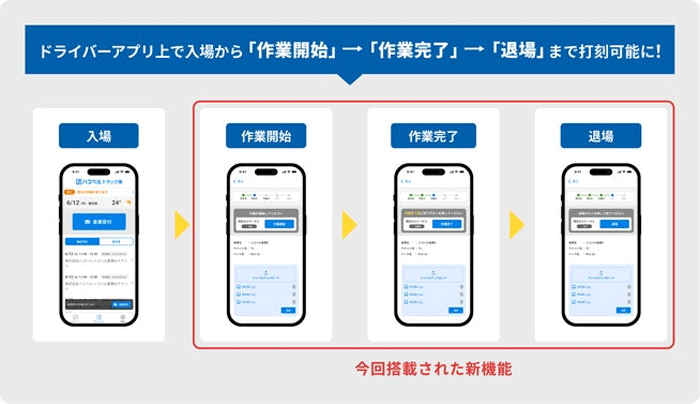
Previously, drivers could clock in upon entry via the driver app, but with this new feature, they can now also clock in at the start, completion, and exit of work. This means that even at sites where warehouse workers are not permanently stationed or where warehouse workers are busy, drivers can clock in at the start and completion of work, allowing for more accurate tracking of loading and unloading times.
This feature requires a subscription to the smartphone reception option. Customers who have already subscribed to the smartphone reception option can use it immediately after the app update.
The background to this is the enforcement of the Logistics Efficiency Improvement Act in April 2025, which aims to address the shortage of transportation capacity in the logistics sector, a social infrastructure that supports people's lives and economic activities. This act calls for three initiatives: improving loading efficiency, reducing waiting times for loading and unloading, and shortening loading and unloading times.
Truck reservation/reception systems are recommended for implementation and use to reduce waiting times for loading and unloading, and are also effective in shortening loading and unloading times. In particular, to shorten loading and unloading times, it is necessary to visualize how much of the time trucks spend on the premises is spent waiting and how much is spent loading and unloading. In typical operation, drivers clock in and out upon entry and exit, and warehouse workers clock in and out upon the start and completion of loading and unloading. However, in automated warehouses where warehouse workers are not always present and loading and unloading is completed solely by drivers, or in sites where warehouse workers are busy, there is a problem in that clocking in and out of the start and completion of work tends to be missed.
With the logistics industry as a whole facing labor shortages, not just among drivers, enabling accurate time stamping not only by warehouse workers but also by drivers has made it possible to collect more precise information.


