


Amidst the accelerating shortage of transportation capacity due to the 2024 problem and labor shortages, two revised logistics efficiency laws (the Logistics Efficiency Law and the Freight Motor Vehicle Transportation Business Law) came into effect in April 2025, followed by the enactment of the revised Subcontracting Law in May, and further changes to the Freight Motor Vehicle Transportation Business Law being passed as the "New Truck Law" in June. These changes represent a gradual progression of legal reforms. Professor Arisa Wakabayashi of Komazawa University Law School, who will participate as a member of the next "Study Group on Comprehensive Logistics Policy Outline," assesses that "appropriate costs and a five-year permit renewal system (the New Truck Law) will have a significant impact on pricing." We interviewed her about the key points of the legal reforms, their impact on the industry, and the responses required of companies. (Interview date: September 4, Location: Komazawa University Law School)
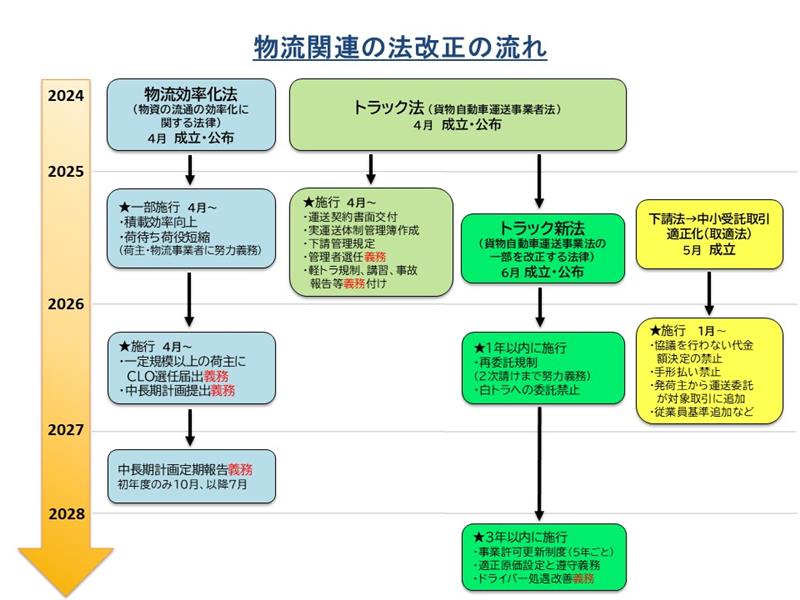
<Flow of legal revisions related to logistics>
The legal changes will have a significant impact on pricing.
Attention is also being paid to the "obligation to make efforts" to restrict the second level of subcontracting.
--As you participate in the upcoming "Study Group on Comprehensive Logistics Policy Guidelines," could you share your impressions of the logistics industry?
Wakabayashi: I'm a researcher in economic law, and I've been involved in discussions on logistics at the Ministry of Land, Infrastructure, Transport and Tourism for about two years now. At first, I thought it was just a case of bullying of subcontractors, but I've gradually come to understand that various circumstances and business practices are intertwined, some of which are not very rational, and others that are incomprehensible from a consumer's perspective. It's a situation that we all have to work together to resolve.
What surprised me most was the problem of the multi-layered subcontracting structure. Goods flow from the top to the bottom layers, but one of the issues is that there is a practice that prevents businesses downstream from bypassing layers and doing business with businesses upstream. I was very struck by the story that some businesses are afraid to even negotiate because they fear being cut off by the businesses that currently provide them with work if they try to bypass layers. I am participating in this event with the belief that now is the chance to change these irrational practices as well.
—Broadly speaking, are these business practices unique to Japan?
Wakabayashi: That's right. It's often said that the concept of "contract" is weak in Japan, and this tendency may be particularly pronounced among small and medium-sized enterprises. In Western countries, it's common for contracts to protect oneself, and for things not written in them to be handled with mutual understanding. However, due to Japan's unique culture, there's a tendency towards ambiguity, or rather, it's not clearly defined what constitutes a contract. Even if there is a contract, it's often not documented in writing, which can lead to situations where it's unclear who is responsible if something goes wrong later.
—Currently , various legal reforms are underway to address industry-wide challenges such as improving business practices and streamlining logistics. What are some of the key points that are expected to impact the industry?
What seems to be a big deal for the Wakabayashi industry is, first and foremost, the pricing. The new revised Freight Motor Vehicle Transportation Business Act (New Trucking Act), which was enacted in June of this year, allows the Minister of Land, Infrastructure, Transport and Tourism to set "appropriate costs," and if appropriate costs are announced, general freight motor vehicle transportation businesses must not accept transportation at fares or charges below that amount. In terms of implementation, if this is linked to the five-year license renewal system for general freight motor vehicle transportation businesses, which was also introduced in this revision, then I think it will be a very significant change.
— How will this differ from the "standard fare"?
Wakabayashi: Up until now, the Ministry of Land, Infrastructure, Transport and Tourism has issued a "standard freight rate," and truck operators have used that as a reference for negotiations. However, I believe that in the Multi-Layer Subcontracting Study Group, only about 6% of the responses indicated that price negotiations were actually successful in some form. Of course, I think that the activities of the Truck and Logistics G-Men could provide some kind of guidance at an earlier stage, but at the very least, the "standard freight rate" was merely a reference and basically had no legal enforceability. On the other hand, if compliance with the law is reviewed when renewing permits after the new Truck Law comes into effect, I think this system will be effective.
--I see. What other points are attracting attention?
Wakabayashi: Similarly, regarding multi-tiered subcontracting, prime contractors have been given an "obligation to make efforts" to keep it within the second tier of subcontracting, but the question is whether that will actually be effective.
In the United States, there are actually regulations limiting the number of subcontracting levels. In the study group, we discussed whether Japan should also limit subcontracting to two or three levels, or even prohibit it to some extent with some degree of enforcement power. However, a new law was enacted in the middle of this discussion, and it was written in a somewhat lenient form as an "obligation to make efforts," so I think it is necessary to follow up to see whether it will actually work.
— What is the legal difference between a "duty to make an effort" and a "duty"?
Wakabayashi: A "duty to make an effort" simply means there is an obligation to make an effort, and it basically has no legal force. However, if a business actually fails to make an effort, the truck and logistics inspectors will provide guidance, so it is not necessarily the same as saying it has absolutely no effect.
Regarding the "duty to make efforts" under the revised Product Efficiency Act, if an investigation is conducted into the status of efforts, it appears that the names of businesses with low scores may also be made public.
—If it becomes mandatory, will it have legal force?
Wakabayashi: That's right. Generally speaking, I think it would be subject to some kind of administrative action, and in some cases, criminal penalties. Given that the multi-layered subcontracting structure has been firmly established as custom and it's difficult for those at the bottom to take action, I thought it would be desirable to make it mandatory to limit subcontracting to the second tier, allowing each party to secure work and contracts through their own ingenuity and resourcefulness. However, I understand that there were opinions that this would be difficult given the current situation. I'm interested to see whether imposing a "duty to make efforts" in the future will actually lead to the elimination of multi-layered subcontracting.
—We also need mechanisms to ensure the effectiveness of legal reforms.
As was also mentioned in the Wakabayashi multi-layered subcontracting study group, I believe that a mechanism for matching needs is necessary, separate from the law. In the case of logistics, the method of transportation differs depending on the characteristics of the goods being transported, so there may be some difficulties, but if a matching system like a taxi app starts to function even partially better than it does now, the situation where people are at the lower layers and can only get work from the same people and therefore cannot negotiate might start to change a little.
The Antimonopoly Act (hereinafter referred to as the "Antimonopoly Act") has a type of violation called "abuse of dominant position." In order to determine a violation, it is necessary that the business operator is in a dominant position, and one of the important criteria for determining this dominant position is how much work the other business operator receives from them (degree of transaction dependence). The lower the degree of dependence, the stronger the bargaining power becomes. As the volume of transactions on matching apps and the like increases, the degree of dependence will decrease, and it will become easier to negotiate prices and so on. I hope that alternative routes of transactions will function well through the power of technology.
However, regarding how to deal with illegal transactions on matching sites, I believe we need to consider holding the sites responsible in some way, rather than simply saying that the sites only provide a platform for intermediaries and therefore bear no responsibility for individual transactions. How to incorporate this into the law and impose obligations is a challenge for the future.
■Related links
Revised Truck Transportation Business Law (Ministry of Land, Infrastructure, Transport and Tourism)
The revised Subcontracting Act expands the scope of transactions.
Violators may receive a "warning" and their company name may be made public.
<Professor Wakabayashi>

--With the amendment to the Subcontracting Act, transactions between shippers and transportation companies are now covered. What kind of impacts and countermeasures can be expected?
Wakabayashi: Up until now, violations of the Subcontracting Act have only covered situations where a logistics company subcontracts work to a lower party. However, this doesn't mean that abusive practices in transactions between shippers and transport companies were not addressed by law. These practices have long been considered potentially subject to the "abuse of dominant position" under the Antimonopoly Act. While this provision is similar in content to the Subcontracting Act, the Subcontracting Act is slightly more flexible in its application.
—What do you mean by "light on your feet"?
If we consider the Wakabayashi Antimonopoly Act, for example, in the case of "abuse of dominant position," the Fair Trade Commission needs to prove whether the business operator truly has a dominant position and whether the actions truly constitute abuse. This requires conducting investigations and gathering evidence, which takes a considerable amount of time. If a violation is found, legal penalties such as surcharges or cease and desist orders are imposed, but if the business operator is dissatisfied, it can lead to a lawsuit, which further delays the determination process. In reality, it was a rather cumbersome law.
In the case of the Subcontracting Act, a subcontracting relationship is defined based on the difference in capital for certain types of transactions, and prohibited acts (such as delaying payment, price reductions, and price gouging) are stipulated. Therefore, there is no need to individually consider whether a company is in a superior position, and the scope is broader than the Antimonopoly Act, which requires consideration of whether there are justifications for prohibited acts. On the other hand, if a violation occurs, the only response is a "recommendation," which is like administrative guidance. However, one significant aspect of the Subcontracting Act is that when a "recommendation" is issued, the company name is made public. In Japan, companies are very reluctant to have their names made public due to the reputational risk. Therefore, even a "recommendation" can be quite effective.
When the outsourcing of services by one transportation company to another became subject to the Subcontracting Act as a service outsourcing agreement, transactions between shippers and transportation companies were not subject to the Subcontracting Act for technical reasons. However, they actually became subject to provisions similar to the Subcontracting Act as a "special designation" under the Antimonopoly Act *1.
This "special designation" was a much more flexible provision compared to the "abuse of dominant position" provision in the Antimonopoly Act that I mentioned earlier, but it hasn't really been effective. Therefore, I think shippers haven't been very aware of the "special designation." In fact, no cease and desist orders have been issued based on "special designations" since the law was introduced in 2004. There were only about two "warnings," which are the step before cease and desist orders, before the revision discussions began, but last November, the Itoki case came up for the first time in a while. *2
*1 Special designation: A system under the Antimonopoly Act in which the Japan Fair Trade Commission specifically designates and regulates unfair trade practices that are problematic in particular business sectors.
*2 Regarding the warning against Itoki
Japan Fair Trade Commission, November 28, 2024 (announcement)
--It seems the shippers will need to review their past transactions.
Regarding the fact that transactions between shippers and prime contractors will be subject to the Subcontracting Act, there are of course various opinions, but from a positive perspective, I think it will send a strong message to shippers. Until now, the industry had a somewhat confusing system where logistics outsourcing from shippers to trucking companies was handled under "special designation," and logistics outsourcing from trucking companies to subcontractors was handled under the Subcontracting Act, but I think this will be eliminated and things will become somewhat clearer with just the revised Subcontracting Act.
--The revised Subcontracting Act also prohibits unilateral price determination.
Wakabayashi: The issue that arose with this amendment to the Subcontracting Act was the case where, amid rising costs due to inflation, some companies "absolutely refuse to raise prices." I think it's the same in every industry, and there was a desire to do something about this. The Fair Trade Commission has dealt with cases where companies unilaterally lower prices as at least "price gouging," but it's still a problem because the other party has a superior position, making it difficult for them to negotiate persistently.
Furthermore, even if prices are raised, there's a possibility that the price will be determined unilaterally, and the increased price won't cover the costs at all. That's why the recent amendment to the Subcontracting Act includes an obligation to properly negotiate.
— If it's "prohibited," will there be penalties?
Wakabayashi: If you violate the "prohibited" items, the Subcontracting Act will issue a "recommendation," and your company name and other information will be made public. The Subcontracting Act also includes an obligation to clearly state the details of the transaction, which is similar to the obligation to provide written documents (amended Freight Motor Vehicle Transport Business Act) that was recently implemented in the logistics sector, but this one also has criminal penalties in place for violations.
Furthermore, this amendment to the Subcontracting Act expands the range of businesses subject to the law. Previously, the criterion for determining whether a business was subject to the Subcontracting Act was the amount of capital, but now the number of employees has been added as a new criterion. (In the case of logistics outsourcing, transactions between businesses with more than 300 employees on the outsourcing side and fewer than 300 employees on the contracting side are subject to the law.) In the future, there may be cases where a business thought that its outsourcing transaction with a trading partner was not subject to the Subcontracting Act based on the amount of capital, but in reality it was. Since the number of employees can fluctuate, it will be necessary to check this when conducting business.
—In the future, written contracts will become important regarding the terms of transactions. By exchanging written agreements, both the client and the service provider can protect themselves.
Wakabayashi: That's absolutely right. In addition to the Subcontracting Act, the Freelance Act has also recently been enacted, so when you outsource to a one-person trucking business in the transportation industry, you need to clearly state the terms of the transaction in writing or by email. The Freelance Act basically applies to all businesses that outsource to freelancers, and the same prohibitions as the Subcontracting Act apply, so the outsourcing company can't just think, "We're not a big company, so it's okay."
— Is it illegal to entrust someone to you over the phone, or to do so verbally?
Wakabayashi : That's right. It would be a violation under both the Subcontracting Act and the Freelancers Act. If a violation occurs, there is a hotline available for freelancers, and they can report it to the contact point. The Subcontracting Act has been amended and renamed the Act on the Proper Operation of Small and Medium-Sized Contracting Transactions, and guidelines will be published on October 1st, with the law coming into effect in January of next year.
Legal reform is not for anyone's benefit, but for society as a whole.
Turning this into an opportunity for safe and sustainable logistics
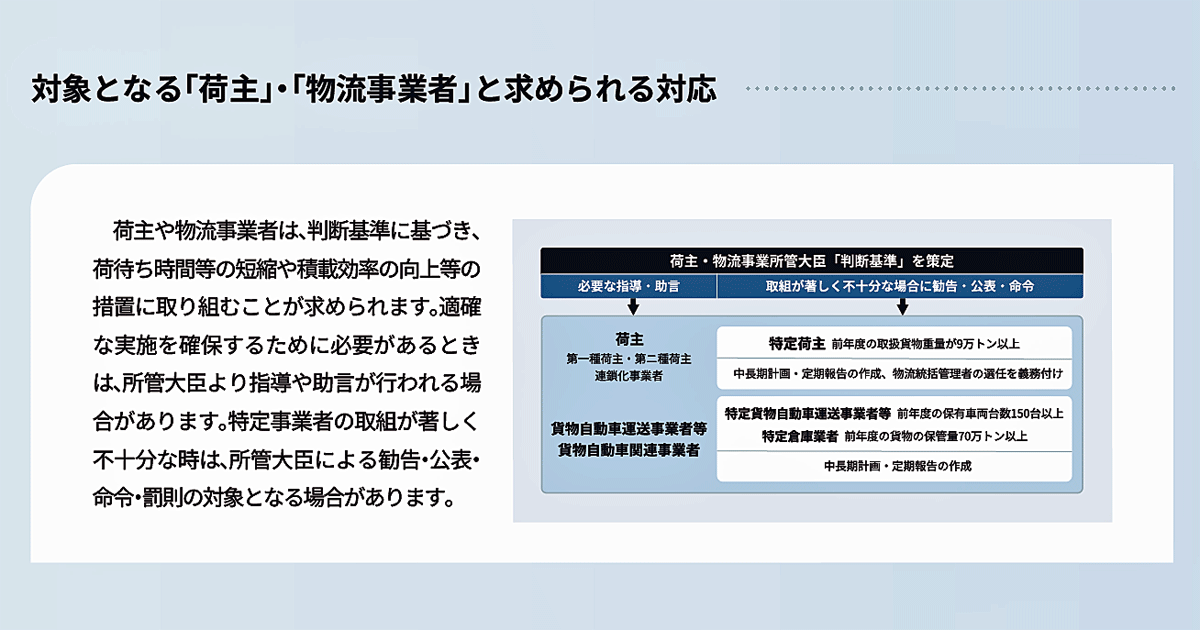
<Target shippers and logistics operators and required actions Source: Portal site for promoting understanding of the "Logistics Efficiency Improvement Act">
--The revised Logistics Efficiency Improvement Act includes regulatory measures for shippers. What are your thoughts on the requirement to appoint a Chief Logistics Officer (CLO)?
It is said that there are approximately 3000 designated shippers in Wakabayashi , but I think the obligation to appoint a CLO will also apply to shippers other than large companies that have legal departments and can properly handle legal matters, i.e., medium-sized shippers. Therefore, I think it will be necessary to develop a CLO training system throughout the industry in the future.
—Besides these obligations, what else should companies be mindful of?
In addition to Wakabayashi shippers, specific businesses including freight trucking companies, warehouse operators, and convenience store headquarters are required to submit regular annual reports on the status of their efforts to improve logistics efficiency.
Furthermore, the creation of medium- to long-term plans is mandatory, and violations of these plans are subject to criminal penalties. If the initiatives outlined in the medium- to long-term plan are insufficient, a "recommendation" will be issued, and if this is not followed without a valid reason, an "order" will be issued. In addition, violations of the "order" are subject to criminal penalties.
In other words, while the initiative itself is merely a "duty to make efforts," a separate system has been established to ensure that certain businesses do not neglect it, and sanctions are ultimately imposed in stages, making it a system that cannot be taken lightly as a mere "duty to make efforts."
—With the legal reforms as a turning point, what will the industry as a whole be working on to improve the efficiency of logistics going forward?
Wakabayashi: Some of the various problems we've faced so far could be solved through things like increased industry efficiency or technological advancements, but others have arisen from a mix of irrational business practices. If we can turn this crisis into an opportunity, I think it would be beneficial for Japanese society.
Another important point is safety. We need to ensure that drivers are properly paid, their working conditions are protected, safety is guaranteed, and that the system functions as a vital part of society's infrastructure.
In the future, as the population declines and rural areas become increasingly isolated, logistics will become more important than ever, not only for industry but also for the lives of individual consumers. I hope that these legal revisions will serve as a catalyst for the logistics industry to become more sustainable.
—Finally , I'd like to ask if there are any guidelines you use when studying law.
Wakabayashi : What I've been thinking about lately is that when it comes to law, we tend to focus on the technical aspects and engage in narrow, focused discussions. But we must always return to the fundamental question of why we are doing it, what purpose does the law serve, and for whom?
—To reiterate, what is the aim of this series of legal reforms?
Wakabayashi: If I were to sum up this legal reform in one word, I would say it's for the benefit of Japanese society as a whole. It's not just for the benefit of subcontractors, nor is it solely for raising wages or freight rates. Rather, it should be a reform that benefits the entire logistics system, including workers, and society as a whole, including consumers. We need to discuss this while considering the consumers who ultimately bear the costs, and at the same time, I believe that consumer awareness also needs to change.
■Related links
Logistics Efficiency Improvement Act Portal Site (Ministry of Land, Infrastructure, Transport and Tourism)
Interview and writing by Terumi Yoshisaka
■ Profile

Arisa Wakabayashi
Professor, Komazawa University Law School
Graduated from the Department of International Relations Law, Faculty of Law, Sophia University; completed an LL.M. at the University of Pennsylvania Law School; and withdrew from the doctoral program at the Graduate School of Law, Sophia University after completing the required coursework. Previously served as an assistant at the Faculty of Law, Rikkyo University, and an associate professor at the Department of Law, Faculty of Humanities, Shizuoka University, before assuming his current position. Since April 2025, he has been a Senior Research Officer at the Competition Policy Research Center, Japan Fair Trade Commission.
My specialties are competition law and economic law. In recent years, my research has focused on issues of business regulation and competition, as well as the abuse of dominant position.


