


Teikoku Databank (TDB) released the results of its survey and analysis of Nissan Motor's supply chain trends on February 31th.
<Number of companies in Nissan Motor's supply chain>

According to a survey by TDB, Nissan Motor Co., Ltd., one of Japan's leading automakers, has a supply chain of 19,141 companies nationwide, an increase of 57 companies compared to February 2025.
Broken down by transaction tier, there were 1800 "Tier 1" companies that do business directly with Nissan Motor, 12,259 "Tier 2" companies that do business with Tier 1 companies, and 5082 companies in "Tier 3 and above."
<Number of companies and their breakdown by sales scale>
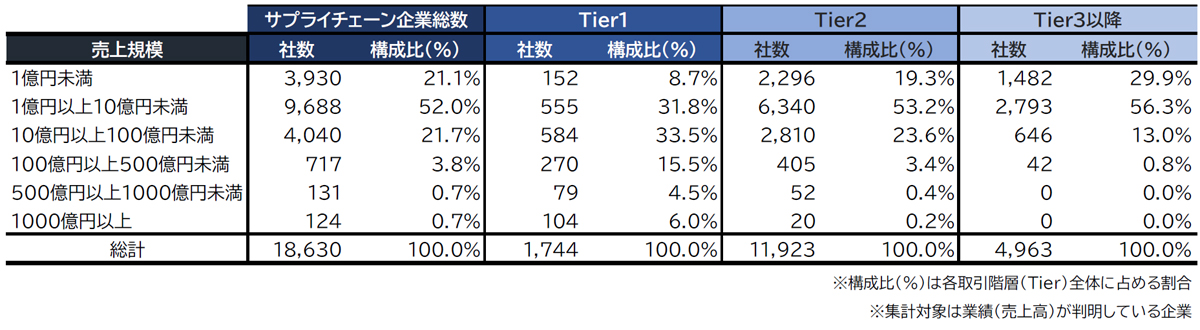
Looking at the companies in the entire supply chain whose sales figures were available, broken down by size, the largest group in Tier 1 was "1 billion to less than 10 billion yen" (584 companies, 33.5%), followed closely by "100 million to less than 10 billion yen" (555 companies, 31.8%).
In Tier 2 and Tier 3 and beyond, the "10 million to less than 1 billion yen" category is the most common, accounting for more than half of the total. Furthermore, in Tier 3 and beyond, small businesses with "less than 1 million yen" account for approximately 3%.
Even considering the total number of companies in the entire supply chain, 13,618 companies, or 73.1%, have annual sales of less than 1 billion yen, highlighting once again the current situation where small and medium-sized enterprises (SMEs) support the supply chain.
<Industry Breakdown (Overall)>
Looking at the companies for which sales figures were available, broken down by industry, the largest group in Tier 1 was "contract software development," with 92 companies (5.3% of the total).
This was followed by "Automotive parts and accessories manufacturing" (68 companies, 3.9%), "Other business services" (66 companies, 3.8%), and "Wholesale of precision machinery and equipment" (51 companies, 2.9%).
In Tier 2, "contract software development" was the top category with 512 companies (4.3%).
The next highest rankings were "Automotive parts and accessories manufacturing" (474 companies, 4.0%) and "General freight trucking" (445 companies, 3.7%).
From Tier 3 onwards, "general freight trucking" topped the list with 493 companies (9.9%), followed by "manufacturing of molds, parts, and accessories" (232 companies, 4.7%) and "manufacturing of metal pressed products" (203 companies, 4.1%).
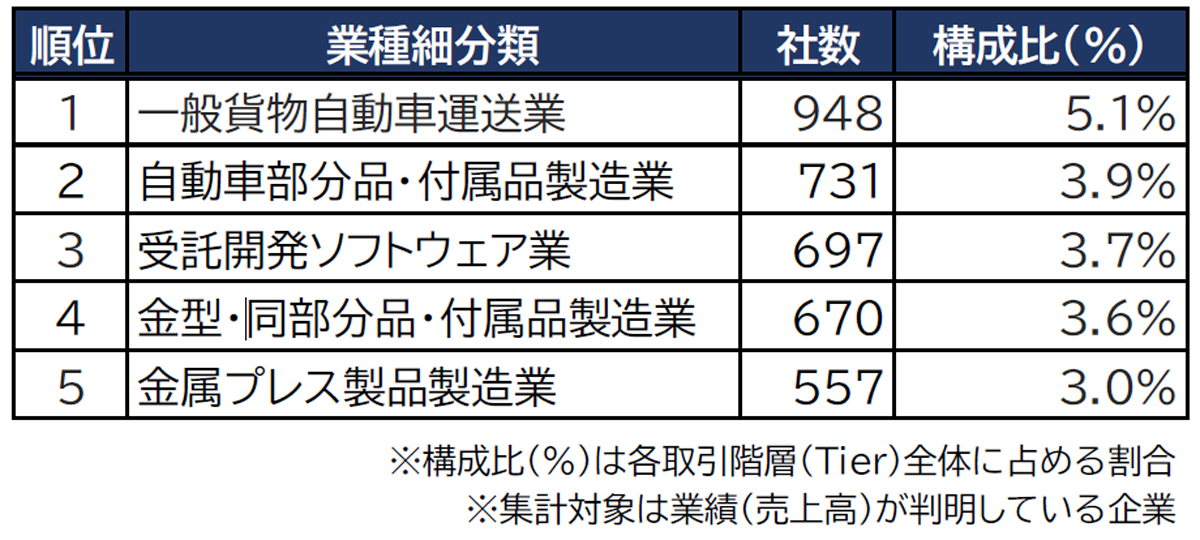
Across the entire supply chain, "general freight trucking" topped the list with 948 companies (5.1%). This was followed by "automotive parts and accessories manufacturing" (731 companies, 3.9%) and "contract software development" (697 companies, 3.7%).
<Number of companies by prefecture (ranked from highest to lowest)>
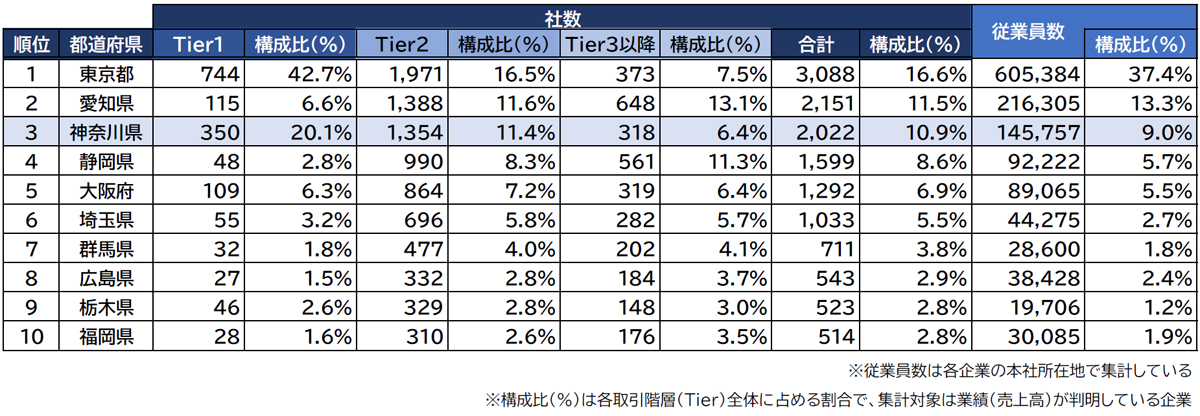
Looking at the companies whose sales figures were available by prefecture, Tokyo topped the list with 3088 companies (16.6%), followed by Aichi Prefecture with 2151 companies (11.5%). Kanagawa Prefecture, where the company's headquarters and Oppama factory are located, accounted for 2022 companies (10.9%), and among Tier 1 companies, it had the second highest number at 350 companies (20.1%), after Tokyo (744 companies).
This survey revealed that Nissan Motor's supply chain has 19,141 companies nationwide, including in Tokyo, Aichi, and Kanagawa prefectures. Of these, over 70% have sales of less than 1 billion yen, confirming once again that many small and medium-sized enterprises support the supply chain.
Furthermore, looking at sales trends from fiscal year 2024 onward, it was found that the percentage of companies with increased revenue decreased by 8.3 percentage points from the previous period, while the percentage of companies with decreased revenue increased by 3.1 percentage points.
As Nissan Motor Co., Ltd. promotes its management restructuring plan, "Re:Nissan," it is expected that some businesses will be affected by the restructuring of their supply chains as the company moves towards full-scale management reconstruction, including the reorganization and efficiency improvements of its vehicle production plants and the revamping of its development processes.
While suppliers are required to shift their strategies to survive and create growth opportunities, attention is increasingly focused on the trends in the automotive industry and its suppliers, given concerns about intensifying competition with the global market over technology development and costs, as well as the impact of Trump's tariffs.
Nissan Motor's supply chain: High proportion of general freight trucking subcontractors.


