


Booost, a company that supports companies' Sustainability Transformation (SX), launched "booost Logistics," a solution specifically for the logistics and transportation industry, on November 5th. It enables the creation of a system that allows for the unified calculation and management of greenhouse gas (GHG) emissions from in-house transport (Scope 1) and outsourced transport (Scope 3), as well as energy consumption based on the Energy Conservation Act, supporting shippers in calculating energy consumption and emissions related to transportation.
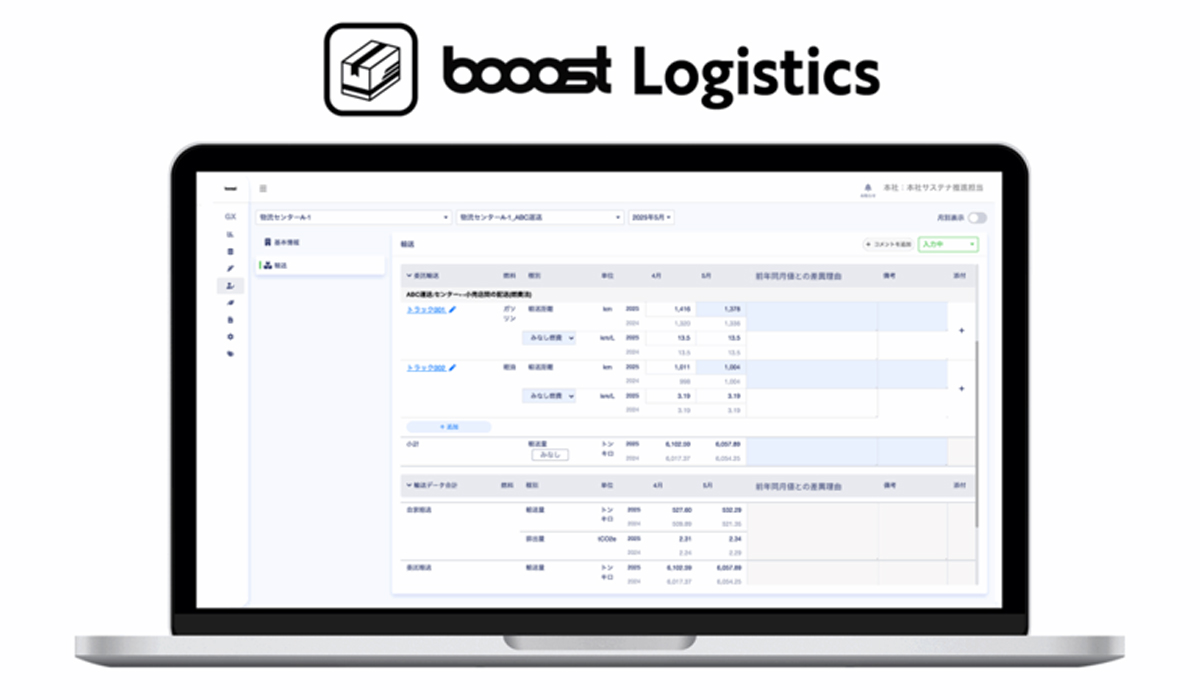
<Screenshot of "booost Logistics">
Under the Energy Conservation Act, "specific shippers" with an annual transport volume exceeding a certain level are required to periodically report their energy consumption. However, in industries such as food and distribution, where outsourced transport is prevalent, cumbersome communication using Excel spreadsheets with outsourced transport companies has become commonplace, resulting in highly individualized and inefficient operations.
In recent years, there has been a growing need to calculate Scope 3 emissions, and there is a demand for the visualization of Category 4 (procurement transportation) and Category 9 (outbound transportation) in accordance with the GHG protocol. Therefore, we have developed a new function to visualize transportation emissions.
"booost Logistics" is a transportation emissions visualization module developed by Booost that allows for centralized management of "Scope 1 and 3" emissions and supports automatic output of reports required by the Energy Conservation Act. It also allows for input of activity data for each mode of transport (truck, ship, rail, and aviation) and calculations using various calculation methods (fuel method, fuel consumption method, improved ton-kilometer method, and conventional ton-kilometer method).
The system allows for recording and summarizing the activity levels of contracted transportation companies on a vehicle-by-vehicle basis, and supports various calculation methods such as the fuel method, fuel efficiency method, and ton-kilometer method.
It can output data in a format optimized for the Energy Conservation Law, the Global Warming Countermeasures Law, and the Fluorocarbon Law Electronic Reporting System (EEGS), and supports the calculation of not only emissions but also "energy usage," which is a reporting obligation for certain shippers.
Going forward, we will work towards further refining Scope 3 emissions by addressing emissions associated with refrigerant leaks during transportation and life cycle emissions (LCI) associated with the manufacturing of vehicles and facilities.


