


On November 7, the Ministry of Land, Infrastructure, Transport and Tourism held the 86th Basic Policy Subcommittee meeting of the Road Division of the Social Infrastructure Development Council. There, they shared information on the current situation and challenges surrounding the special vehicle traffic permit system and discussed measures to promote registration under the "Special Vehicle Traffic Confirmation System" (Confirmation System), which is currently used by only about 1% of vehicles.
Vehicles exceeding the "general limits" of 2.5m in width, 12m in length, and 3.8m in height are treated as special vehicles and require permits to pass through traffic. The annual number of permits issued for special vehicles, which was 940,000 in fiscal year 2014, is projected to more than double to 211 million in fiscal year 2024, and this number is expected to continue to increase due to factors such as a shortage of drivers.
<Trends in permits for special vehicles>
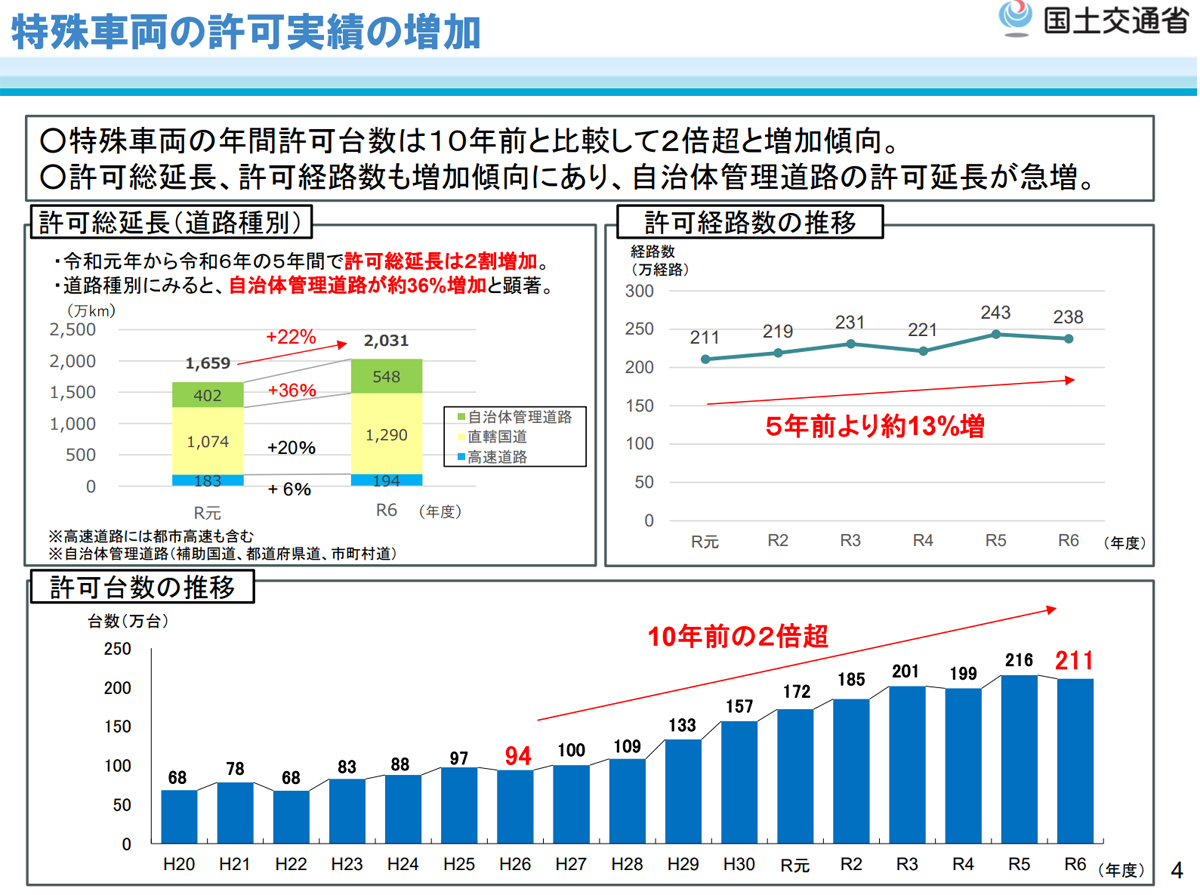
Under the "Special Vehicle Traffic Permit System" (permit system), transportation companies and others are required to apply for each route, but because the review process is paper-based and involves consultations with local governments, it takes an average of 34 days from application to permit approval, and there have been calls for improvement for some time.
In light of this situation, the Ministry of Land, Infrastructure, Transport and Tourism launched the "Special Vehicle Traffic Confirmation System" in 2022, which uses electronically stored information on passable roads to show routes. Users register their vehicle (valid for 5 years, 5000 yen per vehicle), enter their departure and arrival points and weight online, and are immediately shown the results of either a "two-point two-way two-route search" (600 yen per year) or a "prefecture search" (400 yen per year). No permission is required if driving on the route displayed on the map.
On the other hand, the use of the verification system remains at only about 1% of the total number of special vehicle trips, indicating that it is not yet widely adopted.
An analysis of requests from the All Japan Truck Association and the results of interviews with the Japan Federation of Certified Administrative Procedures Specialists revealed several issues, including: "The verification system is more expensive than the permit system (200 yen)," "Many places have not registered the data necessary for the verification system," and "While the permit system requires vehicle information to be entered per model, the verification system requires it per vehicle, which is time-consuming."
The Ministry of Land, Infrastructure, Transport and Tourism has indicated directions for the future of the permit and confirmation system, including "automating all reviews except those that cannot be automated through the confirmation system," "considering revisions based on user needs," and "unifying the application system so that applications for both the permit and confirmation systems can be made in one place." At the Basic Policy Subcommittee meeting, members expressed their opinions on how to realize these plans.
Regarding the fees, some opinions included: "The 5000 yen registration fee for the verification system over five years is not high as a business expense," "How about setting it at 1000 yen per year to make it easier to try?", and "With postal rates rising, 200 yen for the permit application is cheap."
Furthermore, some suggested that the permit period for "important logistics roads," which exempt international maritime container vehicles (40-foot high-cube) from requiring permits in designated sections, should be revised from the current "two years in principle, four years for excellent operators" to "four years in principle, two years for problematic operators."
Other suggestions included the need to consider creating public data utilizing information obtained from ETC2.0, which is a prerequisite for using the verification system.


