


Jones Lang LaSalle (JLL) released its Q12 2025 market summary, "Logistics Market Dynamics (Tokyo, Osaka, Fukuoka)," on February 3.
<Supply and Demand Trends in Tokyo>
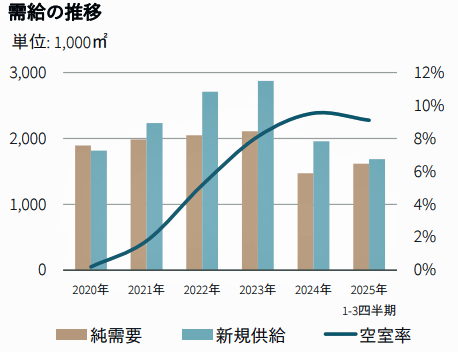
In the Tokyo market, strong demand continued, with net demand reaching 696,000 m2 in the third quarter of 2025. Lowering rents stimulated new demand, resulting in demand exceeding new supply. Rising transportation costs have led to increased demand for properties located close to the city center, while demand for properties in surrounding areas with longer transportation distances has weakened, with some properties taking nearly two years to reach full occupancy.
In the third quarter of 2025, a total of 472,000 m2 of new housing was supplied across four buildings, with two in the bay area and the remaining two in the inland area. The vacancy rate for the entire Tokyo metropolitan area was 9.1%, a decrease of 116 basis points compared to the previous quarter and a decrease of 79 basis points compared to the same period last year. The vacancy rate in the bay area decreased by 16 basis points to 8.3%, while the vacancy rate in the inland area decreased by 155 basis points to 9.4%.
<Supply and Demand Trends in Osaka>
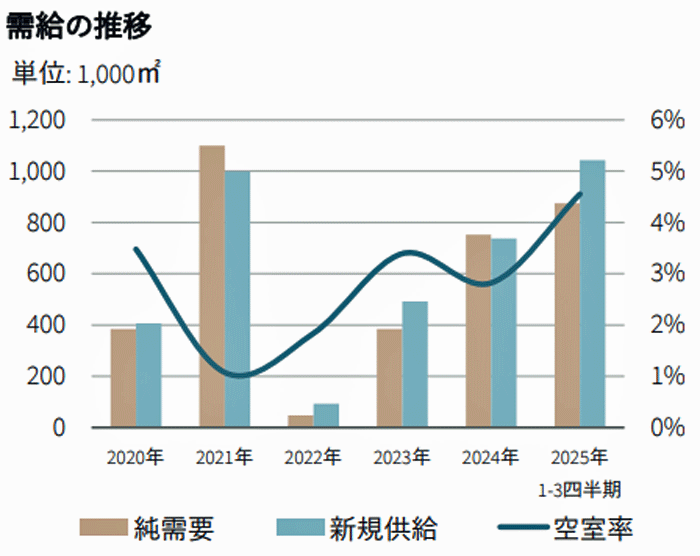
In the Osaka market, strong demand and a large volume of new supply led to net demand of 236,000 m2 in the third quarter of 2025. Demand is seen from a variety of sectors, including e-commerce companies, 3PL companies, and retailers.
In the third quarter of 2025, a total of 345,000 m2 of new housing was supplied across three buildings, bringing the total stock area to 8,069,000 m2, a 4.5% increase compared to the previous quarter. As vacancies in existing properties were absorbed and newly supplied properties were completed with generally high occupancy rates, the vacancy rate for the Osaka area as a whole fell by 37 basis points compared to the previous quarter to 4.6%. This represents an increase of 153 basis points compared to the same period last year.
<Supply and Demand Trends in Fukuoka>
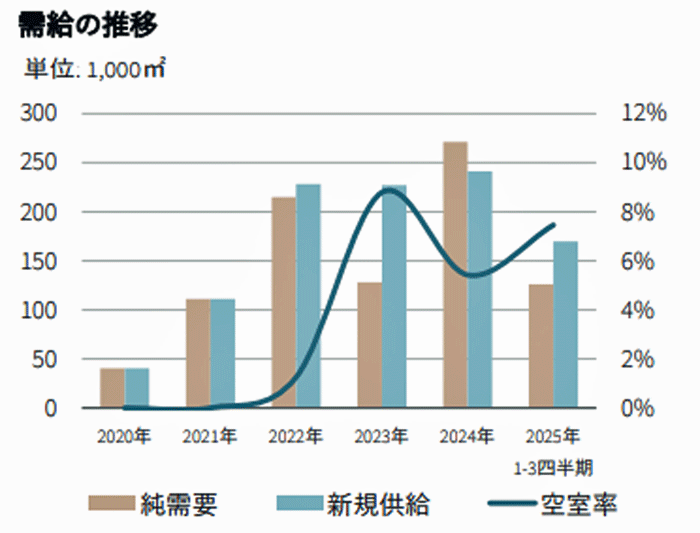
In the Fukuoka market, new supply exceeded net demand. This quarter, new supply amounted to approximately 8 m2, while net demand remained at only about 4000 m2.
With the addition of Logi Station Fukuoka Ogori, the total stock area increased by 11.0% year-on-year to 1,688,000 m2. Consequently, the vacancy rate for the entire Fukuoka area rose to 7.5%, an increase of 440 bps compared to the previous period and 200 bps compared to the same period last year. However, this increase is largely due to the impact of newly supplied properties, and the occupancy rate of existing properties remains strong.


