


Teikoku Databank (TDB) announced on November 17 that as of October 2025, 51.6% of companies will face a shortage of regular employees, and 28.3% will face a shortage of non-regular employees.
<Monthly trends in the ratio of labor shortages for regular and non-regular employees>
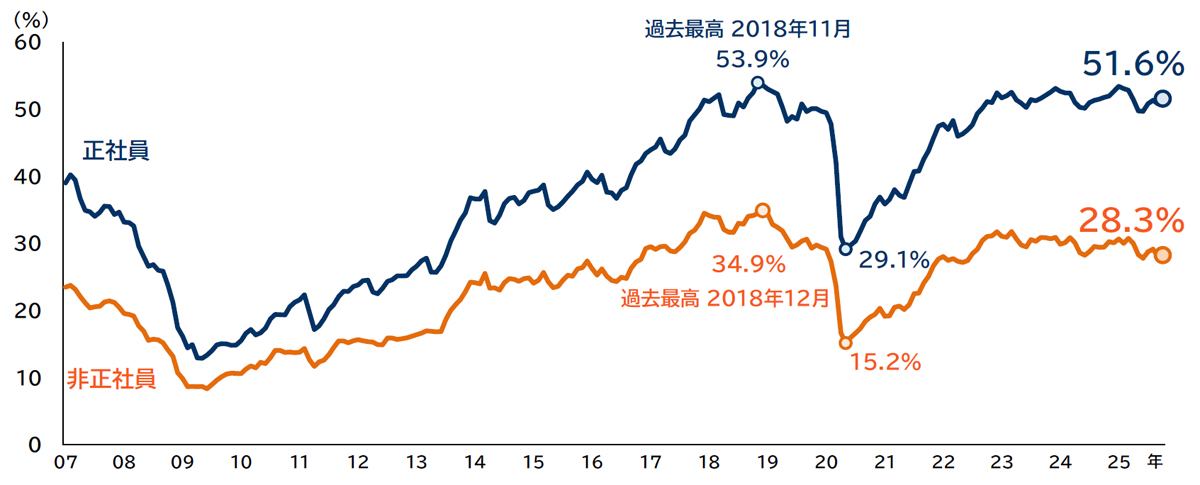
The labor shortage remains a serious and persistent problem. As of October 2025, 51.6% of companies are reporting a shortage of full-time employees, exceeding half for the fourth consecutive year in October.
Although the change was small, falling by only 0.1 percentage points from 51.7% in the same month of the previous year, it remains at a high level.
Furthermore, the labor shortage rate among non-regular employees was 28.3%, a decrease of 1.2 percentage points from the same month last year, and the second consecutive year that it has fallen below 30% for October.
<Percentage of labor shortages by industry. "Transportation and warehousing" shows a slight increase compared to the previous year.>
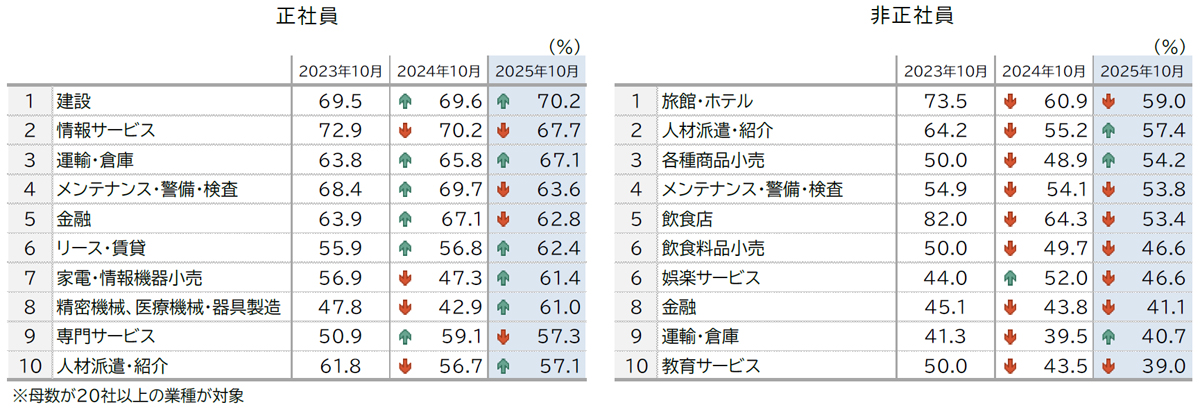
By industry, the construction industry had the highest percentage of companies feeling a shortage of full-time employees, at 70.2% (up 0.6 percentage points from the same month last year). Companies cited reasons such as, "We can't accept orders even if we have projects due to the labor shortage. We can't reflect the increase in labor and material costs in our order prices" (civil engineering, Nara Prefecture), and "We have many projects, but the client's budget and the construction costs don't match. If material costs, labor costs, and the shortage of skilled workers continue to rise, we may have to refrain from accepting orders, which could lead to a decrease in sales" (wooden building construction, Nagano Prefecture).
The "Transportation and Warehousing" sector, which is suffering from a severe driver shortage, remains at a high labor shortage rate of 67.1%, a 1.3 percentage point increase from the previous year, approaching the figure for the second-ranked "Information Services" sector. Overall, eight out of 51 industries exceeded 60% in terms of labor shortages.
Amidst these circumstances, 214 bankruptcies due to labor shortages occurred in the first half of fiscal year 2025 (April to September), marking the third consecutive year of record highs for the first half of the year. Furthermore, looking at the full year, the cumulative total from January to October 2025 has already reached 359 cases, surpassing the 342 cases in 2024 and marking the third consecutive year of record highs.
Some lament the shortage of young talent, saying, "Many young people are going to work for large corporations, so even when we post job openings, we don't get any applicants" (paving work, Iwate Prefecture). Others say, "We're getting a lot of projects, mainly from the Tokyo metropolitan area, but we don't have enough personnel with the right skills, so we haven't been able to secure any orders. This is because we can't secure talented personnel" (software development outsourcing, Niigata Prefecture), indicating a fierce competition for highly skilled personnel.
With young talent flowing to the Tokyo metropolitan area, it is becoming increasingly difficult to recruit skilled full-time employees, particularly in regional areas, and the shortage of full-time workers is expected to remain high in the future.


