


Nippon Express announced on November 25 that it will launch a modal combination transport service called "Sea & Rail Shin Nihonkai Route (Niigata Port - Tomakomai East Port)" on December 1, in collaboration with Shin Nihonkai Ferry.
<Announcement regarding the new Japan Sea Route (Niigata Port - Tomakomai East Port)>
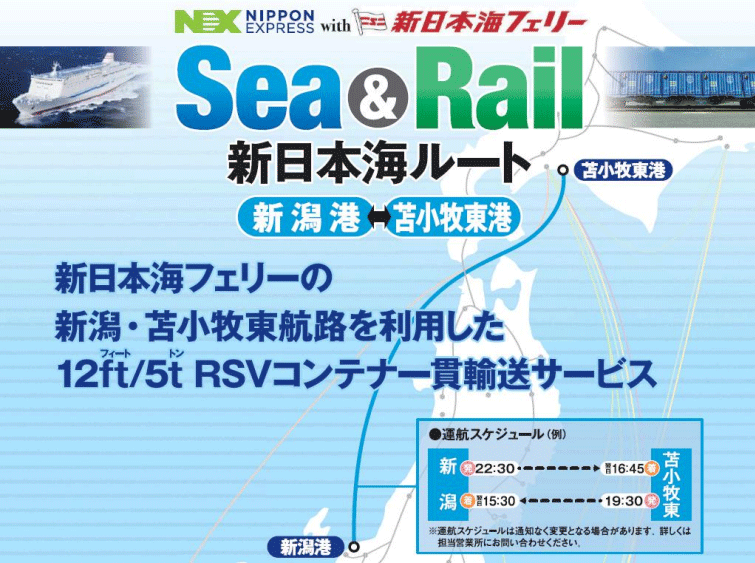
This situation stems from the anticipated future labor shortage, fueled by stricter regulations on overtime work for truck drivers, making long-distance truck transport a major challenge. In this context, Nippon Express, in collaboration with Shin Nihonkai Ferry, has developed a new modal combination transport service, the "Sea & Rail Shin Nihonkai Route (Niigata Port - Tomakomai East Port)," which traverses the Tsugaru Strait. This service can be used to address both environmental concerns and future labor shortages.
The Sea & Rail service is characterized by its environmentally friendly transportation service that contributes to reducing CO2 emissions, thus supporting customers' sustainability management. It is also an effective measure to address regulations on overtime hours for truck drivers. By duplicating transportation routes and avoiding sections that would be disrupted in the event of a disaster, it is also effective for business continuity planning (BCP). By using Nippon Express's proprietary RSV container, which can be used on both rail and sea, cargo can be shifted between rail and sea without unloading or transshipping. By combining it with rail and truck transport, it is possible to handle collection and delivery even in locations far from ports.
Going forward, they plan to develop new routes in cooperation with shipping and ferry companies, and work to further expand their "Sea & Rail" service.


