


Concepts for improving productivity in truck transportation
The "Guidelines on Productivity Improvement Measures in Truck Transportation (March 2017)" from the Freight Division of the Road Transport Bureau (now the Logistics and Road Transport Bureau) of the Ministry of Land, Infrastructure, Transport and Tourism outlines the productivity of truck transportation in four stages.
These are (1) when viewed per truck, (2) when viewed by truck operating time, (3) when viewed by truck driving conditions, and (4) when viewed by truck loading conditions (see Figure 1).
Let's consider these points one by one.
<Figure 1: Ministry of Land, Infrastructure, Transport and Tourism's approach to productivity improvement>

(Source): Ministry of Land, Infrastructure, Transport and Tourism, Road Transport Bureau, Freight Division, "Guidelines on Productivity Improvement Measures in Truck Transportation" (March 2017) [Reference Material 1)]
(1) Actual operating rate
The operational rate is calculated by distinguishing between the truck's operating time (time spent on business) and non-operating time (time spent in storage, maintenance, etc.), and expressing it as "(operating time) ÷ (operating time + non-operating time)".
To increase the operational efficiency, it is necessary to increase the number of times trucks are used (turnover rate) or to increase the operating time itself through longer usage periods (see Figure 2).
However, focusing solely on operating hours can sometimes lead to other metrics performing poorly.
For example, in urban deliveries, it's common for cargo volume to be high on Mondays and Fridays (e.g., 4-ton trucks) and low on other days (e.g., 2-ton trucks). If the same 4-ton truck is used every day, the utilization rate will be high from Monday to Friday, but the load rate will be only 50% on days other than Monday and Friday. Conversely, one could use a combination of 4-ton and 2-ton trucks for deliveries on different days of the week to increase the load rate, but this would result in a lower utilization rate.
(2) Vehicle utilization rate (per hour)
The vehicle utilization rate (per hour) is the ratio of driving time to the total operating time of a truck, and is calculated as "(driving time) ÷ (driving time + non-driving time)".
To increase the vehicle utilization rate (per hour), non-driving time (rest time, loading/unloading time, waiting time for loading/unloading, etc.) must be reduced, but rest time cannot be reduced. Therefore, reducing loading/unloading time and waiting time for loading/unloading is essential.
(3) Vehicle utilization rate (per distance)
The vehicle utilization rate (per distance) is the ratio of the total distance traveled by a truck when it is loaded with cargo, and is calculated as "(distance traveled when loaded with cargo) ÷ (distance traveled when loaded with cargo + distance traveled when not loaded with cargo)".
To increase the vehicle utilization rate (per mile), it is necessary to minimize the distance traveled by empty (unloaded) vehicles. Therefore, the introduction of matching systems to secure return cargo and joint transportation services is required.
(4) Loading rate
The load factor is the ratio of the amount of cargo loaded to the truck's maximum load capacity, and is calculated as "(load capacity) ÷ (maximum load capacity)". It is often expressed in terms of weight, but can also be expressed in terms of volume.
To increase loading efficiency, cargo should be transported in batches and fully loaded. Therefore, when frequent small-lot shipments are necessary, it is necessary to consider consolidating various types of cargo or collaborating with other companies for transportation.
Furthermore, cargo can be categorized into "weight-dominant cargo" (cargo that is heavy but has a small volume) and "volume-dominant cargo" (cargo that is light but bulky). Therefore, combining heavy and light cargo can potentially increase both the weight-based and volume-based loading rates, but choosing the right cargo combination is difficult.
<Figure 2: Measures to improve productivity in truck transportation>
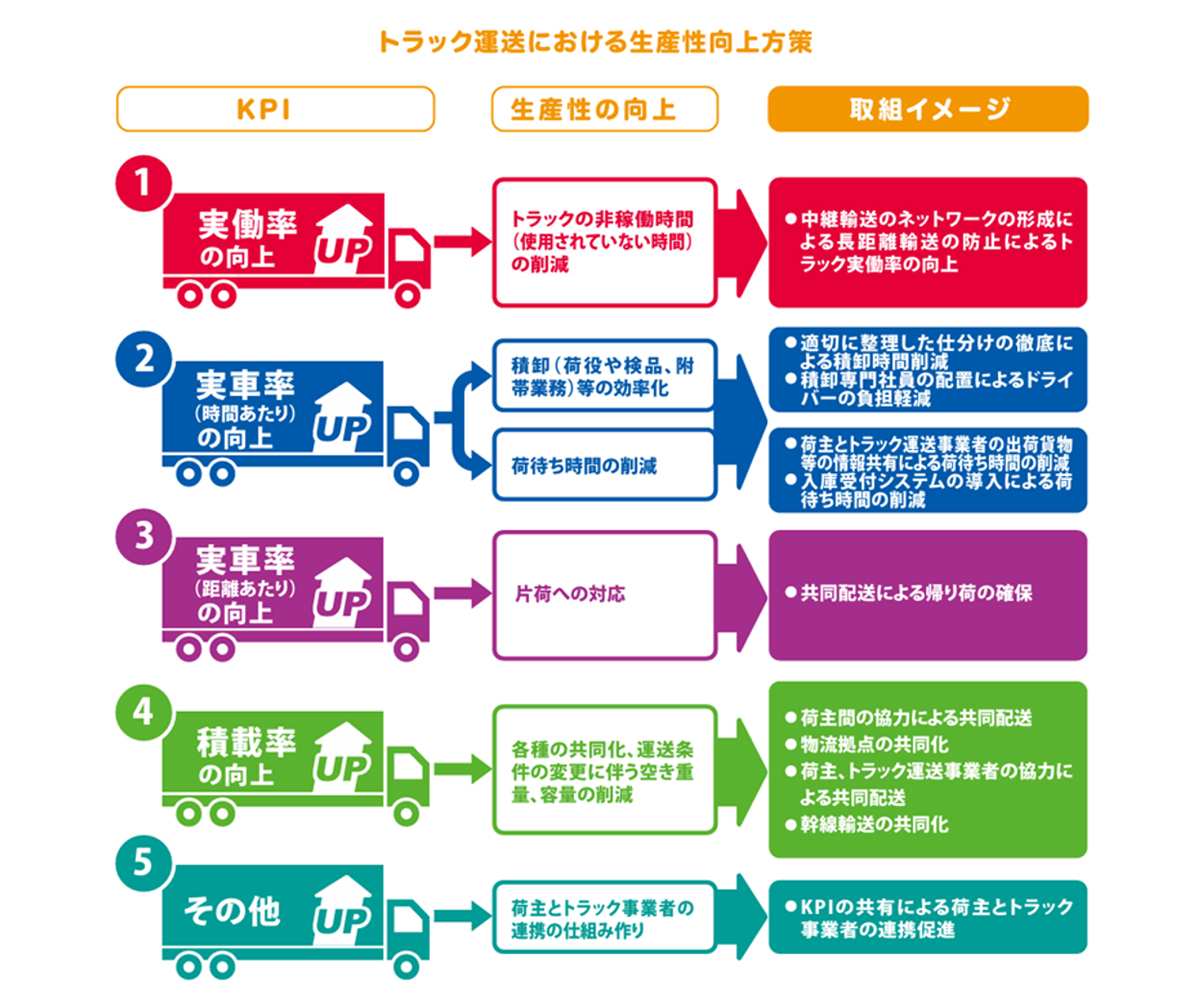
(Source): Ministry of Land, Infrastructure, Transport and Tourism, Road Transport Bureau, Freight Division, "Guidelines on Productivity Improvement Measures in Truck Transportation" (March 2017) [Reference Material 1)]

[Appendix]: Understanding the Challenges of Logistics Through Numbers and Graphs
(Part 15) The concept behind the formula for calculating loading efficiency
Nobuko Kosugi, Professor, Faculty of Economics, Chuo University
Definition of loading efficiency by the Ministry of Land, Infrastructure, Transport and Tourism
The Ministry of Land, Infrastructure, Transport and Tourism defines loading efficiency (transportation efficiency) as "the ratio of actual transportation activity (ton-kilometers) to the transport capacity of a vehicle," and expresses it as a percentage using the formula "(transportation ton-kilometers) ÷ (capacity ton-kilometers) × 100." However, if loading efficiency is expressed as a percentage, the "×100" is unnecessary. [Reference Material 2)]
Expressing the load factor as a percentage, it can be transformed as follows. If we name the distance traveled while loaded as the "distance ratio" relative to the total distance traveled, then the load efficiency is the product of the "load factor" and the "distance ratio" (see Equation 1).
The Ministry of Land, Infrastructure, Transport and Tourism also defines loading efficiency (transportation efficiency) as "(loading rate) × (actual vehicle utilization rate)" (see Equation 2).
Furthermore, by rearranging the formulas, it can be seen that the "formula using ton-kilometers (Formula 1)" and the "formula using load factor and vehicle utilization rate (per distance) (Formula 2)" are the same. In addition, by using the "mileage ratio" to calculate the load factor, it becomes easier to calculate the load factor over the entire travel distance, even when the load factor changes due to loading and unloading during transport.

Loading efficiency when there is no loading or unloading during transport (Example 1: No loading or unloading)
Let's consider the loading efficiency when there are no loading or unloading operations during cargo transport.
As an example, consider the case where the load rate is 80% and the distance traveled is 100km. In this case, the load efficiency is 0.80 (load rate 0.80, distance traveled ratio 1.00) (see Figure 3).
<Figure 3 Loading efficiency when there is no loading or unloading during transport (Example 1: No loading or unloading)>

Loading efficiency when loading and unloading occur during transport (Example 2: 1 loading/unloading operations)
Let's consider the loading efficiency when the load rate changes due to loading and unloading of cargo during freight transport. In such cases, we can calculate the loading efficiency for each section of the journey with a different load rate, and then sum them up to find the overall loading efficiency for the entire journey (see Equation 3).
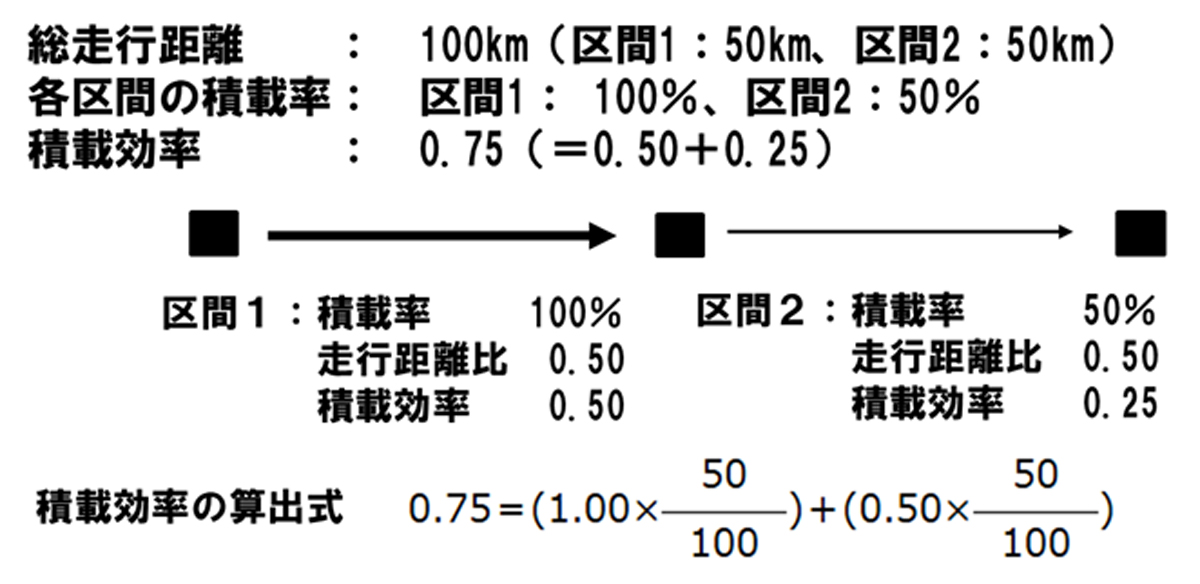
As an example, consider a case where, out of a total distance of 100km, section 1 has a load factor of 100% and a distance of 50km, and section 2 has a load factor of 50% and a distance of 50km. In this case, the load efficiency for section 1 is 0.50 (load factor 1.00, distance ratio 0.50). Also, the load efficiency for section 2 is 0.25 (load factor 0.50, distance ratio 0.50). From this, the load efficiency for the entire journey is 0.75 (= 0.50 + 0.25) (see Figure 4).

<Figure 4 Loading efficiency when loading and unloading occur during transport (Example 2: 1 loading/unloading)>
Loading efficiency when loading and unloading occur during transport (Example 3: 2 loading/unloading operations)
Next, let's consider the loading efficiency when there are two loading/unloading stops during transport, and the loading rate changes at each stop. In this case as well, we can calculate the loading efficiency for each section of the journey with different loading rates, and then sum them up to find the overall loading efficiency for the entire journey.
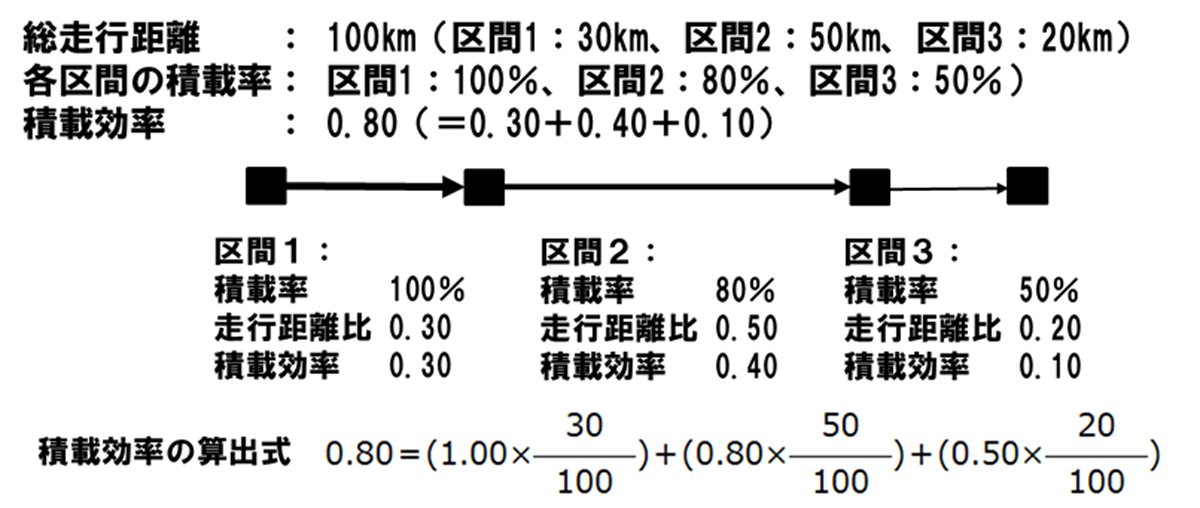
As an example, consider a case where, out of a total distance of 100km, section 1 has a load factor of 100% and a distance of 30km, section 2 has a load factor of 80% and a distance of 50km, and section 3 has a load factor of 50% and a distance of 20km. In this case, the load efficiency for section 1 is 0.30 (load factor 1.00, distance ratio 0.30), the load efficiency for section 2 is 0.40 (load factor 0.80, distance ratio 0.50), and the load efficiency for section 3 is 0.10 (load factor 0.50, distance ratio 0.20). From this, the load efficiency for the entire journey is 0.80 (= 0.30 + 0.40 + 0.10) (see Figure 5).
<Figure 5 Loading efficiency when loading and unloading occur during transport (Example 3: 2 loading/unloading)>
Concepts and general formulas for improving loading efficiency
The loading efficiency over the entire route (loading efficiency in a single trip) is, as shown in Equation 3, the "sum of the product of the loading rate and distance ratio for each section." In other words, it will vary depending on the magnitude of the loading rate and distance ratio for each section, so to improve loading efficiency, it is necessary to "increase the loading rate for each section" and "increase the distance traveled in sections with high loading rates."
Finally, the formula for calculating loading efficiency can be generalized as follows:
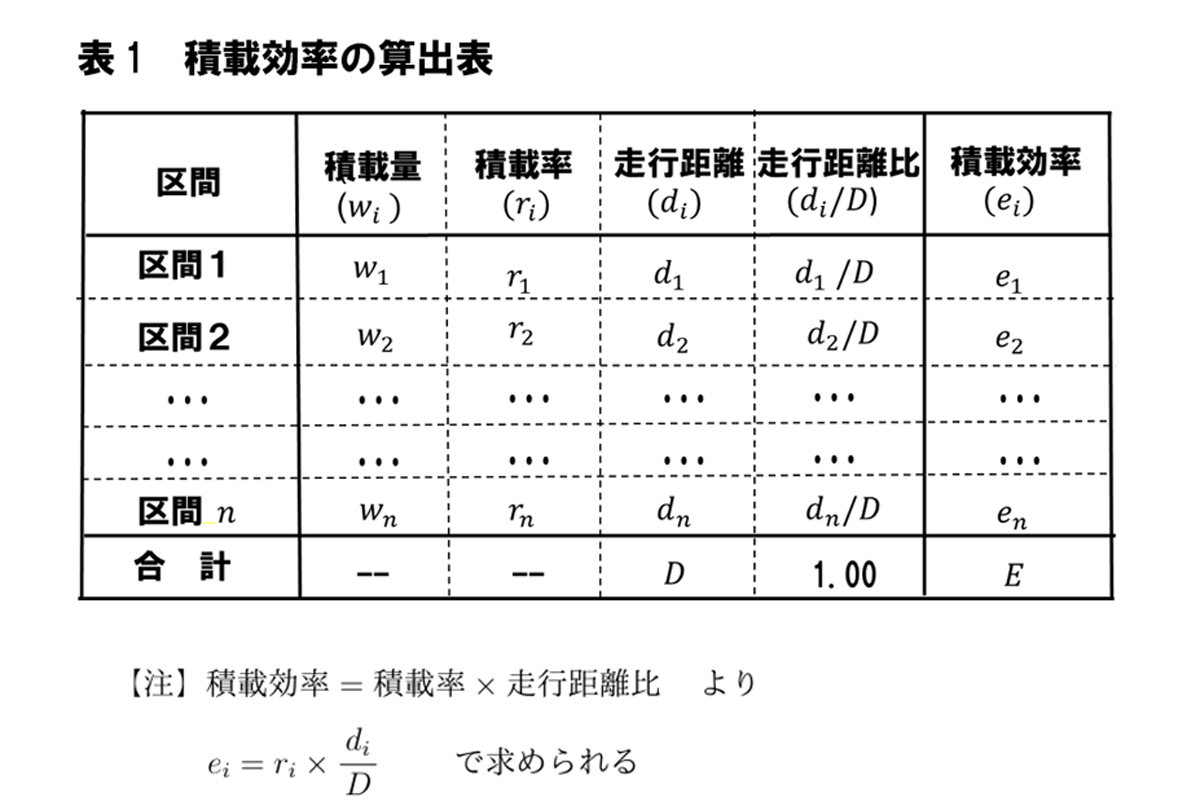
Let E be the loading efficiency for the entire journey , W be the load capacity , and D be the total distance traveled . Let n be the total number of sections divided by loading and unloading points during transport . Let w be the load capacity in section i , d be the distance traveled in section i , and ri be the loading rate in section i . If e is the loading efficiency for each section , then the following equation holds (see Equation 4).
The loading efficiency based on this formula can also be shown using a table (see Table 1).

<Table 1: Calculation Table for Loading Efficiency>
Reference document
1) Ministry of Land, Infrastructure, Transport and Tourism: Guidelines on measures to improve productivity in truck transportation.
https://www.mlit.go.jp/common/001189107.pdf
2) Ministry of Land, Infrastructure, Transport and Tourism, Automobile Transport Statistics Survey
https://www.mlit.go.jp/k-toukei/jidousya_yougo.html


