


The 15th International Conference on Logistics and Transportation (ICLT) 2025, one of the most prestigious international conferences in the Asia-Pacific region in the field of logistics and transportation, is being held for three days from November 26th at the University of Tokyo's Hongo Campus.
Co-sponsored by Thammasat University and Chiang Mai University in Thailand, which established ICLT in 2009, as well as the Northeast Asian Logistics and Distribution Research Institute at Chung-Ang University in South Korea and the University of Tokyo, this will be the third time the event is held in Japan, following Kyoto in 2013 and Okinawa in 2018.
<"ICLT2025" to be held at the University of Tokyo>

<Researchers from around the world gather>
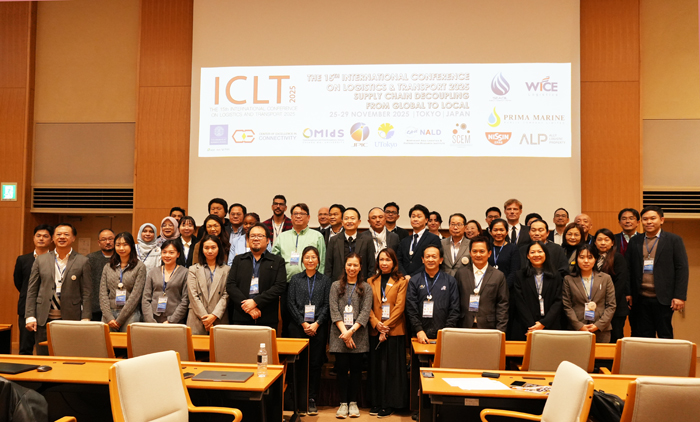
Approximately 60 participants from over 10 countries worldwide, including researchers, government officials, and business practitioners, attended the conference. Focusing on the theme of "supply chain decoupling," which is being affected by geopolitical risks, trade friction, and pandemics, keynote speeches and presentations of the latest research were held to deepen discussions on logistics strategies in Asia and the world.
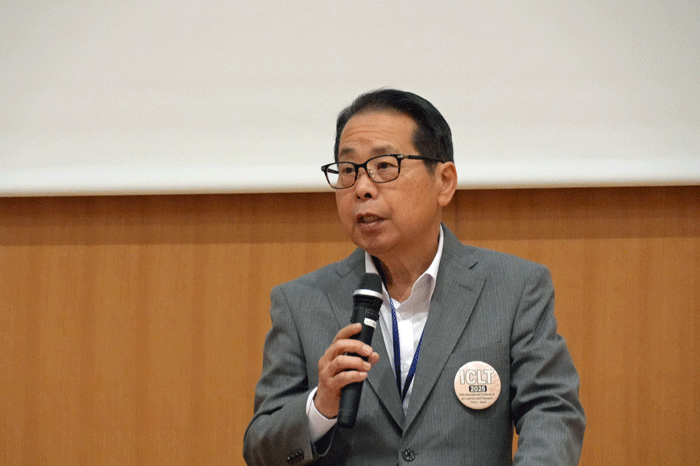
At the opening ceremony, Professor Emeritus Takayuki Mori of Ryutsu Kagaku University, who served as the chairman of the organizing committee, gave a speech. "This year's theme perfectly summarizes the important challenges and transformations facing our industry. Over these three days, I hope that more than 30 presentations will foster active exchange of ideas and new collaborations. The true value of ICLT lies not only in paper presentations, but also in dialogue and relationship building outside of the conference room," he said, emphasizing the significance of the event.
<Professor Emeritus Takayuki Mori>
Next, Takayuki Hirabayashi, Director of the Consumer and Distribution Policy Division and Director of the Logistics Planning Office, Commerce and Service Group, Ministry of Economy, Trade and Industry, took the stage. He delivered a keynote speech titled "The Physical Internet: Shaping the Future of Logistics in Japan." Director Hirabayashi explained that, in light of Japan's logistics challenges and the 2024 problem, the ministry is working on the Physical Internet as a next-generation logistics system, and described the roadmap formulated for implementation in 2040 and the vision for that future.
<Mr. Hirabayashi, Section Chief, Commerce and Service Group, Ministry of Economy, Trade and Industry>

Furthermore, Charlie Chang, co-founder and CEO of Taiwanese logistics developer Ally Logistics Property (ALS), presented on "Smart Logistics Infrastructure," showcasing the company's advanced logistics solutions and services. ALS has developed its large-scale automated warehouse model "OMEGA" in Taiwan, Malaysia, Thailand, and other countries, expanding its network throughout Asia. The company also established a Japanese subsidiary in August of this year and is planning to develop properties in the Tokyo metropolitan area.
<Taiwanese logistics developer also presents case study>
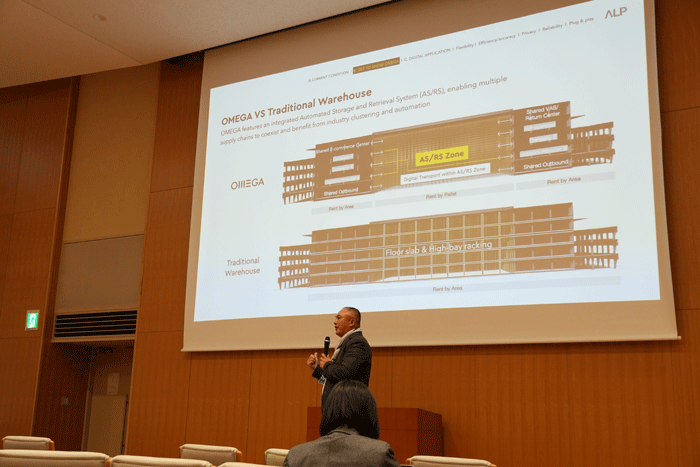
Professor Emeritus Mori, who serves as the chairman of the Physical Internet Center and aims to implement the physical internet in Japan, said, "ALS's case, which is expanding its business by providing both digital and infrastructure services, is noteworthy as a warehouse model for the physical internet. Offering warehouse rentals that combine shared and dedicated spaces, its expansion in Japan could be a catalyst for revitalizing the warehousing industry."
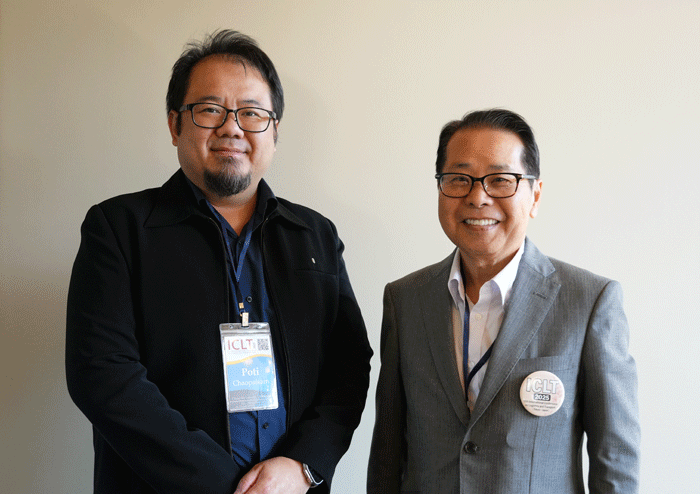
Furthermore, Dr. Poti Chaopaisarn, chair of ICLT, praised Japan's efforts toward the physical internet, stating, "There is a foundation in the people and communities involved in research. Japan is also a country that was quick to recognize the importance of the physical internet." He cited the large demand and the government's promotion through the formulation of a roadmap as contributing factors, and expressed his aspirations, saying, "There are many new values that will be created by the spread of the physical internet. From a company's perspective, the most obvious are cost and personnel reductions, and the fact that logistics warehouses will become more efficient and overall management will be easier. Through this conference, I would like to spread awareness of its importance to researchers in other countries and consider how it can be introduced into the current logistics network."
<From left: Dr. Poti Chaopaisarn and Professor Emeritus Mori>
In addition to the presentations of approximately 30 peer-reviewed research papers, the conference will also feature presentations by Shigeyuki Takano, President of Sustainable Shared Transport (SST), and Yuha Ueno, General Manager of Logistics Solutions at Tokio Marine Smart Mobility, who will introduce initiatives for collaborative transportation that transcends company boundaries through digitalization.
Furthermore, they are scheduled to visit Yamato Transport's Haneda Chronogate on the 28th, which will be a valuable opportunity to share the latest knowledge and trends in the logistics and transportation sectors from the perspectives of industry, academia, and government.


