


[This article is a report on the LNEWS collaborative seminar.]
On October 7, 2025, the "TECH+ Seminar Logistics DX 2025 Oct. The Turning Point in Logistics: The Next Steps Companies Should Take" was held online.
Shippers and logistics operators face a wide range of challenges, including the need to comply with legal requirements, the demand for increased logistics efficiency for sustainable growth, labor shortages, rising costs, and demands for environmental contributions.
In this context, how can companies achieve problem-solving and transformation through the use of digital technology, in other words, "logistics DX"?
This article reports on the session "Why did we start? How a joint transportation platform creates the power to transport goods," given by Satoshi Okubo, Senior Professional at NEC's Smart ILM Division, which launched a noteworthy joint transportation platform.
<Satoshi Okubo, Senior Professional, Smart ILM Division, NEC Corporation>

[What are the obstacles to promoting DX in logistics?]
At the beginning, Okubo said, "Many people feel that change is necessary but it's difficult to get started, to take that first step. I hope we can explore together some hints for finding a solution."
Mr. Okubo, who worked at NEC, was involved in project management for system development for the distribution industry, as well as service development to realize customers' DX (Digital Transformation) and new business development utilizing AI. He currently plays a leading role in new business development in the logistics and energy sectors. He introduced himself by saying, "Based on my experience in promoting DX from both the field and business perspectives, I would like to share the challenges and prospects regarding logistics transformation."
Next, Mr. Okubo began by explaining that despite all players understanding the need for logistics transformation, progress is slow.
In the logistics industry, the so-called "2024 problem," a significant shortage of transport capacity due to driver working hour regulations implemented under the Work Style Reform Act, has attracted attention, and many companies have indeed been affected. However, it was pointed out that future revisions to the two logistics laws (the Comprehensive Logistics Efficiency Improvement Act and the Freight Motor Vehicle Transport Business Act) will strengthen obligations, requiring both shippers and logistics operators to improve logistics efficiency and strengthen their management systems. "Furthermore, a significant decline in transport capacity is expected by 2030. From now on, it will no longer be enough to simply maintain the status quo; it will become increasingly important to be a company that continues to be chosen by customers and partners," he said.
However, while considering joint transportation as one measure to achieve this goal, which would not only improve logistics efficiency but also contribute to the environment, he pointed out that when trying to put it into practice, they face the dilemma of "agreement in principle, but opposition to the details." He said that even if there is agreement among the top management, discussions on the ground do not come together, and the plan does not translate into actual action, causing the project to stall.

"Even in these circumstances, more and more companies are taking the first step towards joint transportation and delivery, and examples of its implementation are spreading to diverse fields such as automobiles, chemicals, and beverages and food," says Mr. Okubo.
They presented examples showing how NEC's joint transportation platform has been used to realize cross-industry joint transportation, resulting in effects such as increased truck loading rates and a reduction in the number of vehicles.
[NEC's solution for realizing joint transportation and delivery]
So why do so many companies still find it difficult to implement joint transportation and delivery? Mr. Okubo introduced the steps to achieving joint transportation and delivery, and the challenges at each stage.
In the first step, the preparation phase, there are many cases where people don't know how to proceed due to a lack of know-how and resources.
In the subsequent Step 2 planning and implementation phase, and Step 3 commencement phase, problems can arise such as a lack of available data and information, time spent considering routes/areas and adjusting conditions, and hitting roadblocks with contracts. Furthermore, in Step 4 operation expansion phase and Step 5 development and optimization phase, various challenges can be faced, such as not achieving the desired results or being unable to expand to other routes.
Here, Mr. Okubo introduced NEC's joint transportation and delivery platform.
"This system was built to solve the obstacles and challenges in realizing joint transportation and delivery, and it began operation in October 2024. By connecting logistics data between companies, it promotes the realization of joint transportation and delivery, contributing from the perspectives of reducing CO2 emissions and maintaining and improving the transportation network."
The functions offered on this platform can be broadly divided into three categories: "grouping," "planning," and "operation."
First, grouping is the function of finding partner companies for joint transportation and delivery and forming a group; planning is the function of creating a concrete plan for joint transportation and delivery among the companies in the formed group; and operations is the function of sharing cargo volume and vehicle information among the group and matching cargo and vehicles on a daily basis.
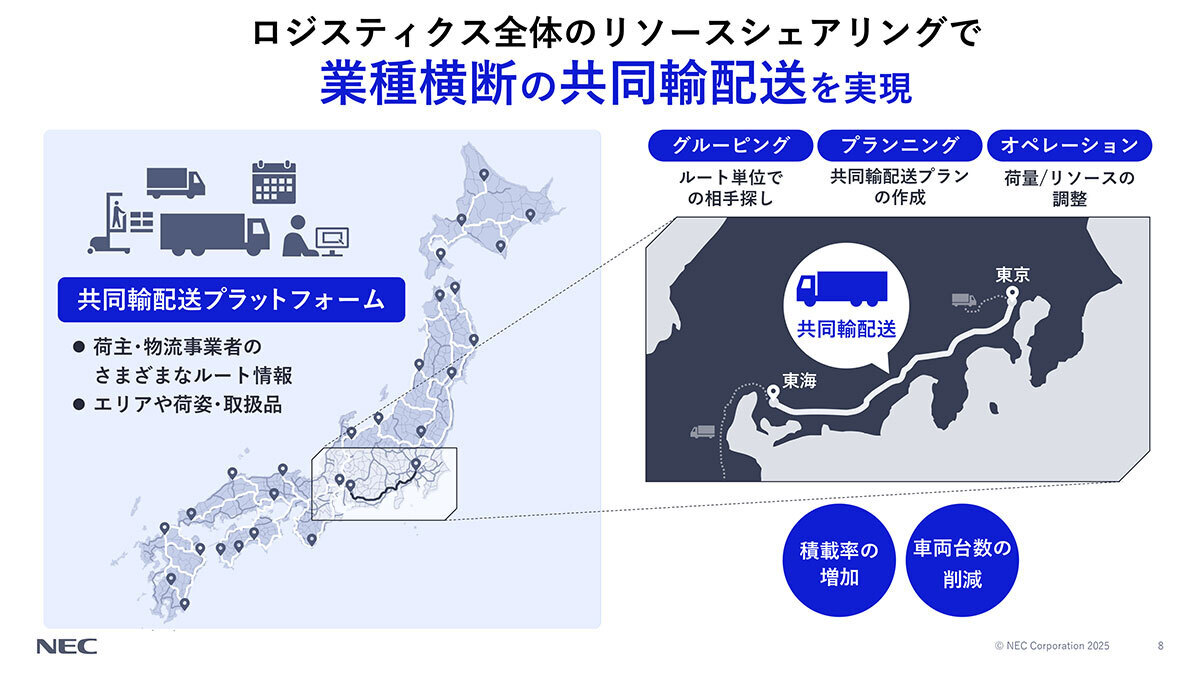
Mr. Okubo cited two key points regarding the services offered on the platform.
The first point is to address challenges such as the fact that adjustments cannot be made in time after shipment confirmation, and that switching subcontractors or consolidating routes is difficult. This involves aligning conditions in advance to minimize last-minute adjustments, and starting small rather than immediately tackling contract or route consolidation, thereby reducing the hurdles to joint transportation and delivery.
The other point is that all phases, from route searching to planning and execution, will be digitized, eliminating the limitations of human intervention as much as possible, with the aim of resolving bottlenecks and shortening the man-hours and time required to realize joint transportation and delivery.
[Case studies from participating companies on the platform and the "next step" in logistics DX]
Next, Mr. Okubo moved on to discussing the usage status of the platform by participating companies.
"This platform allows both shippers and logistics providers to participate, registering a wide range of goods and promoting open, cross-industry collaborative transportation. Registered routes cover a broad area, centered around the major logistics arteries of Kanto, Chubu, and Kinki. Furthermore, the success rate for forming collaborative transportation groups is over 85%, with many companies forming groups in a short period of time."
Furthermore, the presentation highlighted successful case studies of initiatives undertaken through the platform by Yokogawa Electric and Mitsui Soko Supply Chain Solutions.
Yokogawa Electric faced challenges such as reduced loading rates due to the use of chartered transport, while Mitsui Soko Supply Chain Solutions faced the issue of numerous extra transport arrangements due to fluctuations in cargo volume on regular routes. To address these issues, they registered on the platform and implemented joint transportation between the Tokyo area and the Tokai area. As a result, they have seen improvements in both loading rates and a reduction in extra transport.
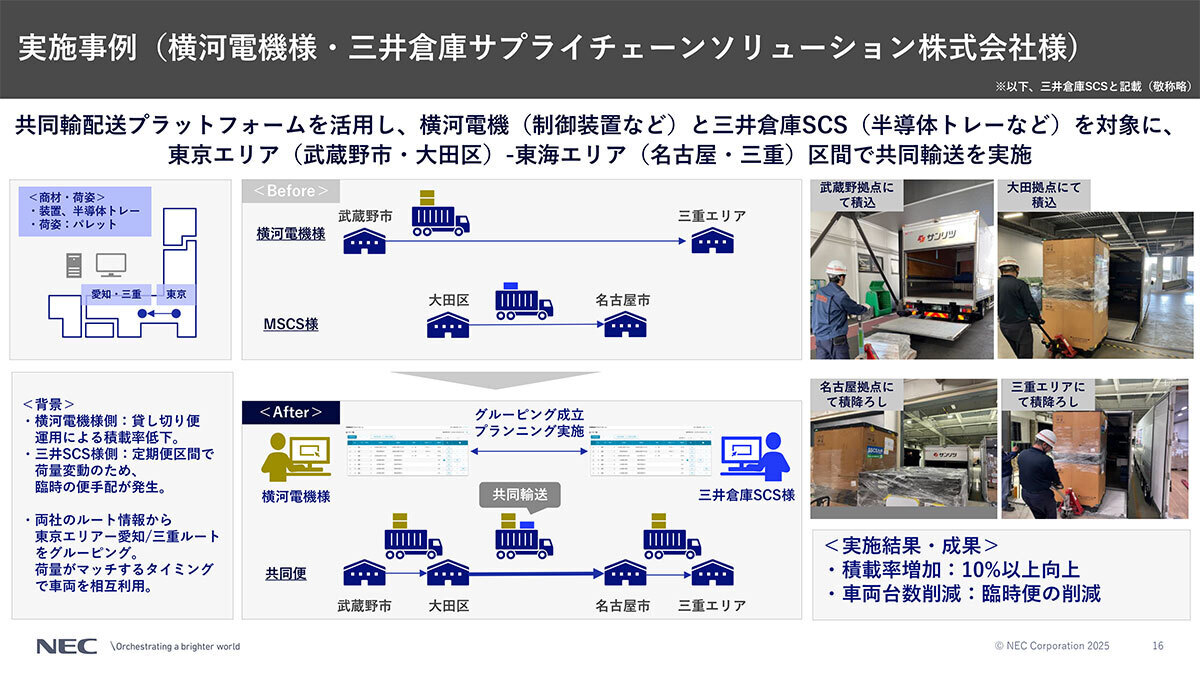
How did the companies participating in the platform take steps to realize joint transportation and delivery, overcome challenges, and bring it to operation?
In the preliminary preparation stage of Step 1, the process began with an invitation to participate in the platform, and the platform served as a foundation for inter-company communication and acted as a guardrail to ensure that discussions proceeded with a shared understanding.
In the subsequent Step 2, the planning and concretization phase, the system is designed so that the process can begin with the input of only the minimum necessary data, based on the recognition that it is actually rare for sufficient data and information to be available for consideration.
Furthermore, in the implementation phase of Step 3, the main focus becomes coordination with other companies. "As explained in Step 1, the system has common items, which serve as a basis for exploration and condition adjustments. In other words, this platform will become a common language for inter-company communication, and we believe that this will reduce the number of 'disappointing joint ventures' that fall through after prolonged discussions," he explained.
Mr. Okubo emphasized that by overcoming steps 1, 2, and 3 in this way, they were able to start joint transportation and delivery, stating, "In fact, I believe the platform played a role in facilitating communication among stakeholders, increasing the possibilities for joint transportation and delivery, and reducing the effort required for consideration."
"Ultimately, it's people who drive the project forward, so it's crucial to foster empathy with stakeholders and partners and build relationships that allow us to overcome even the smallest challenges. We also provide ongoing support to help you get past Steps 1, 2, and 3, as well as collaborative transportation consulting services," he added.
Finally, Mr. Okubo addressed the topic of "the next move," which is also the title of the entire seminar.
"Joint transportation and delivery has its hurdles at each stage, and various ingenious methods are needed to overcome them. We have seen examples of how platforms have been used to overcome these challenges. However, the real goal we should be aiming for is not just the transformation of individual companies, but the creation of sustainable logistics across the entire supply chain and the entire industry. We envision steadily upgrading our platform so that it can become an indispensable tool for creating transportation power and optimizing inter-company logistics networks. We aim to overcome the crisis and realize sustainable logistics."
This online seminar presented practical examples of joint transportation and delivery, along with concrete measures to overcome challenges. It highlighted the usefulness of inter-company collaboration through NEC's joint transportation and delivery platform in promoting logistics DX (Digital Transformation).
I sincerely hope that you will use the case studies presented in this seminar to promote the development of sustainable logistics.
<<Related Links>>
NEC
Joint transportation platform
Joint Transportation Implementation Example: Tokyo Area - Tokai Area
Logistics Sharing Community
Logistics and distribution solutions


