


The world's largest robotics trade show, "International Robot Exhibition 2025," opened on December 3rd at Tokyo Big Sight. Organized by the Japan Robot Association and Nikkan Kogyo Shimbun, the exhibition is held every two years and this marks its 26th edition.
This year's event, themed "A Sustainable Society Brought About by Robotics," features a record-breaking 673 companies and organizations from Japan and abroad, occupying 3334 booths. Each exhibitor is showcasing unique and innovative displays of their actual robots and demonstrations. The event runs until December 6th.
<Tokyo Big Sight, the venue for the International Robot Exhibition>
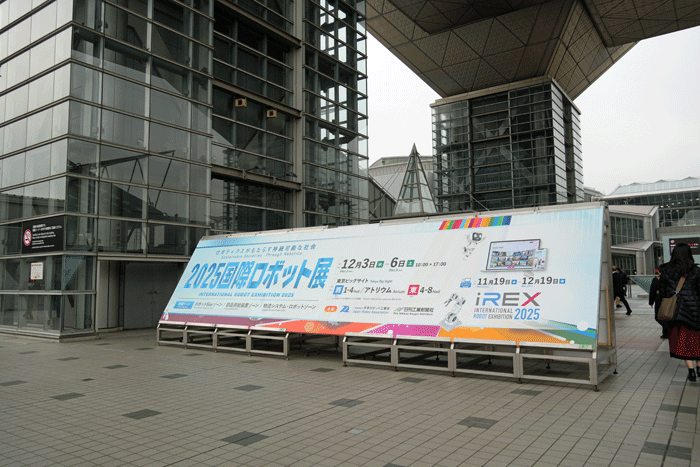
<Scenes from the venue>
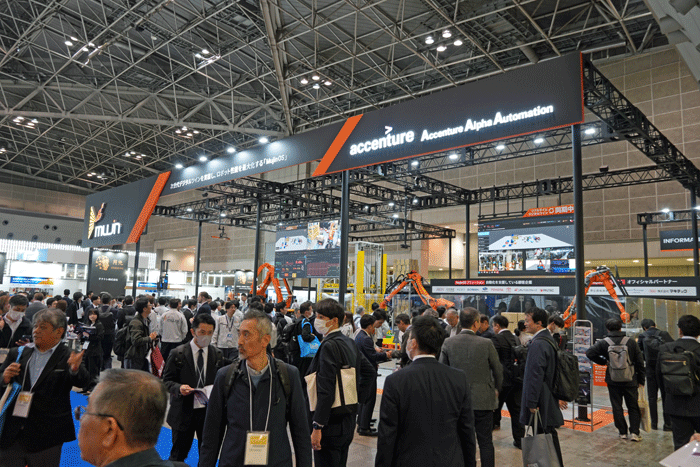
Due to renovation work, the venue will utilize West Halls 1-4, East Halls 4-8, and the Atrium, with booths divided into three zones: the Logistics Systems & Robotics Zone, the Parts Supply Equipment Zone, and the Robot SIer Zone. Logistics-related exhibits will mainly be located in East Halls 4-8.
This year, the exhibition is divided into two categories: "smart production robots" that support manufacturing, construction, and agriculture, forestry, and fisheries, and "smart community robots" that play an active role in local communities and daily life. In the smart production robot category, transportation, sorting, and picking were the most common, while in the smart community robot category, delivery was the most common, followed by medical applications. This reflects the growing need for these robots, which is linked to social issues such as labor shortages. Another notable feature is the record number of exhibitors from overseas, with 140 companies from 14 countries participating. The visitor base is also diverse internationally, with approximately 10,000 international visitors expected.
A notable trend is the increasing number of exhibits showcasing AI-powered robots and solutions. In addition to advancements in robot hardware, exhibits also included software that allows robots to move autonomously using AI, collaborate with other robots to optimize the work environment, and humanoid robots that evoke a vision of a future where robots work collaboratively with humans.
<Mujin recreates the "latest digital twin factory and warehouse">
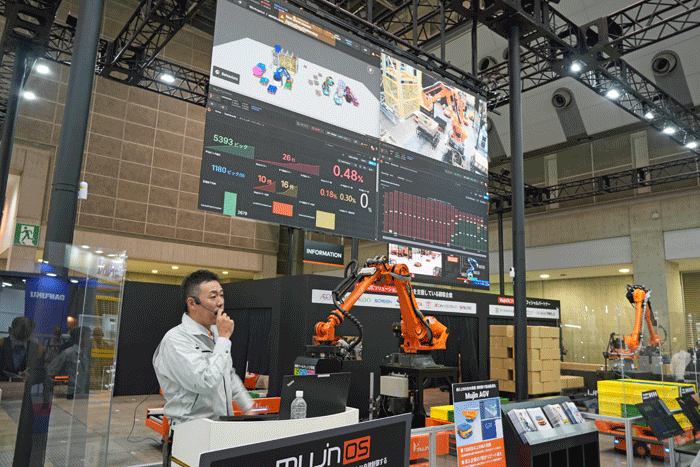
Upon entering East Hall 6, the first thing that catches the eye is Mujin's booth. Based on their integrated automation platform "MujinOS," they recreated a "state-of-the-art digital twin factory/warehouse" using physical AI and digital technology, where the situation on-site is synchronized in real time on a browser, attracting considerable attention.
The demonstration showcased a depalletizing/palletizing robot capable of picking multiple cases simultaneously. It demonstrated its speed, handling up to 1000 cases per hour, from environment setup to stacking recipe creation. Also on display was the first intelligent single-unit palletizer under the "MujinOS" brand. This palletizer can stack up to 1400 cases per hour, simultaneously picking two cases at once, and performing teachless loading and unloading. Features such as stacking recipe creation and a dashboard for real-time operational data monitoring were also demonstrated.
CEO and co-founder Kazuyuki Takino says, "It supports multi-pick without a master copy, and management can be done in real time via a browser. Further optimization is possible by updating the OS. We want people to know what the future of factories and warehouses will look like."
<Daifuku unveils AGF for the first time>
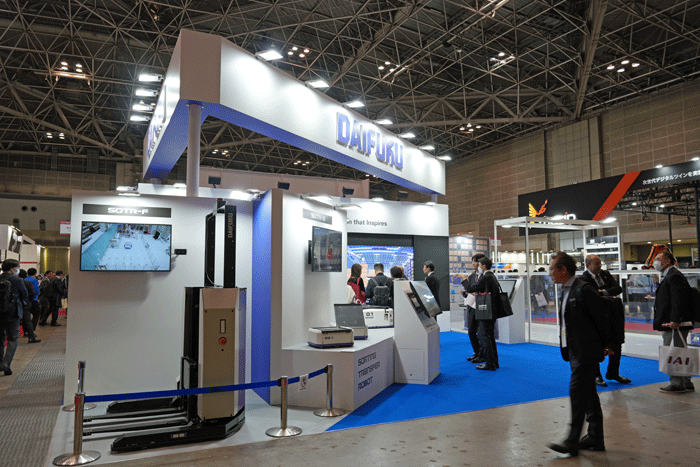
In the sorting and transport systems section, major material handling manufacturer Daifuku exhibited four models from its "SOTR" series. In addition to systems for sorting individual pieces, transporting cases and containers, and transporting pallets, they also showcased their automated guided forklift (AGF), the "Sorting Transfer Robot F," for the first time. The AGF has a compact body and achieves the industry's smallest turning radius of 4 meter, making it usable even in narrow spaces. Furthermore, by employing SLAM (Simulated Landing Map) control, which allows it to map its own position using a sensor camera, it can smoothly adapt to changes in layout and environment, and there is interest in its use for intermediate transport in warehouse receiving and shipping operations.
<Okura Transport Aircraft>
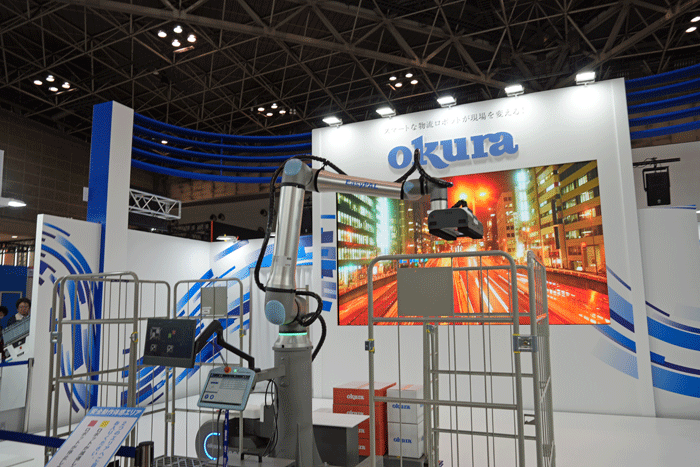
Okura Transport Machinery exhibited "OKURUN," an autonomous transport robot that does not require floor rails or other guides, and "EasyPAL," a collaborative palletizing robot equipped with a camera on its hand. They demonstrated the automation of the "loading," "unloading," and "transporting" operations of transport carts. They also displayed the 3D mobile robot "Skypod" along with a video, introducing their future-oriented maintenance service, "Predictive Maintenance Service."
<Kawasaki Heavy Industries exhibited AI depalletizing (right) and loading onto a 6-wheeled vehicle.>
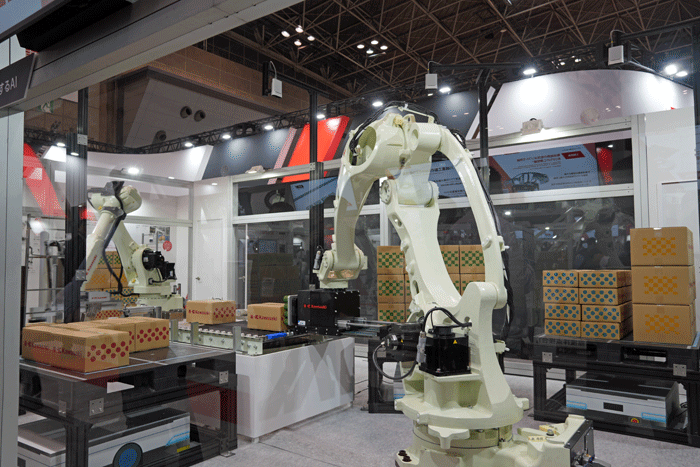
Kawasaki Heavy Industries' booth was themed "Robots as 'Partners'." They showcased AMRs (Autonomous Mobile Robots) used in car assembly lines and painting robots in production facilities, as well as AI-powered depalletizing systems to support unloading in warehouses and robots for loading onto six-wheeled carts. The company proposed a future where robots become more familiar through technologies such as AI, autonomous movement, and remote control.
The compact AI depalletizing robot uses a camera mounted on top of the unit to automatically identify packages using AI, ensuring stable unloading. In addition to the advancements in robotics, a key feature is its masterless operation thanks to AI, highlighting its ability to meet the needs of workplaces facing accelerating labor shortages.
<Four-legged walking robot "CORLEO">
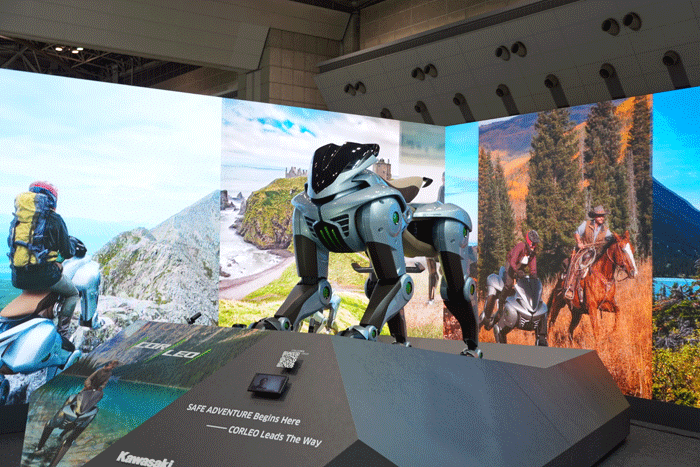
Also on display was "CORLEO," a four-legged walking robot that was unveiled at the Osaka World Expo. Designed not only for industrial use in factories but also for human riders, it attracted a lot of attention at the venue, with many people stopping to take pictures.
<Yamazen achieves integration of humanoid and AMR>
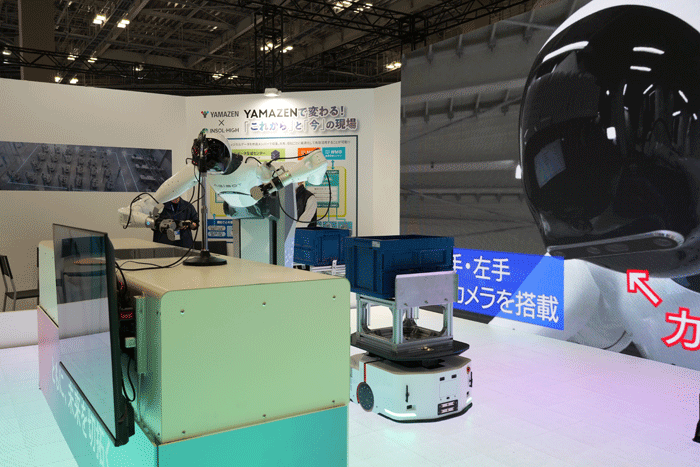
Humanoid robots were also on display. Yamazen unveiled its first demonstration of the collaboration between humanoid robots and AMRs (Antimicrobial Resistance Devices). Using physical data acquired in an actual warehouse and in collaboration with INSOL-HIGH, with whom they have been working since April of this year, they demonstrated how picking work and container movement can be linked using the same platform control as AMRs.
AMR can be used by any manufacturer, and Mineyoshi Kitano, manager of humanoid robot market development at Yamazen, says, "There are processes that inevitably remain even with industrial robots alone. The advantage of humanoids is that they are easy to introduce as a substitute for humans. In the future, we aim to implement them on-site by 2026 in accordance with customer needs."
<GMO Internet Group>

GMO Internet Group is exhibiting three types of humanoid robots in spaces designed to resemble a store, cafe, and warehouse, allowing visitors to experience a future where humans and robots coexist. They are also conducting a demonstration of transporting containers in the warehouse setting.
Mujin/AGV lineup expands to include 300kg compact and 1500kg heavy models.


