


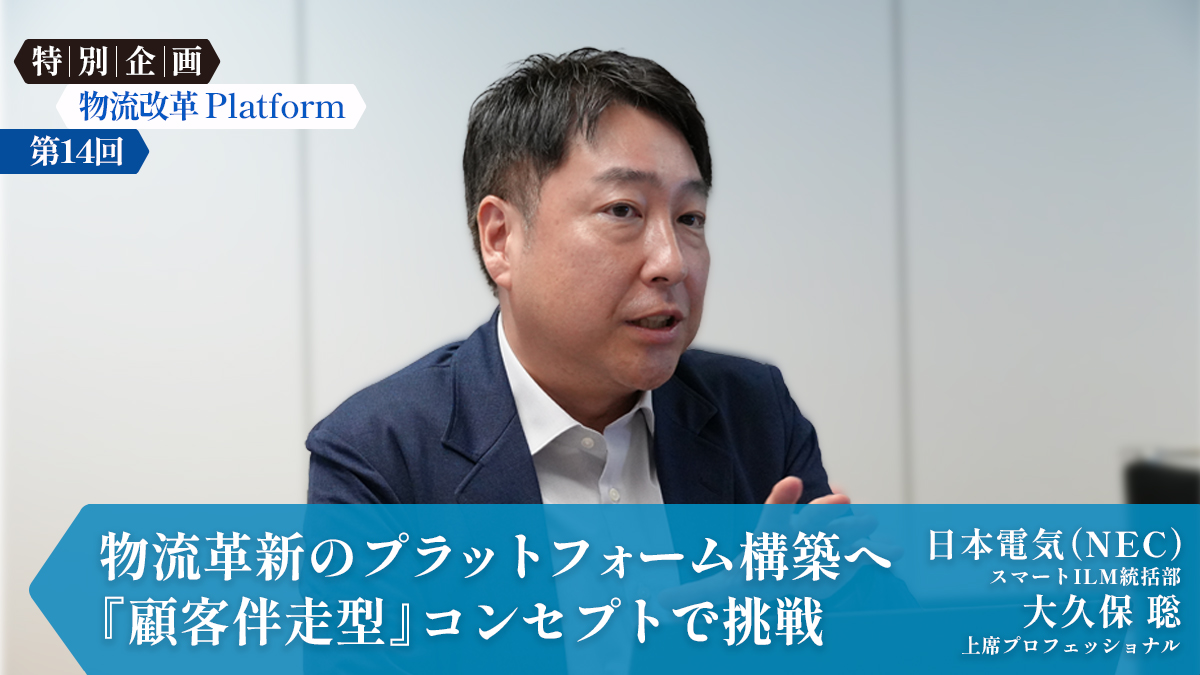
NEC Corporation is developing and providing a new logistics platform based on digital technologies, including AI. Because it is not a direct logistics player, NEC can maintain a neutral stance, working with users to solve individual challenges and drive logistics innovation. We spoke with Satoshi Okubo, Senior Professional at the Smart ILM Division, about the concept, features, and future plans of NEC's new platform. (Interview date: October 24, 2025, at NEC Headquarters)
Utilizing our expertise in AI and other technologies, we serve our customers
Providing a platform that leads to problem solving
— What led to the development and provision of this new "logistics solution"?
Okubo : Our Smart ILM Division is an organization that discovers new businesses in the transportation and logistics sectors, including the movement of people and goods. In the logistics world, concerns about the so-called "2024 problem" have been discussed for several years, and as the sense of crisis intensifies towards 2030, our team has been discussing what NEC can do since around 2022. As we continued our discussions, considering what will be necessary in the future, from 2025 to 30, and what the framework of the logistics industry and transportation will be like, we came to the conclusion that we should provide a platform to solve customer problems using AI, which is our area of expertise. We proceeded with development based on the concept of supporting customers in solving logistics problems with the power of digital technology while "walking alongside" them.
<Senior Professional Okubo speaks about the solution concept>

— How do you invite companies and other organizations to participate?
Okubo: Addressing the logistics challenges that are expected to become more serious in the future will be difficult for manufacturers and logistics companies to do alone, and it is not something that NEC can solve by itself, so we believe it is important to work together with our customers. We have business goals for 2030 and 2035, but if we do not succeed in taking the first step, there will be no further development, so we are proceeding through trial and error. Customers may be afraid of making mistakes, but we believe that it is better to start small and then move on to the next step while making improvements. We tell our customers, "Let's take a small first step together, looking ahead to three or five years from now."
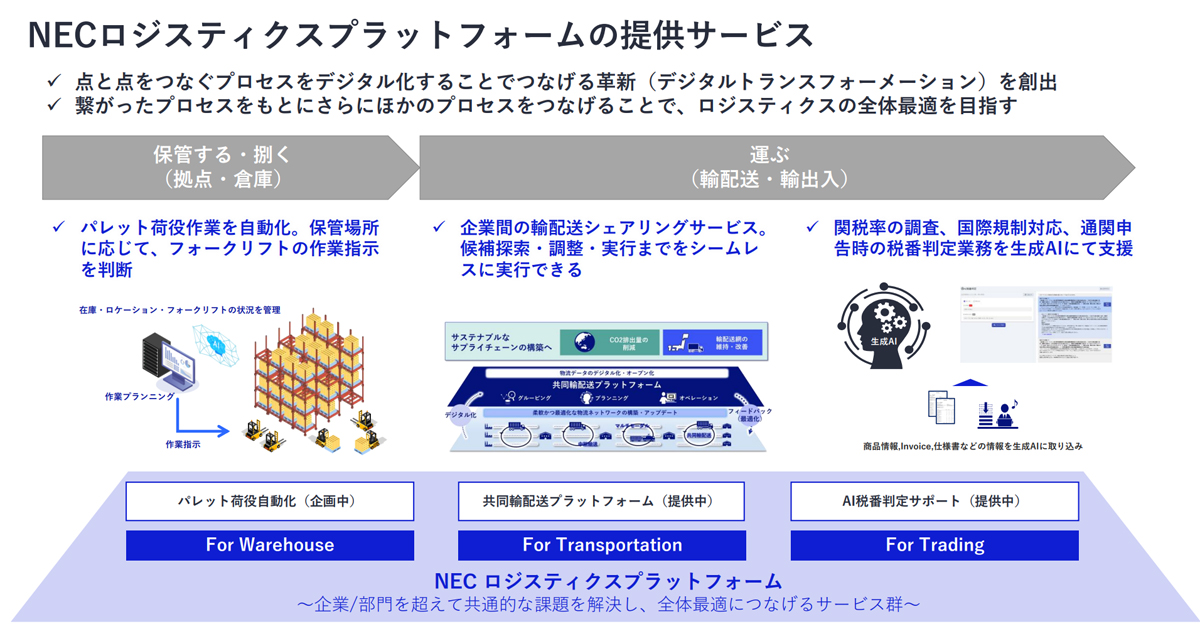
<Conceptual diagram of services provided by the logistics platform>
—Could you tell us about the new solutions you've developed and are now offering?
Okubo is working on developing and providing three main services: "Automated Pallet Handling Solutions," "Joint Transportation Platform," and "Customs Clearance Efficiency Improvement (AI Tariff Code Determination Support)." Of these, the Automated Pallet Handling Solutions are being developed with great effort to create a platform that utilizes AI and other digital technologies to automate and optimize cargo handling operations, and we aim to release it in 2026.
By narrowing down the information you input
Increase the chances of matching
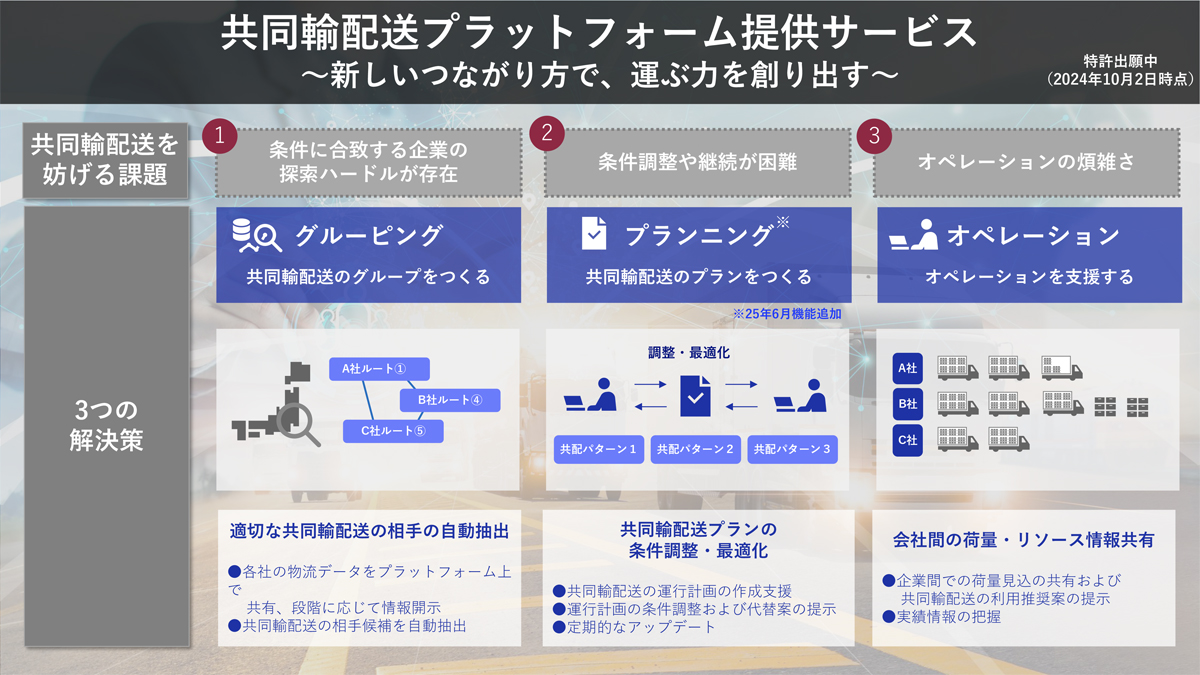
<Conceptual diagram of the "Joint Transportation Platform Service">
—Could you please explain the specific system details of the "joint transportation and delivery platform"?
Okubo's "Grouping" feature shares logistics data from each company on the platform, disclosing information in stages and automatically extracting potential partners for joint transportation. Existing platforms often require users to enter detailed information when registering, resulting in many cases where users are unable to find companies that meet their criteria. NEC's new platform facilitates smooth digital exploration and coordination by having users input a general area for transportation routes in "Grouping," and then supporting joint transportation operation planning, adjusting operation plan conditions, and suggesting alternatives in "Planning." In the subsequent "Operation" stage, the platform facilitates the sharing of cargo volume forecasts among companies before executing joint transportation, and aims to further expand the use of joint transportation through data accumulation, such as understanding performance information.
— What is the current level of participation in the "joint transportation and delivery platform"?
Our service is currently used by approximately 20 shippers and logistics companies in Okubo . We understand that while many stakeholders, including manufacturers, wholesalers, and logistics companies, have felt the need for joint transportation and delivery, various obstacles have prevented progress. Therefore, we aimed to create a system that is easy to use and increases the matching rate by eliminating these obstacles at each stage of "grouping," "planning," and "operation."
— What were some of the obstacles to conventional joint transportation and delivery?
Okubo : First, there's the "search for companies that meet the criteria." To address this challenge, the "grouping" function of the joint transportation platform automatically extracts suitable joint transportation partners based on logistics data shared by each company on the platform. Next, there's the obstacle of "difficulty in adjusting and continuing conditions." To address this, "planning" involves adjusting and optimizing the conditions of the joint transportation plan, as well as performing regular updates. Finally, to address the obstacle of "operational complexity," we eliminate the complex tasks involved in actual operations by sharing cargo volume forecasts between companies, suggesting recommended joint transportation options, and understanding performance data.
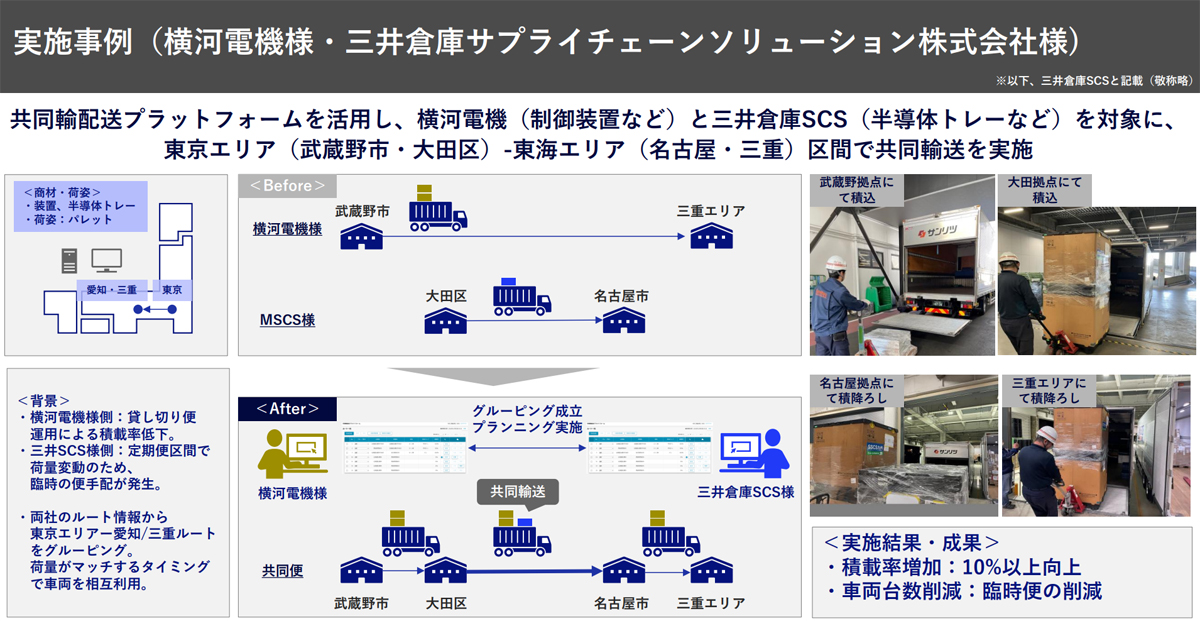
<Example of joint transportation and delivery by Yokogawa Electric and Mitsui Warehouse Supply Chain>
— What kind of results did you see from actually using the platform?
Based on measurements taken one month after registration of the Okubo route, the success rate of joint transportation groupings has reached 85%. Furthermore, in the case of joint transportation between the Tokyo area (Musashino City and Ota Ward) and the Tokai area (Nagoya City and Mie Prefecture) by Yokogawa Electric and Mitsui Warehouse Supply Chain, the loading rate improved by more than 10 percentage points by consolidating control devices and semiconductor trays, and significant benefits were achieved, such as eliminating the need to arrange and operate extra shipments that were previously run when cargo volume increased.
In the future, the accumulated information and
The potential for broad application of this knowledge is also a factor.
—It seems to be steadily yielding results, but what are the future plans for the "joint transportation and delivery platform"?
Okubo: Currently, we are in a small-scale start-up phase, but we anticipate that as we continue operations, the number of users will increase and the accumulation of information will accelerate. In addition, through "supportive assistance" that works closely with each user to solve their problems, we aim to alleviate anxieties during the operational phase and further improve the knowledge and know-how of both users and ourselves regarding joint transportation and delivery. We hope to utilize the information and knowledge gained in this way not only for joint transportation and delivery but also for improving the efficiency of the entire supply chain. If that happens, the platform, which is currently only used by practitioners, may become available to administrators and senior management.
-- Of the three solution options, what are the details and implementation effects of "Digitalization of Customs Clearance Operations"?
Our Okubo Customs Clearance Efficiency Improvement service is being used by dozens of companies, including Nippon Express and Fukuyama Transporting. In addition, we launched a new service in May called "AI Tariff Code Determination Support," which utilizes AI generation. While the number of transactions in import and export operations is increasing due to globalization, we are facing the challenge of a shortage of customs brokers. Therefore, we are reducing the workload by combining the digitization of trade documents (AI-OCR), tariff code determination support using AI generation, and the digitalization of customs duty calculation sheets. In one user's case, if the workload before implementation is set at 100, the introduction of AI-OCR reduced Excel data entry work by 77%, and the introduction of the customs duty calculation sheet system reduced customs duty calculation work by 74%.
— What initiatives are you taking to acquire new users?
In October 2024, Okubo launched the "Logistics Sharing Community," which provides a platform for companies interested in promoting joint transportation and delivery to network and deepen their understanding of key trends and operations. The community has held six meetings so far, including panel discussions by joint transportation and delivery user companies, and plans to continue holding regular meetings. Participation in the "Logistics Sharing Community" is free of charge for shippers (manufacturing, wholesale, and retail) and logistics companies aiming to reform their logistics and distribution systems and realize joint logistics and joint transportation and delivery. We welcome participation from anyone interested in joint transportation and delivery.
<Members of the Smart ILM Division, who aim to contribute to solving customer problems with the motto of "supporting them every step of the way." From left: Yoshika Nagase, Satoshi Okubo (Senior Professional), Yosuke Umeda (Professional) *Affiliations are as of the date of the interview>

■NEC Logistics Solutions related website
https://jpn.nec.com/logistics/index.html
https://jpn.nec.com/logistics_service/kyouhai-pf/index.html
https://jpn.nec.com/nec-community/logisticssharing/info.html
https://jpn.nec.com/logistics_service/tsuukan/index.html


