



Characteristics of cargo in long-distance transport
When people go on a family trip in a car, the same number of people ride in the car on both the outward and return journeys, so the number of passengers and the occupancy rate remain the same for both legs of the trip. On the other hand, goods rarely return to their place of origin, such as fresh food or beer produced on a farm or in a factory and consumed by the buyer.
International cargo shipping involves exporting cement from Japan to overseas destinations and importing coal from overseas. Similarly, container shipping involves exporting electrical products and importing food products overseas. Even if the goods or products being transported differ, having cargo being transported both ways is desirable from a profitability standpoint.
The same applies to long-distance domestic transport, where one-way cargo transport (transporting only the outbound or inbound journey) is somewhat unavoidable. Many long-distance freight transport companies in Japan originated in rural areas. This is due to the uneven distribution of cargo. During the period of rapid economic growth, local transport companies were able to collect outbound cargo from rural areas to major cities through their local connections, and the volume of cargo from major cities to rural areas on the return journey was significantly larger, making it easy to collect. Therefore, it is said that local companies that could acquire cargo on both the outbound and return journeys developed significantly.
The concept of loading efficiency (= loading rate × vehicle utilization rate)
The Ministry of Land, Infrastructure, Transport and Tourism expresses loading efficiency as a percentage, calculated as "(transport ton-kilometers) ÷ (capacity ton-kilometers) × 100". The Ministry also expresses loading efficiency as "(loading rate) × (vehicle utilization rate)".
As shown in the previous installment (No. 32) , if we define the "mileage ratio" as the distance traveled while loaded relative to the total distance traveled, then the loading efficiency is the product of the "loading rate" and the "mileage ratio," and the two equations above can be rearranged to become the same. Furthermore, by using the "mileage ratio," we can determine the "loading efficiency for the entire travel section" even if there are loading and unloading operations during transport.
Loading efficiency in multiple sections with different load rates
In long-distance freight transport, to avoid uneven loading and improve loading efficiency, it is important to secure cargo for both the outbound and return journeys, assuming that the cargo for the outbound and return journeys will be different.
For this reason, an appropriate method for calculating the loading efficiency for round trips is necessary.
In the appendix, we will consider the loading efficiency of round-trip long-distance transport using several case studies.

[Appendix]: Understanding the Challenges of Logistics Through Numbers and Graphs
(Part 16) Loading efficiency in round-trip long-distance transport
Nobuko Kosugi, Professor, Faculty of Economics, Chuo University
Formula for calculating loading efficiency
The loading efficiency presented by the Ministry of Land, Infrastructure, Transport and Tourism is "the product of the loading rate and the actual vehicle rate (the ratio of the distance traveled when carrying cargo to the total distance traveled by the truck)." Here, the loading rate is "the ratio of the amount of cargo to the amount that can be loaded." In actual transportation, loading and unloading may occur during the truck's journey, and the loading rate changes each time.
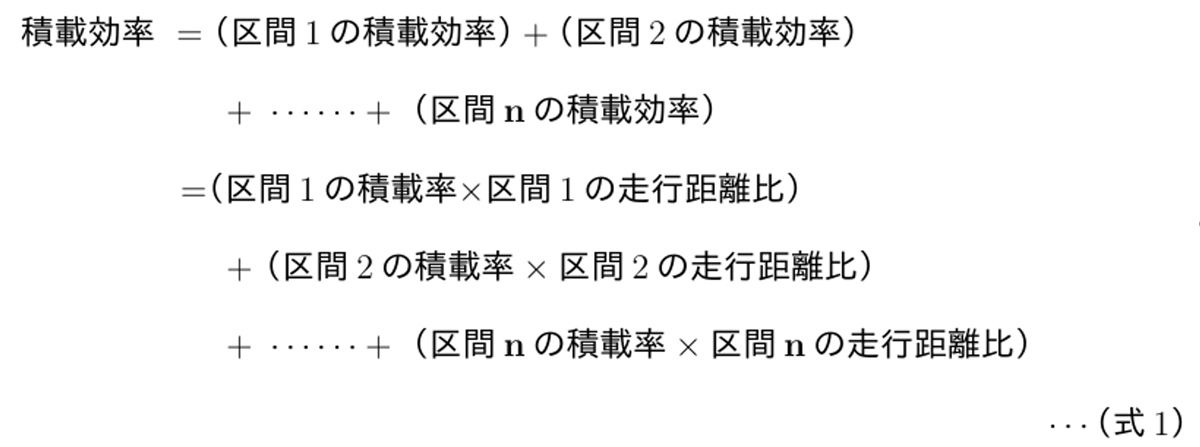
As mentioned in the appendix to the previous (32nd) installment , to calculate the loading efficiency when there are loading and unloading stops along the way, it is convenient to use the "mileage ratio" instead of the "vehicle utilization rate." The "mileage ratio" is "the ratio of the distance traveled in a section where a certain loading rate is being used to the total distance traveled." Therefore, the loading efficiency for each section of travel, divided at loading and unloading points, can be calculated as "the product of the loading rate for each section and the mileage ratio for each section." Now, suppose the entire travel route is divided into n sections at loading and unloading points. In this case, by calculating the loading efficiency for each section and summing them up, we can find the "overall loading efficiency for the entire travel route" (see Equation 1).
For example, if the load rate changes between the outbound and return journeys, we can calculate the load efficiency for the round trip by setting n=2 in Equation 1 and considering section 1 as the outbound journey and section 2 as the return journey.
Please note that the load factor and mileage figures used here may not accurately reflect reality, but they were chosen for clarity in the calculation process.
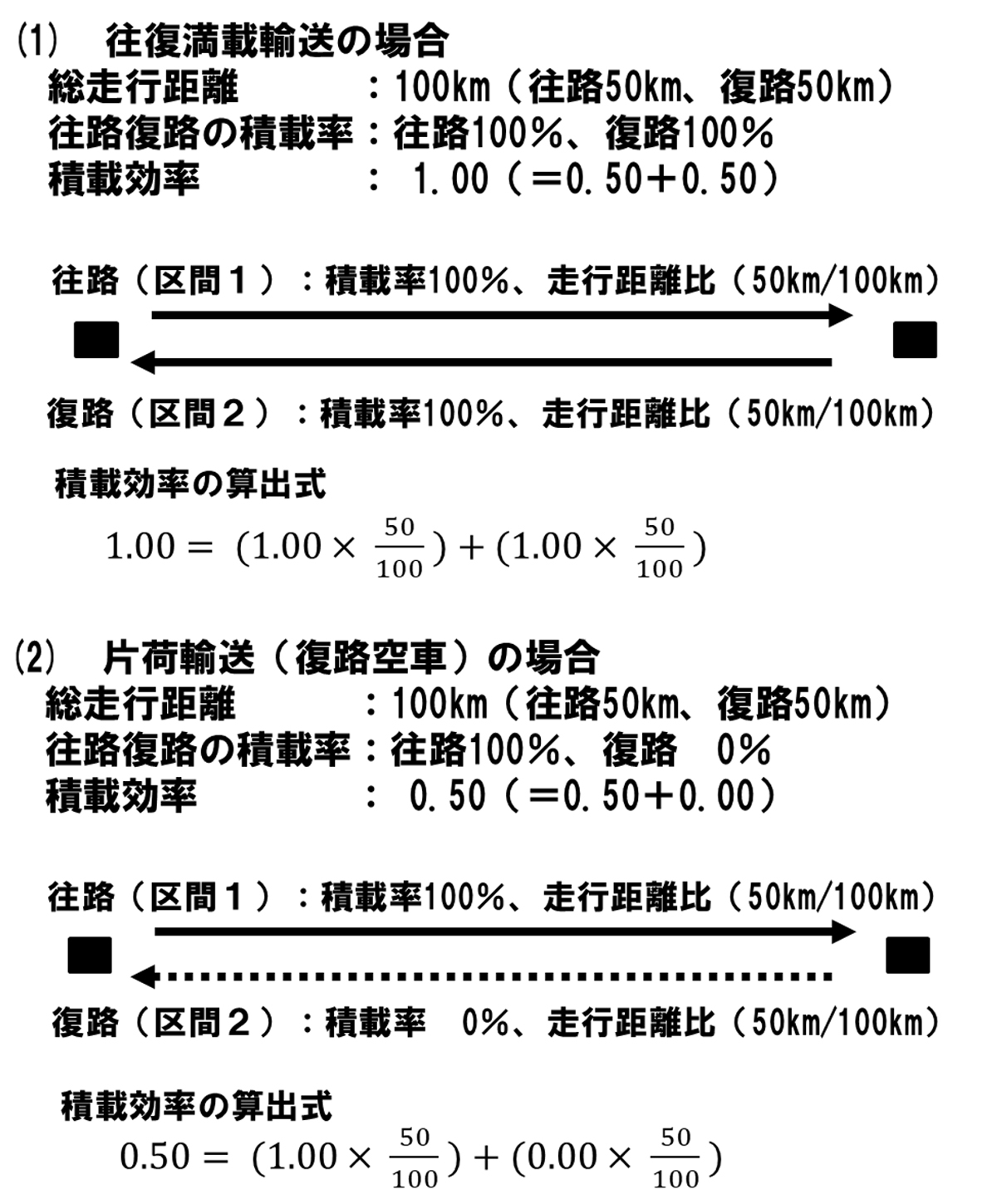
Loading efficiency when operating round trip (see Figure 1)
When operating a long-distance round trip, the loading efficiency can be calculated by adding up the loading efficiencies of the outbound and return journeys. When operating a round trip on the same route, the ratio of the outbound and return journeys to the total distance traveled (distance ratio) is 0.50 for each. Therefore, if the loading rates for the outbound and return journeys are known, the loading efficiency for the round trip can be calculated.
Figure 1(1) shows the case where the load rate is 100% on both the outbound (50km) and return (50km) journeys over a round trip of 100km, resulting in a load efficiency of 100. While this is an ideal situation, it is rarely achieved in reality.
Figure 1(2) shows the case where, for a round trip of 100km, the loading rate on the outbound trip (50km) is 100% and the loading rate on the return trip (50km) is 0%, resulting in a loading efficiency of 0.50. For example, in the delivery of raw materials to a factory or the transportation of waste from a construction site, the loading rates on the outbound and return trips are a combination of 100% and 0%.
<Figure 1: Example of calculating loading efficiency when operating round trip>
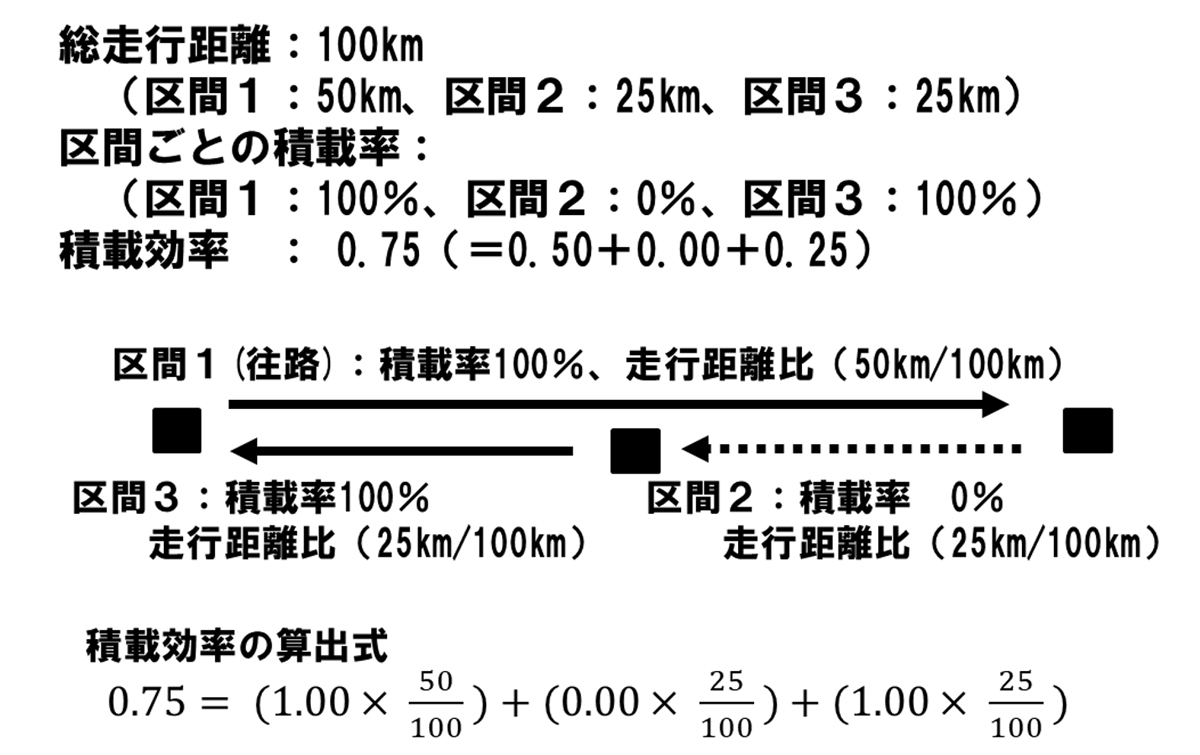
Loading efficiency when loading cargo en route to the return journey (see Figure 2)
Figure 2 shows a case where cargo is loaded on the return trip during a round-trip transport along the same route.
For example, on a round trip of 100km, the load rate is 100% on the outbound journey (section 1: 50km), 0% on the first half of the return journey (section 2: 25km), and 100% on the remaining half of the return journey (section 3: 25km).
Section 1 has a loading efficiency of 0.50 (100% loading rate, 0.50 for distance traveled), Section 2 has a loading efficiency of 0.00 (0% loading rate, 0.25 for distance traveled), and Section 3 has a loading efficiency of 0.25 (100% loading rate, 0.25 for distance traveled). As a result, the total loading efficiency for all sections (Sections 1 to 3) is 0.75 (= 0.50 + 0.00 + 0.25).
<Figure 2: Example of calculating loading efficiency when loading cargo en route to the return journey>
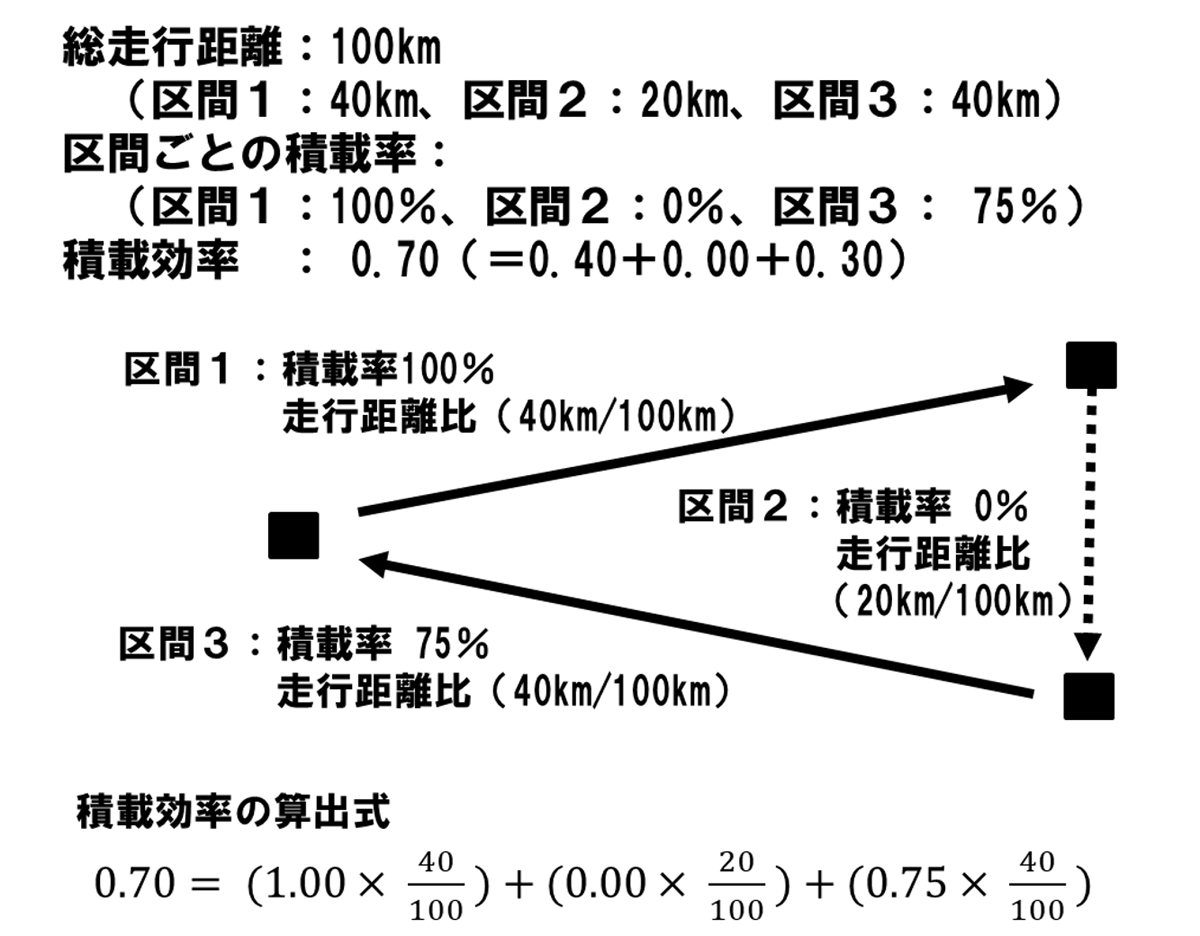
Loading efficiency in round-trip transport (see Figure 3)
Figure 3 shows the case of round-trip transport. If there are two loading and unloading points for cargo during transport, one trip will consist of three sections.
For example, let's say the total distance traveled is 100km, with a load rate of 100% for section 1 (40km), 0% for section 2 (20km), and 75% for section 3 (40km).
Section 1 has a loading efficiency of 0.40 (100% loading rate, 0.40 for distance traveled), Section 2 has a loading efficiency of 0.00 (0% loading rate, 0.20 for distance traveled), and Section 3 has a loading efficiency of 0.30 (75% loading rate, 0.40 for distance traveled). As a result, the total loading efficiency for all sections (Sections 1 to 3) is 0.70 (= 0.40 + 0.00 + 0.30).
<Figure 3: Example of calculating loading efficiency for round-trip transport>
Reference document
1) Ministry of Land, Infrastructure, Transport and Tourism, Automobile Transport Statistics Survey
https://www.mlit.go.jp/k-toukei/jidousya_yougo.html
2) Portal site for promoting understanding of the "Logistics Efficiency Law": Regarding loading efficiency, waiting time, and handling time.
https://www.revised-logistics-act-portal.mlit.go.jp/faq/#sekisai_koritsu


