


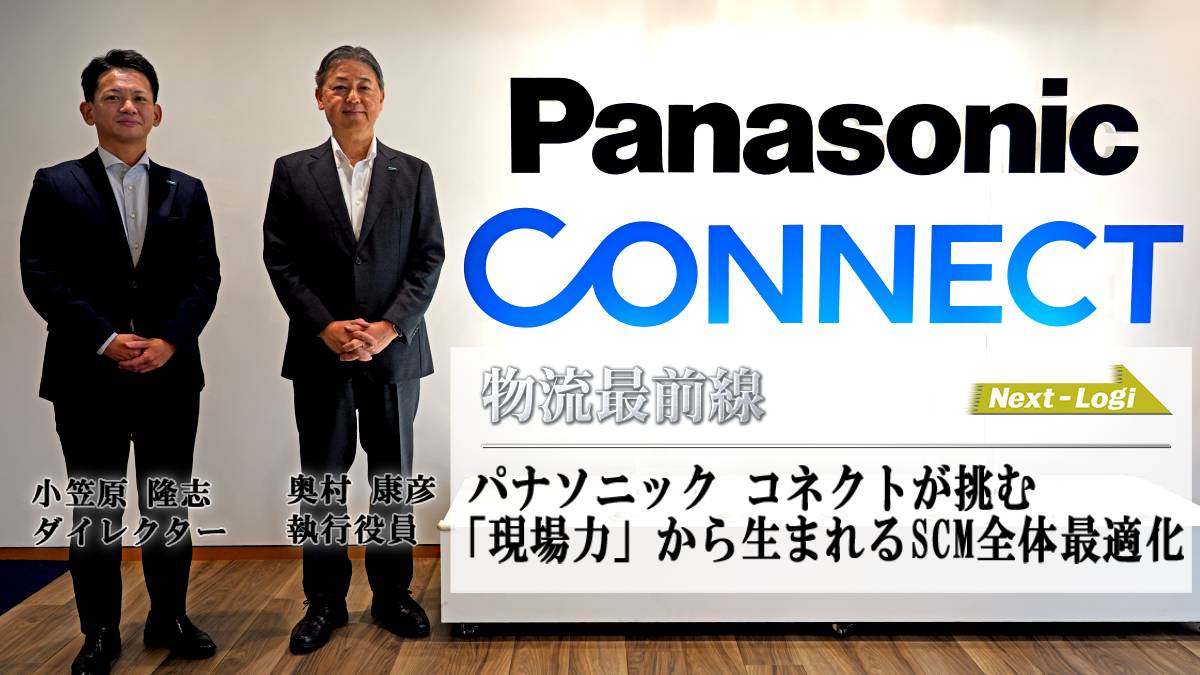
Panasonic Connect has been advancing its SCM business by incorporating overseas software providers such as Zetes and Blue Yonder (which conducts business with over 3000 companies in 81 countries worldwide). With "overall optimization starting from the field" as its domestic business concept, Panasonic Connect provides logistics solutions utilizing the know-how cultivated overseas. We spoke with Senior Vice President Yasuhiko Okumura and Director Takashi Ogasawara of the Field Solutions Company about the current state of SCM transformation in Japanese companies, the strengths of their standardization-based solutions, and the challenges they face.
Interview: November 13th, Location: Panasonic Connect Headquarters
<Takashi Ogasawara, Director (left), Yasuhiko Okumura, Senior Vice President (right)>
The Japanese market has a strong presence on the ground.
Therefore, overall optimization does not progress.
-- From the perspective of Panasonic Connect, which develops solutions for logistics sites, could you first tell us about the current state and challenges of the logistics industry in Japan?
Ogasawara Panasonic was founded in 1918, and over the past 100 years, people's lives have dramatically improved in terms of convenience thanks to advancements in logistics. However, we recognize that maintaining the same level of convenience for the next 100 years is a critical challenge. With labor shortages becoming apparent, many companies are finding it difficult to maintain the status quo of their existing services, which is a major issue. Recently, we've seen a noticeable increase in challenges such as reviewing and optimizing our services.
Amidst these circumstances, I believe that the sense of crisis among management is definitely increasing, spurred by factors such as stricter regulations due to legal revisions and the movement to establish CLOs (Chief Logistics Officers). More and more companies are actively appointing CLOs and CSCOs (Chief Supply Chain Officers), and the number of executives with authority over logistics is also increasing.
The recognition is that improving logistics efficiency is now a management agenda for the entire industry, and optimizing the entire supply chain has become a critical issue directly linked to a company's competitiveness.
--Your company's domestic SCM business concept is "overall optimization starting from the field." What are some of the challenges you face in the field?
In Japan , logistics operations have relied on the ingenuity of the people working on the ground, and I believe that their exceptional operational capabilities, exemplified by their flexibility and responsiveness, have greatly contributed to shortening supply chain lead times. Conversely, I believe that this has led to a "personalization" and "collections of individual optimization," which are major obstacles to digitalization and overall optimization. The difference between such Japanese companies and advanced global companies lies in whether or not they have standardized their operations and have a foundation capable of handling the increasing complexity of supply chains. In Japan, building a data infrastructure is the real starting point.
Since Okumura added Zetes from Europe in 2017 and Blue Yonder from the US in 2021 to his group, interacting with their customers has revealed a very clear difference from Japan. For better or for worse, Japan has a strong emphasis on on-the-ground operations and a lot of bottom-up approaches. As a result, a common challenge emerges: it lags behind in overall optimization.
In the US in particular, on-site workers are often categorized as laborers, and operations are run on the assumption that some are first-timers. In Japan, on-site workers are veterans who have all the operational procedures memorized. When you ask, "In five years, everyone will be gone, so what kind of operations are you planning?", the response is usually, "That's the challenge." I wanted to see if there was anything I could do to help.
Personally, I don't think we should simply imitate Europe and America. Ogasawara and I have been thinking for a long time about how we can aim for overall optimization while leveraging Japan's strength in on-the-ground capabilities, and that's how this seemingly contradictory concept of "overall optimization starting from the field" came about.
— How will the characteristic of having a strong "on-site" presence affect the introduction of new solutions?
Okumura: A common example I hear is when a CDO (Chief Digital Officer) or CIO (Chief Information Officer) proposes DX to top management, only to be told things like, "Have you really listened to the opinions of those on the ground?" It's not that they're ignoring the opinions of those on the ground, but when top management says that, it becomes difficult to determine the priorities for implementation.
I believe the CLO (Centralized Lawyer) system could potentially be one way to address this issue.
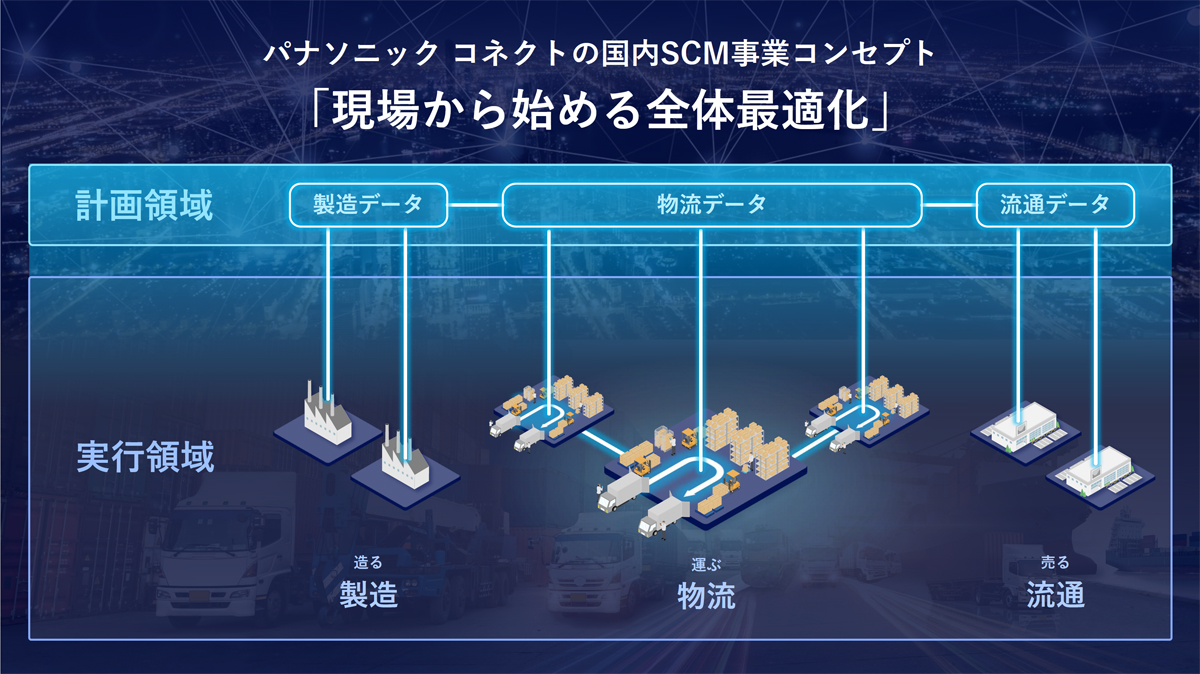
To begin with, if we define the scope of logistics operations, it ultimately boils down to being just a part of the larger framework of the supply chain. Simply implementing solutions within that scope won't lead to significant improvements because the whole system is interconnected. Since focusing solely on the logistics domain has its limitations, we hope that the establishment of the CLO (Chief Logistics Officer) will serve as a trigger to encourage a holistic approach encompassing logistics and supply chain concepts.
<Image of the domestic SCM business concept: "Overall optimization starting from the field">
A proposal to connect management and the front lines.
Standardization connects different sites.
--Could you tell us again about the circumstances that led to you incorporating Zetes and Blue Yonder, and how you came to incorporate logistics improvement into your business?
Okumura : There are three main reasons. First, the supply chain is a growing market where challenges are becoming apparent. Second, Panasonic's B2B business has been primarily domestic until now, so we wanted to bring in overseas partners to secure global growth potential. And finally, since we were a company with a strong hardware DNA, we wanted to incorporate software DNA into our operations.
Since we were incorporating genes that we didn't have ourselves, there were many things that were initially taken aback. Panasonic has a strong tendency to conduct business through a vertical command and control system, but the supply chain and software are horizontal, so many people felt uncomfortable at first. I was a little confused at first too.
On the other hand, I gained many insights. Looking at the Japanese market through their concept revealed a different landscape than before, and I felt a sense of crisis that Japanese industries were falling behind their competitors in the global market. From that perspective, I became more acutely aware of the challenges based on the differences between Japan and overseas, which I mentioned earlier.
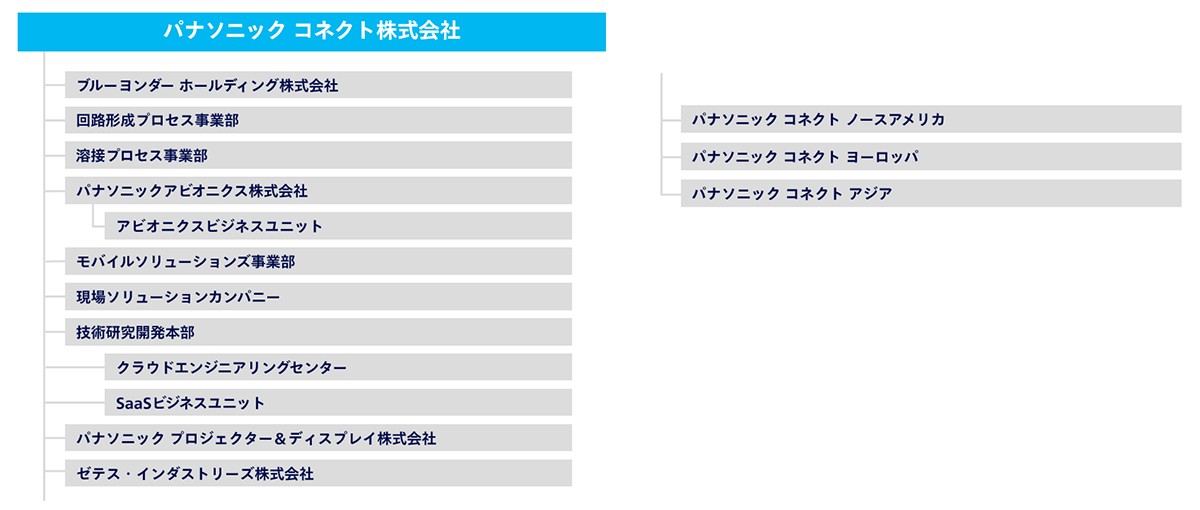
<Acquired all shares of Zetes in 2017 and all shares of Blue Yonder in 2021>
-- You mentioned that your domestic operations are quite unique. When you were applying your overseas experience to your domestic operations, were there any specific indicators or metrics you used?
The packages that have already been deployed and proven successful overseas in the Ogasawara Islands incorporate successful case studies of business processes and other elements. We then apply these to the current Japanese market and prioritize those that we believe can be successfully deployed in Japan, before launching them domestically.
Initially, we started with Zetes' "ZetesChronos ™ ," a transportation progress management system. This year, we have been progressively introducing "ZetesMedea ™ ," a WES (Warehouse Execution Management) system, and "ZetesZeus ™ ," a data collaboration platform for improving delivery operations. Following that, we plan to deploy Blue Yonder's WMS (Warehouse Management System) in Japan.
The effectiveness of this product has been proven when used correctly by Okumura- san. There are already customers in Europe and America who are using it effectively and seeing results in their businesses. This definitely makes for a good sales pitch.
— When considering implementation in Japan, are there any concerns due to differences from overseas?
Okumura : There are many. Basically, we approach implementation from both the management level at headquarters and the field level, but in Japan, there is often a strong bottom-up culture, so we have to advance both simultaneously. Even if we build things up from the field level, it will stop if management level says "no," and even if management level pushes it, it is common to be told to "go to the field and conduct interviews."
— I imagine the CEO will ask the management team, "Did you listen to the opinions of those on the front lines?" And to answer that question, they need to gather the necessary information to say, "These are the opinions of those on the front lines."
Ogasawara : Yes, when we say, "We spoke with this person on-site, and this is the response we received," the management and headquarters staff are very relieved. People on-site will tell us things they might not feel comfortable telling headquarters directly.
Therefore, we always make it a point to hear directly from both management and those on the front lines.
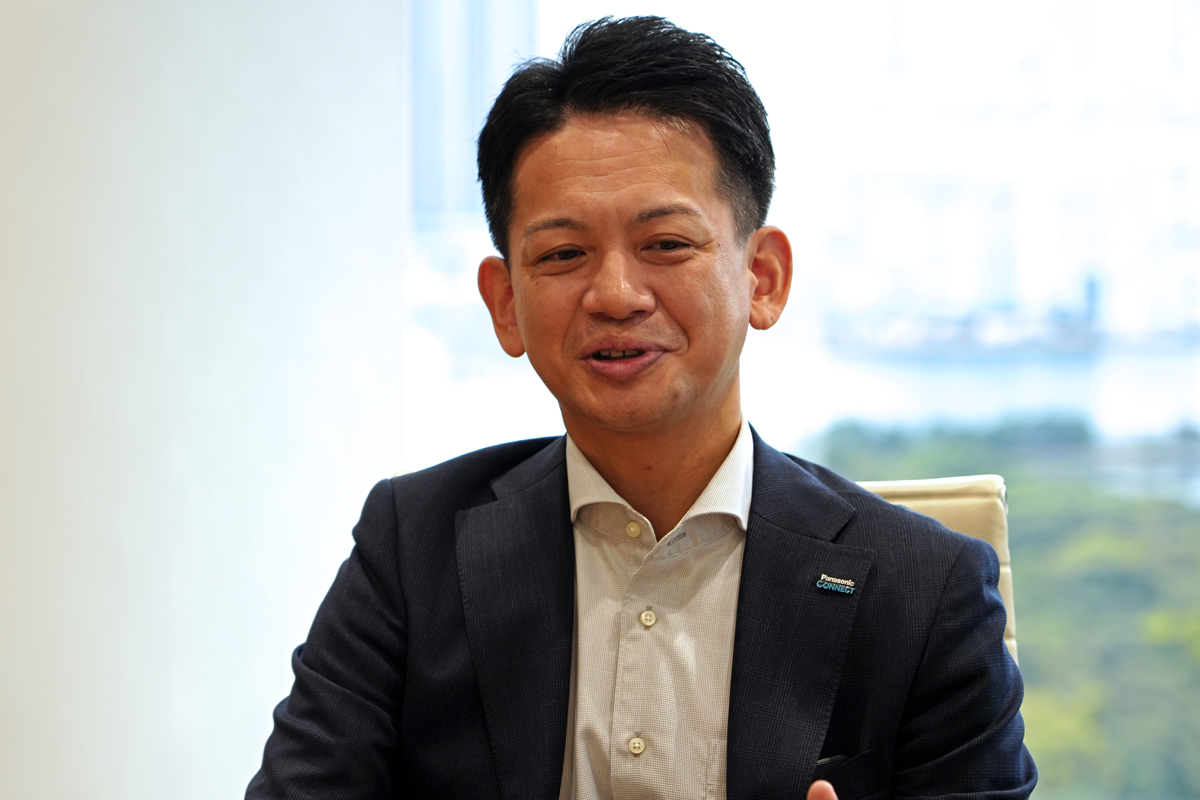
<Takashi Ogasawara, Director, Field Solutions Company / Center Manager, SCM Business Center>
— How do you approach challenges from the perspective of practical work on the ground?
Ogasawara : Well, there are definitely aspects that are unique to Japan, so we have to develop those separately. For example, while overseas labels are based on international standards, Japanese labels have different specifications for each company, so additional development is always necessary.
Another challenge is getting the people on the ground to understand and accept our approach, which we call "Fit to Standard," where we adapt business processes to the package during deployment.
Okumura: In the case of Japanese customers, they often think that the system should adapt to their business processes, and if we accept that, the only option left is customization. This increases costs and time. As a result, we cannot incorporate the ever-evolving DX and AI technologies around the world.
However, on the ground, there's a history of continuous improvement built up through ingenuity and effort. As a result, there's a culture of accepting that each factory has different processes. But this is the exact opposite of standardization. We're telling our customers that it's better to utilize existing successful packages for the parts that can be standardized.
For our Ogasawara clients, we generally recommend an approach that emphasizes standardization. To give you an example, for clients with strong preferences, just defining the requirements for system implementation can take 3 to 4 months. On the other hand, if they understand the need to adapt their business processes to the package, system implementation can be completed in 3 months.
-- So, it's possible to implement it quickly enough to gain understanding. It's been about six months since the announcement in June, how many implementations have there been in Japan so far?
Ogasawara: Currently, we have already implemented our system in about six companies in the manufacturing and retail industries. Many of these companies already had a clear understanding of the challenges we were facing, so the implementation went smoothly. Our system is characterized by its high scalability, allowing it to be used across all business operations, from transportation to warehousing, and that's what they appreciate.
—So, you're going to systematize and connect everything. Approaching shippers will likely be a challenge as well.
Ogasawara: That's right. The fact that the first implementation case was in manufacturing logistics, mainly for manufacturing shippers, is an indication that people are starting to pay attention to it.
Okumura Manufacturing Logistics has a close relationship between shippers and logistics providers. Since manufacturers and logistics companies are not in a typical order-and-delivery relationship, it is often easier to reach a consensus. A characteristic of manufacturing logistics is that the shipper's requests eventually come back to you, so it's easy to take ownership of the work.
Furthermore, collaborative delivery will also have an impact going forward. There are probably no companies left that can handle all logistics on their own anymore. As timely arrangements of vehicles and personnel become necessary, data linkage will become essential. I feel that collaborative delivery is a catalyst for change.
While it may be difficult to implement joint delivery for all of Ogasawara at once, I think there will be localized examples. When we connect those deliveries in the end, the availability of data will be crucial, so we are prioritizing how to link data. Looking to the future, we will also be working on integrating with other companies' systems and coordinating with our customers.
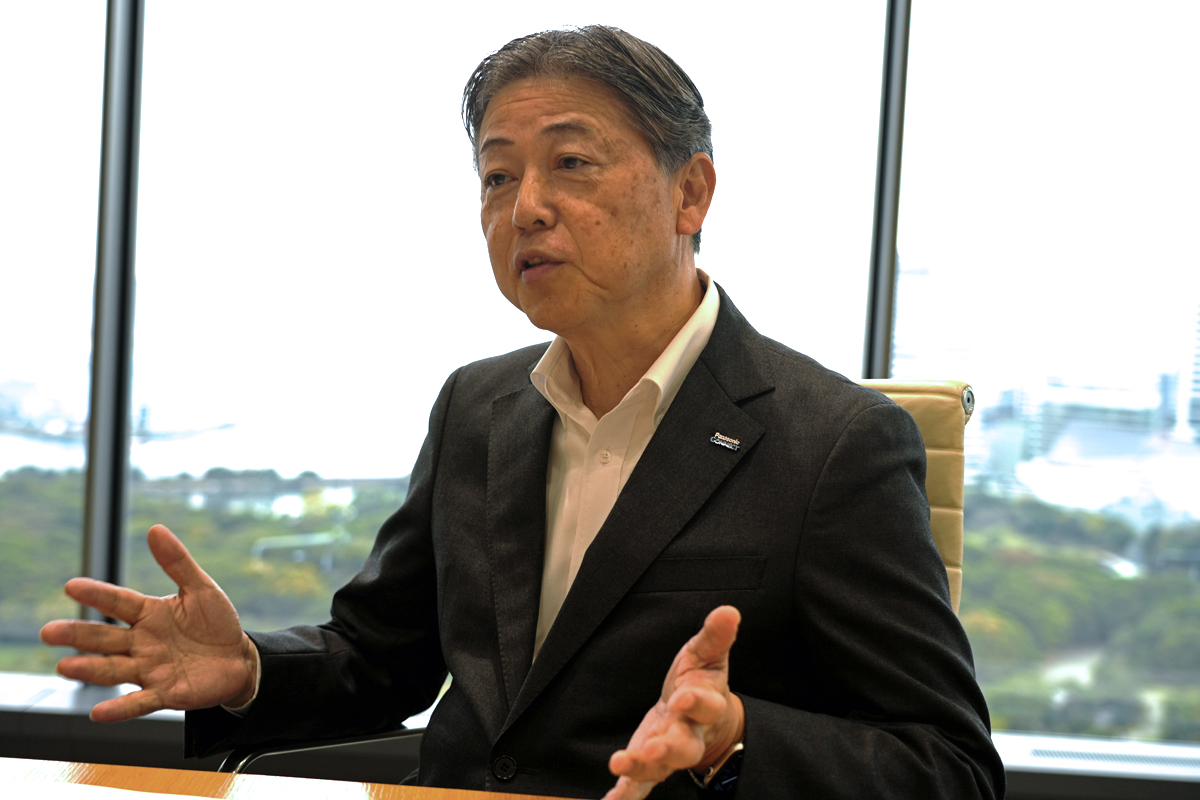
<Yasuhiko Okumura, Executive Officer, Senior Vice President / President of On-Site Solutions Company / Blue Yonder Japan Collaboration Promotion Manager>
System development is an adventure
Existing success stories are persuasive.
-- What are some of the challenges you anticipate facing in standardizing the system?
It's about changing the mindset of the Okumura team members. Up until now, the development process has been based on the assumption that internal members would customize the product, so they would readily accept any requests. But then the question becomes, "Is this really standardization?" I think that's where he (Ogasawara) is struggling the most.
There are some things that simply cannot be changed, such as the issuance of uniquely Japanese invoices. Forcing standardization on a system with completely different business practices would make operations impossible. This is a problem that goes beyond mere competitiveness. We need to assess the situation to a certain extent and develop what is necessary. It's a delicate balance.
Instead of simply selling the Ogasawara Islands ' overseas format, we need to identify what Japan needs, develop the system accordingly, and then implement it. In addition to labels and invoices, there are also formats required by each country, so some adjustments will be necessary on a country-by-country basis.
-- I imagine the cost is also a factor that influences the adoption of the system. What are your thoughts on that?
We offer our services using a pay-as-you-go model, also known as a usage fee model. We believe this is a more user-friendly approach than making a large upfront investment. It's less expensive than system development, and billing is based on the scale of implementation, allowing for a small-scale start focused on the problem-solving process.
—So, localized use is also included as an option for the system package?
Ogasawara: That's right. If you only want to digitize the picking process, we can provide software for that purpose.
Since Okumura SaaS is a service, the cost is calculated per license per month. As the number of accounts increases, the billing amount will also increase, so we define the scale beforehand and make proposals accordingly.
—I hear that system development is an adventure. In that respect, being able to provide successful examples is a strength.
Okumura is absolutely right; system development is an adventure. When you develop from scratch, customers tend to stick with the same vendor. They can't change vendors because modifying the system carries risks, and it also leads to increased reliance on specific individuals.
In that respect, the advantage of packaged software is that the barrier to entry can be set lower than with system development. However, on the other hand, the fact that customers can easily switch means that we are more likely to lose customers.
When we invite Japanese customers to Blue Yonder user conferences and other events, existing overseas customers share success stories and other information, which encourages those considering implementation to listen attentively.
—So that's what your regular overseas work is all about.
Okumura: We're creating an environment where we can constantly share information with our current customers, such as "We're preparing these new features" or "Based on the requests we've received, we'll develop according to this roadmap." This approach is something that didn't exist at Panasonic before, so it's been a great learning experience.
-- Finally, could you please share your thoughts and aspirations for the future with our readers?
Okumura: We provide systems because we have a strong desire to strengthen the competitiveness of our Japanese customers.
Our founder, Konosuke Matsushita, left behind these words: "Don't force sales. Don't sell what the customer likes. Sell what is beneficial to the customer." These words have recently resonated deeply with me.
Rather than simply accepting customization requests, we want to be the kind of company that can say, "Using this will definitely increase your company's competitiveness."
Ogasawara: I also feel a strong sense of crisis regarding the sustainability of supply chains, so I would like to work together to see how we can bring about change. I want to create an environment where people on the ground can perform to the best of their abilities without losing the strengths of the workplace, and I believe that an attractive logistics workplace will also lead to an environment where diverse people can work, so I would like to work together to make that a reality.
Interview and writing by Keita Toba and Kimio Yamauchi
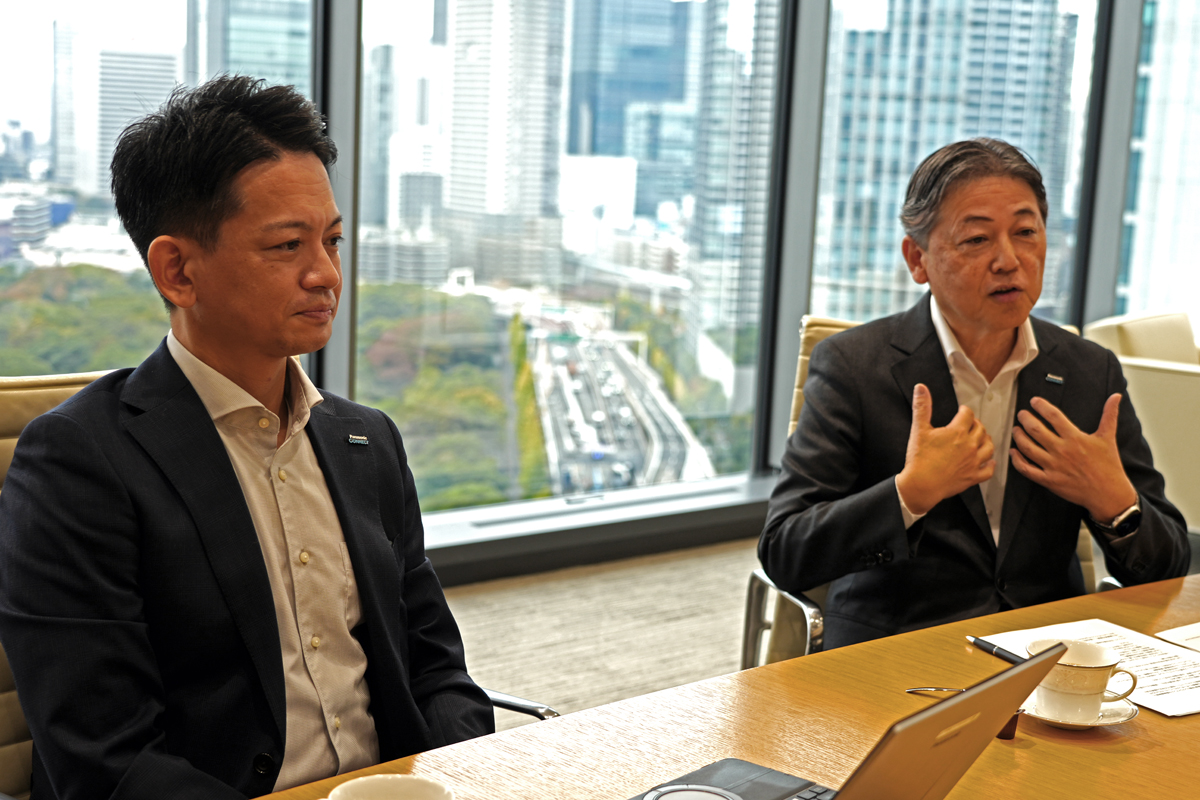
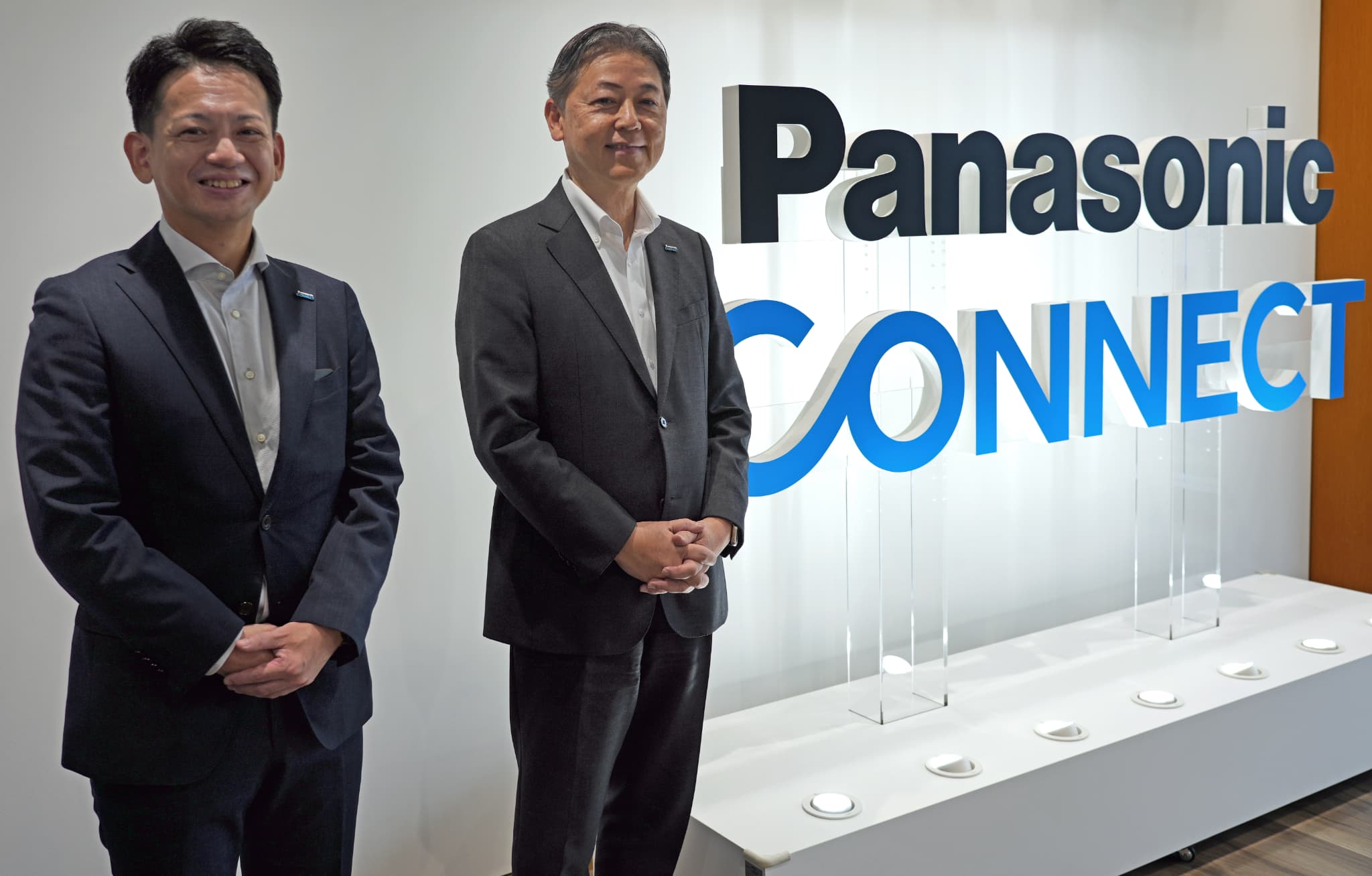
<Director Ogasawara (left) and Senior Vice President Okumura (right)>
■ Profile
Panasonic Connect
Executive Officer, Senior Vice President
President, Field Solutions Company
Blue Yonder Japan Collaboration Promotion Manager
Yasuhiko Okumura
Joined Matsushita Electric Industrial Co., Ltd. in April 1988.
April 2003: Project Manager, e-Solution Division, Panasonic System Solutions, Matsushita Electric Industrial Co., Ltd.
October 2006: Director, Ubiquitous Business Promotion Center, Panasonic System Solutions, Matsushita Electric Industrial Co., Ltd.
April 2008: Executive Officer (Corporate Planning) at Panasonic System Solutions Japan.
November 2011, Group Manager, Corporate Planning Group, Panasonic Mobile Communications.
April 2017: Director, Senior Managing Executive Officer, and Head of Social Systems Division, Panasonic System Solutions Japan.
April 2019: Executive Vice President, Panasonic System Solutions Japan; General Manager, Public Systems Business Division (Responsible for sales, system development, and manufacturing of government agencies, police, roads, airports, local governments, energy, transportation, telecommunications, and broadcast media).
April 2022: Executive Officer, Senior Managing Director, Media Entertainment Business Division, Panasonic Connect.
January 2023: Executive Officer, Senior Managing Director, and President of the Field Solutions Company, Panasonic Connect.
April 2024: Panasonic Connect Executive Officer, Senior Vice President, President of Field Solutions Company, in charge of collaboration promotion for Blue Yonder Japan, in charge of Food Processing Solutions Division, and in charge of construction industry and safety management.
Director, Field Solutions Company
SCM Business Center Director
Takashi Ogasawara
April 2003: Joined Matsushita Electric Industrial Co., Ltd., in charge of government account sales.
January 2012, Panasonic System Networks System Solutions Japan Company, Account Sales Representative for a Logistics Company
April 2016, Panasonic System Networks System Solutions Japan Company, Logistics Solutions Development Section Manager
April 2017, Panasonic System Solutions Japan, Account Sales Manager for Logistics Companies
April 2021, Panasonic System Solutions Japan, Department Manager
April 2024, Director, SCM Business Center, Field Supply Chain Headquarters, Field Solutions Company, Panasonic Connect


