


How to utilize and nurture Generation Z (24)
This series, which has spanned nearly two and a half years, has finally come to an end. The aim of this series was to introduce practical methods for human resource development. As a concluding installment, I would like to summarize four points under the theme, "Strong companies start with good logistics operations! Let's reaffirm our roles."
(1) The balance of three essential skills and human skills required for a leader
Last time , I mentioned that we first need to make efforts to improve our organizational management so that our members feel a sense of closeness and trust in us.
<Figure 1>
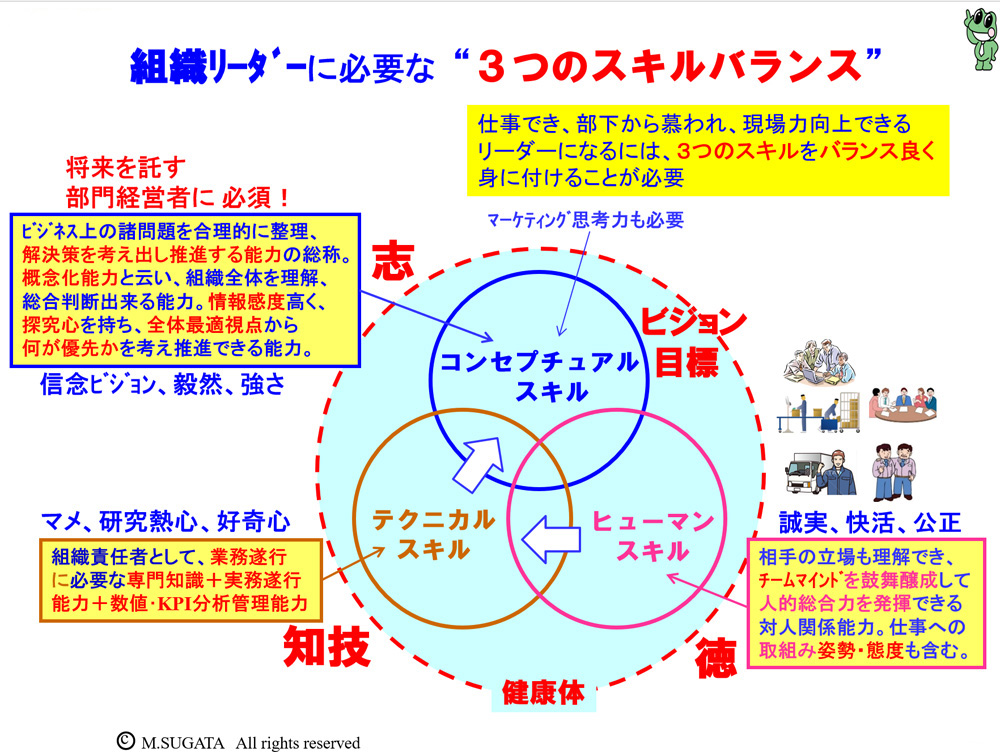
Please see Figure 1. In the lower right corner, you'll see "Human Skills." This refers to the ability to understand others' perspectives, inspire a team spirit, and create an organizational structure that can leverage overall human capabilities—in other words, interpersonal skills. It can also be called human potential.
This includes one's approach to life and work, attitude towards tasks, manners and etiquette when interacting with others, and even business etiquette and personal grooming when dealing with clients.
To instill trust and confidence in others, one must also strive to cultivate personal virtues. If one stumbles here, it becomes difficult to lead and unite the company, and one cannot build good business partnerships with customers.
(2) Technical skills
Next, I will discuss the role of "technical skills" in the lower left of Figure 1.
This section refers to practical skills such as acquiring the fundamental logistics expertise necessary for performing the job (e.g., Business Career Certification Exam, Logistics Management Level 3 & 2 Exam, Logistics Operations Level 3 & 2 Exam, etc.), acquiring techniques for identifying and analyzing operational problems (IE analysis, quality control, cost analysis, profitability management, inventory management/SCM analysis, business and financial analysis), IT technology/information security/DX, material handling/robot automation equipment, transportation systems/building structures, compliance with business laws and related regulations, and numerical/KPI analysis and management abilities.
However, the field is broad, requires extensive expertise, and is constantly evolving, so it's impossible for us to master everything on our own. We need to involve a wide range of members to consider countermeasures for changes in the business environment. Logistics is a service industry, and we also need to quickly keep up with new products from shippers and changes in their business policies and models.
In my case, I listed all the requirements for these technical skills, created a checklist, and assigned a person (primary and secondary) to each item, asking them to explore it. Asking for their cooperation boosted their motivation and provided an incentive for them to acquire knowledge. I also had them sit in on meetings with clients to share the client's interests, concerns, and awareness of problems. This broadened their perspective on the workplace and advanced their talent development.
(3) Conceptual skills
Next is the role of "conceptual skills," which is located in the middle of Figure 1.
This role requires the ability to analyze and organize the current situation and problems within one's own organization, identify their root causes, devise effective improvement measures, and then promote and achieve those measures.
However, you may sometimes feel overwhelmed by the numerous problems and be unable to consolidate your strategies and approaches. It is essential to consistently conduct market and business environment research and analysis (e.g., PEST analysis, 3C market analysis, SWOT competitor analysis, etc.), and then, from a holistic perspective, consider future strategic themes (e.g., STP & USP analysis, Marketing MIX 4P analysis) to determine and promote high-priority key initiatives and essential target KPIs.
Acquiring this skill is not something that can be done overnight. It requires persistent effort spanning more than 10 years. This is why it is said that it takes more than 1 hours of practice to reach semi-professional level or higher. There is no other way than to keep challenging yourself.
(4) Strong companies start with good logistics operations
In my lectures and in my opening remarks when starting corporate consulting work, I always say, "Strong companies start with good logistics operations," as follows:
"Depending on the leadership and leadership of managers and supervisors, a company's operational capabilities can improve dramatically, resulting in a significant increase in client satisfaction. If you can gain the No. 1 level of trust compared to your competitors, you will become a first-call partner company where requests for cooperation are prioritized, and clients will accept a 1% higher price for the same logistics services. As performance improves, work becomes much more interesting. Your subordinates and the workplace will become brighter, more vibrant, and more enjoyable."
As I've mentioned many times in this series, the goal is to boost team members' motivation through improvement suggestion activities and KPI activities, stimulate their curiosity, and provide opportunities for them to excel. This will transform the logistics site into an excellent environment where everyone is motivated, grows, excels, doesn't quit, and is appreciated by clients.
<Figure 2>
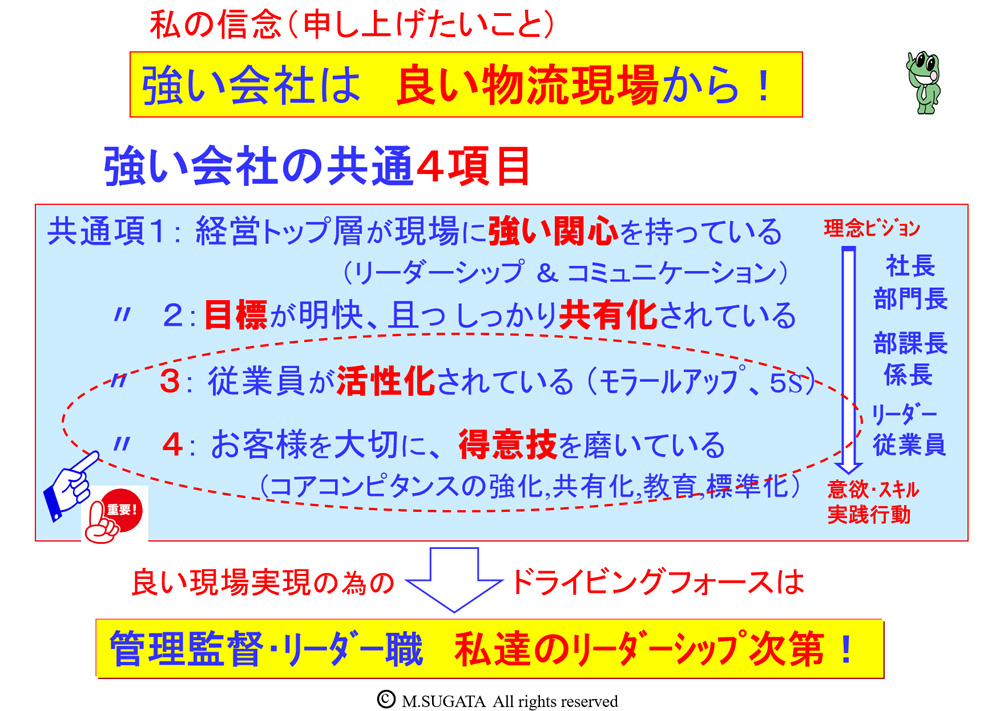
Please see Figure 2. It lists "Four Common Items of Strong Companies," and for on-site operations, items 3 and 4 are particularly important.
Logistics is a labor-intensive industry. Even with excellent management policies, the people on the ground are the ones who implement them, so the results depend greatly on their mindset and actions.
The QCDSS metrics for logistics services that can be provided to customers are greatly affected. Even in large logistics companies, there are many workplaces where you can't help but think that the shippers are having trouble with the operations.
Therefore, I would like those in management, supervisory, and leadership positions to focus their attention particularly on points 3 and 4 and engage in improvement activities. "Refining your strengths" does not mean gathering in a conference room for knowledge and skill training (classroom training: Off-JT), but rather sharing information with everyone and role-playing exercises (such as observing demonstrations of exemplary and ineffective work methods so that everyone can reaffirm their importance) that are conducted as close to the workplace as possible.
I call this a TBM meeting (OJT training, Tool Box Meeting) and encourage its implementation. It's a quick and easy way to ensure everyone is aware of the information. This should be manageable even for busy people.
In particular, when a work error is discovered during the pre-shipment inspection process, or when a customer complaint or product damage occurs, we request a one-hour (within one cycle) reconfirmation TBM (Track By-Marketing) activity from not only the department where the cause occurred, but also all departments performing similar tasks. We have made efforts to ensure that everyone and all departments are reminded of the rules, to be more vigilant, and to adhere to standard operating rules to prevent recurrence.
Instead of announcing problems and errors that occurred in the morning or during the day during the evening closing meeting or the following week's general morning meeting, we acted quickly and immediately, implementing the PDCA improvement cycle. This resulted in remarkable improvements in a short period of time, as seen in the 19th (Figure 3) and 20th (Figure 2) sessions.
In 1969, the "Get It Done Now Department," started by then-Mayor Matsumoto (now the founder of Matsukiyo) in Kashiwa City, Chiba Prefecture, became very popular. Following this example, I have also been practicing a rapid PDCA improvement cycle. Even now, I encourage the companies I support to use this method.
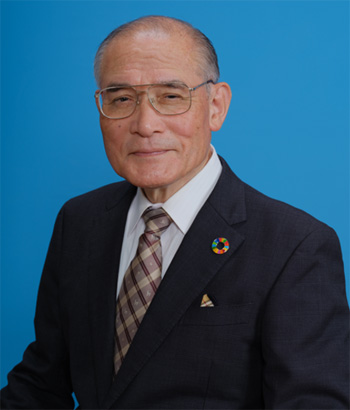
<Author: Masaru Sugata, Representative Director, Logistics Innovation Partners>
Finally, thank you to all our readers for your continued support. Our goal has been to create a vibrant workplace where all employees, including young and part-time workers in the logistics field, can learn and have fun, feel energized, and where people can grow and improve. We have introduced "How to Create a Strong and Excellent Logistics Workplace," focusing on the development of management and supervisory personnel (plus team leaders and supervisors). We would be extremely happy if you found this helpful and want to put it into practice immediately. Good luck with your new job. <End>
■Series: Human Resource Development that Transforms the Workplace


