


On December 24th, Hacobu released its 2025 access ranking for "Hakoblog," a media platform for improving logistics operations operated by the company. In connection with this, they announced keywords that will symbolize the logistics sector in 2025 and predictions for trends that will occur in the logistics sector in 2026.
<2025 Hakoblog Access Ranking TOP 10>
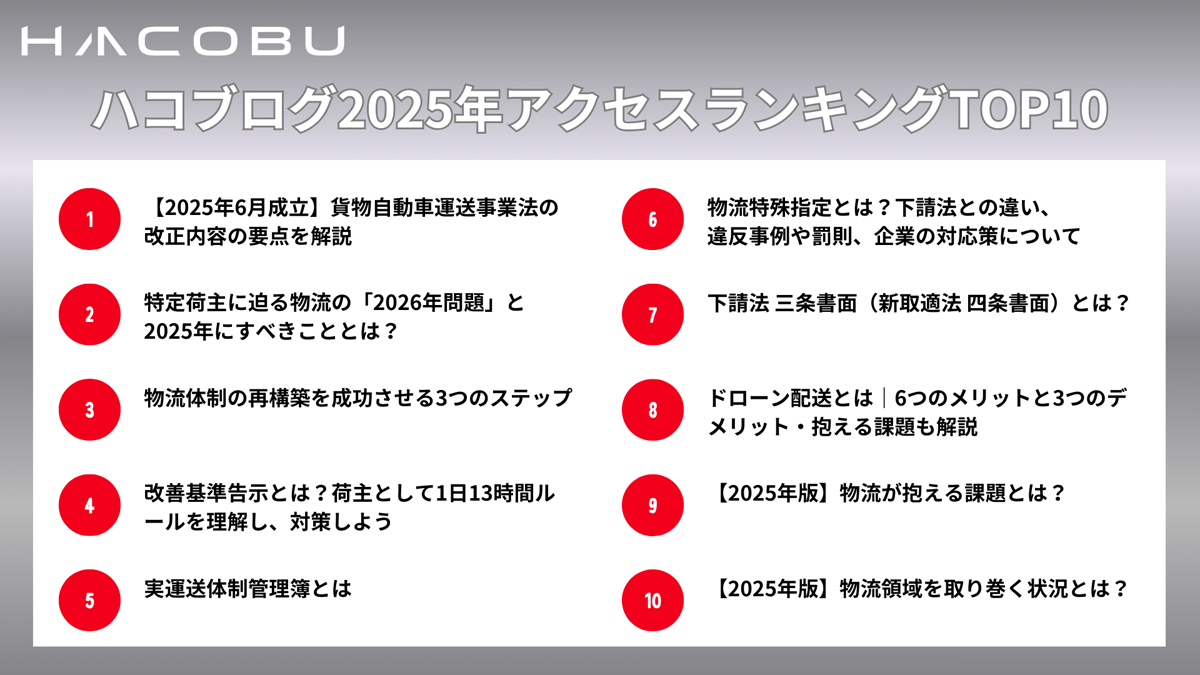
In the 2025 annual access ranking for "Hakoblog," a media outlet operated by the company, six out of the top ten articles were related to legal regulations and amendments, indicating a high level of interest in legal compliance in the logistics sector.
The third-ranked article was related to "restructuring logistics systems," while the eighth and tenth-ranked articles were "industry trends" articles covering new logistics technologies and overall industry trends, clearly indicating a growing interest in practical logistics reforms starting with legal compliance.
<Three keywords symbolizing the logistics sector in 2025>
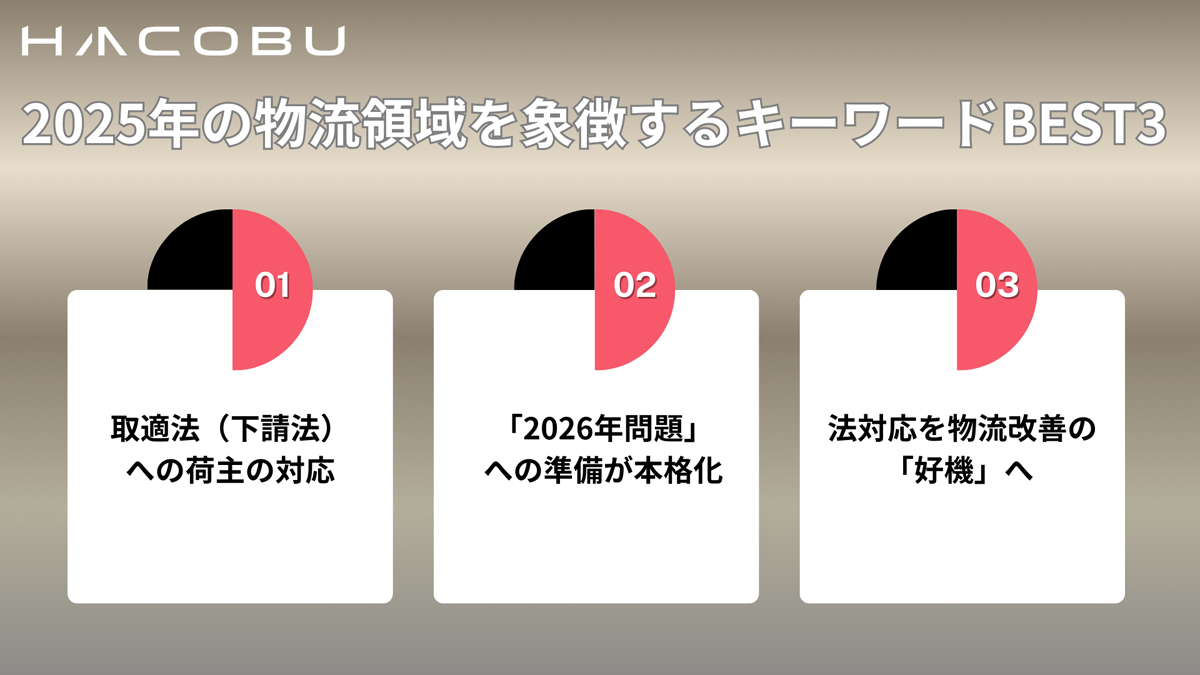
Based on the results above, Hacobu identified three keywords that symbolize the logistics sector in 2025: "Shippers' response to the Subcontracting Act," "Preparation for the '2026 problem' intensifies," and "Turning legal compliance into an 'opportunity' for logistics improvement."
The revised Subcontracting Act, also known as the Act on Fair Trade Practices, is scheduled to come into effect in January 2026. Under this law, transportation outsourcing will be included within the scope of legal regulations, and the creation and publication of transportation contract documents will become mandatory, leading to an increase in tasks required to improve the transparency of transactions.
In this context, the fact that articles on "special designations for logistics" and the "Subcontracting Act" received a large number of views is evidence that many shippers are busy dealing with practical matters. In 2025, the Japan Fair Trade Commission issued several recommendations to logistics companies for violations of the Subcontracting Act, making the importance of legal compliance even clearer.
From April 2026 onwards, "specified shippers" with an annual cargo handling weight of 90,000 tons or more will be legally required to create medium- to long-term plans for reducing waiting and handling times, and to submit periodic reports. The high number of views on articles covering this topic indicates that shippers are showing increased interest in how to comply with these regulations.
Furthermore, an increasing number of companies are aiming for fundamental logistics reforms not only in terms of legal compliance, but also as a result of legal changes. There is growing interest in proactive logistics strategies such as "introduction of truck reservation services," "joint transportation," and "reconstruction of logistics networks." This suggests that companies recognize responding to legal regulations as an opportunity to improve logistics efficiency and strengthen competitiveness.
<Three predicted trends in the logistics sector in 2026>
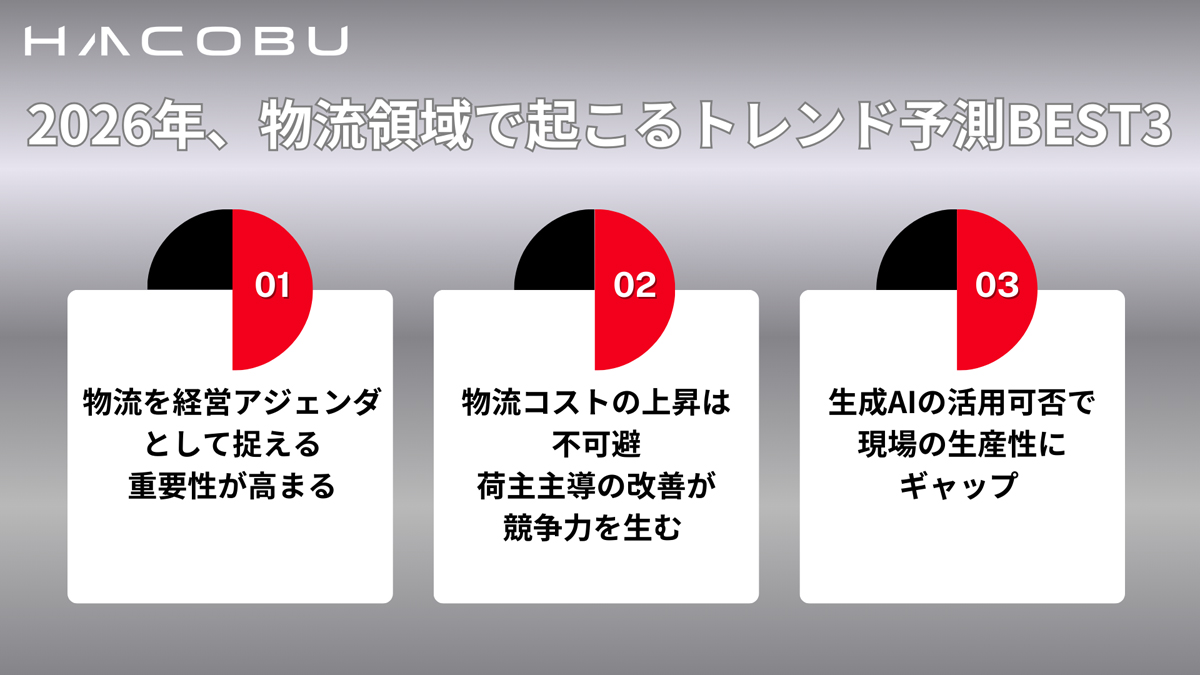
Based on these results, Hacobu predicts three trends for 2026: "The importance of treating logistics as a management agenda will increase," "Rising logistics costs are inevitable; shipper-led improvements will create a competitive advantage," and "There will be a gap in on-site productivity depending on whether or not generative AI can be utilized."
With stricter regulations and rising logistics costs, logistics strategy has become a critical management issue that will determine a company's competitiveness. However, it is likely that more companies will adopt a "legal compliance first" approach, making legal compliance itself the objective. Companies that establish a data-driven decision-making system by appointing a logistics manager or CLO (Chief Logistics Officer) may see a difference in the speed of decision-making between those that do not.
Whether or not companies view legal compliance not as a burden but as an opportunity for improvement will be a factor that will become apparent as a competitive gap across the entire supply chain from 2026 onward.
Furthermore, while rising logistics costs are unavoidable, the report not only predicted that companies that can proactively make improvements, such as visualizing data on waiting times and handling times, will gain a competitive edge, but also predicted that the use of AI will create a gap in corporate productivity.
Regarding these predictions, Kazuyuki Kobayashi, Strategy Director at Hacobu, stated, "In 2026, companies will likely focus on legal compliance, such as establishing logistics managers and CLOs, and creating medium- to long-term plans. However, the goal should not be simply to prepare the documents to be submitted to the government, but rather to use this as an opportunity to review the way a company operates its logistics and work towards creating a sustainable system. Logistics costs continue to rise, and the risk of being unable to transport goods is increasing, meaning that a situation where goods cannot be transported suddenly could occur one day. We believe that 2026 will be a turning point in which the way companies approach logistics will ultimately affect their competitiveness and business continuity."


