


Mitsui O.S.K. Lines and Itochu Corporation announced on January 9th that they have signed a memorandum of understanding for a strategic partnership regarding the use of environmental attribute certificates aimed at promoting decarbonization in the transportation sector.
<Image illustrating the strategic alliance between Mitsui O.S.K. Lines and Itochu Corporation>
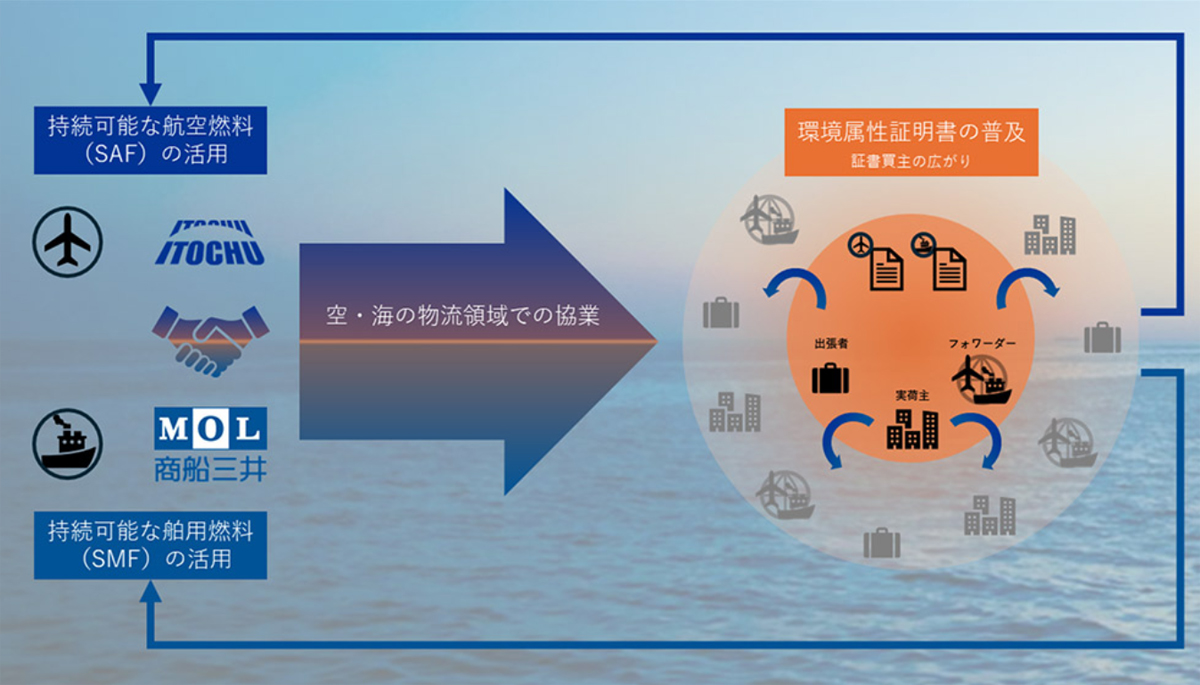
Through the signing of the memorandum of understanding, the two companies will collaborate in areas such as marketing, public relations, and sales to promote environmental attribute certificates as a means for companies using transportation services to reduce Scope 3 greenhouse gas (GHG) emissions (GHG emissions from other companies caused by their own activities) in their supply chains. This will be Japan's first model case for promoting decarbonization, with the sea and air transportation sectors collaborating across industry boundaries.
Environmental attribute certificates are a system that allows companies to issue and utilize "certificates" demonstrating their reduction efforts in indirect GHG emissions generated by their supply chain activities. The two companies engaged in the mutual buying and selling of environmental attribute certificates with the aim of reducing Scope 3 emissions.
<Diagram illustrating mutual trading>

Mitsui O.S.K. Lines purchased an environmental attribute certificate for "Air (Air Passenger Transport, Cargo Transport, etc.)" created by Itochu Corporation to reduce GHG emissions (Scope 3 Category 6) associated with employees' air travel. Itochu Corporation purchased an environmental attribute certificate for "Sea (Maritime Cargo Transport, etc.)" created by Mitsui O.S.K. Lines to reduce GHG emissions (Scope 3 Category 4) associated with the use of maritime transport services.
Mitsui O.S.K. Lines will leverage its strengths in using low-carbon fuels for ships, while Itochu Corporation will utilize SAF (Sustainable Aviation Fuel made from waste cooking oil, etc.). Through collaboration in the maritime and air logistics sectors, they will build a system to support companies using transportation services in reducing Scope 3 emissions, and work towards achieving decarbonization through cooperation across the entire transportation supply chain.
A forum on the topic of NXHD/Scope 3 reduction was held, with approximately 140 participants.


