


On February 9th, the Japan Physical Internet Center (JPIC) announced its "Maturity Model (PIMM)" in Tokyo, which serves as an indicator of the current state of progress toward the social implementation of the physical internet.
This model was developed through collaboration between industry, academia, and government. It models the development stages of the Physical Internet (PI) process in five levels of maturity.
This will be the world's first indicator to objectively and numerically evaluate efforts to solve industry- and company-specific challenges in order to advance implementation and promote the widespread adoption and expansion of PI.
<JPIC Chairman Mori>

JPIC was established in June 2022 with the aim of "collaboration" to build an open logistics ecosystem utilizing digital technology. Currently, it has 89 member companies and acts as a hub for industry, government, and academia, supporting the realization of PI (Primary Initiative).
At the opening of the meeting, JPIC President Takayuki Mori gave a speech. He reported on the completion of PIMM as a step towards shaping the future of logistics, and stated, "If the roadmap for PI implementation by 2024 presented by the government is the map, then PIMM can be the new compass we should follow. I am confident that by utilizing PIMM, we can move from the conceptual stage to the implementation stage."
<JPIC Executive Director Okuzumi>

JPIC Secretary-General Tomohiro Okuzumi explained the overview of PIMM. He stated that the Maturity Model is "a quantitative evaluation of how far a company's logistics processes have come in relation to the ideal state outlined in the roadmap," and that by organizing the components of PI as evaluation axes and evaluating each at a level, "it becomes clear where a company and industry are currently standing in their efforts, and the next steps can be envisioned," he said, explaining its significance.
To measure the maturity of their own company's or inter-company's initiatives, companies will fill out a self-assessment sheet, which will be released in the future, and score themselves. Judges will score the maturity level, and based on the evaluation, certificates will be issued, along with follow-up and advice for further improvement. Unlike typical award systems, the benefit of obtaining "PIMM certification" is that it allows companies to accelerate the realization of their PI by understanding the strengths and weaknesses of their own company's or inter-company's initiatives.
<Third from the left is Mr. Takada, Section Chief of the Ministry of Land, Infrastructure, Transport and Tourism; fourth from the left is Mr. Asai, Counselor of the Ministry of Economy, Trade and Industry.>
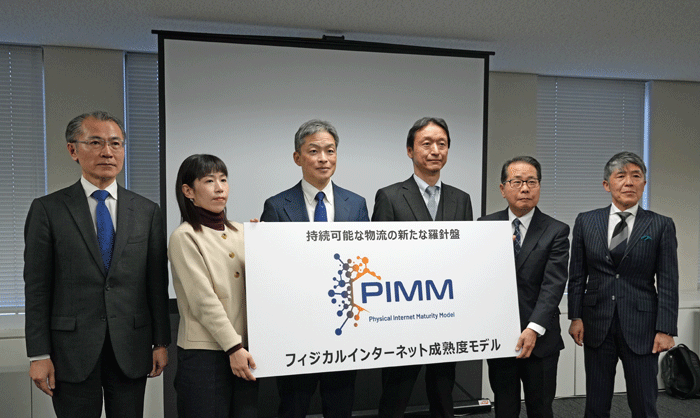
With the completion of PIMM approaching, expectations are being expressed by relevant ministries and agencies. Toshitaka Asai, Counselor of the Commerce and Service Group at the Ministry of Economy, Trade and Industry, commented, "For PI to progress, it is necessary to have a common way of thinking and evaluation criteria, and for efforts to be made across companies and industries. The significance of PIMM lies in the fact that it is a practical tool for thinking about the next step."
Takada Ryu, Director of the Logistics Policy Division at the Ministry of Land, Infrastructure, Transport and Tourism's Logistics and Automobile Bureau, said, "We are currently considering the next comprehensive logistics policy outline for logistics innovation, and among these, initiatives through digital and PI are important. We hope that PIMM will help spread these ideas and lead to their implementation."
JPIC/ "Physical Internet Symposium 2026" to be held on February 26th


